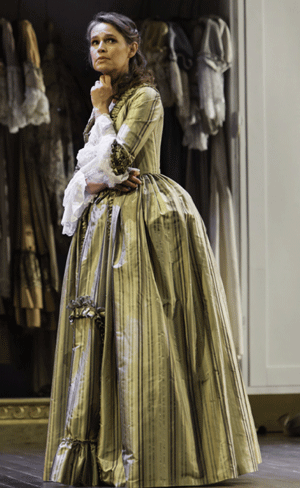
![Diana Damrau as Philine [Photo by GTG / Yunus Durukan]](http://www.operatoday.com/Mignon_GTG_02.gif)
19 May 2012
Damrau Dazzles in Geneva
It is not long into Act One of Mignon at Geneva’s Grand Theatre when Diana Damrau glides on stage as Philine, commands our rapt attention, and sweeps all before her.
English Touring Opera are delighted to announce a season of lyric monodramas to tour nationally from October to December. The season features music for solo singer and piano by Argento, Britten, Tippett and Shostakovich with a bold and inventive approach to making opera during social distancing.
This tenth of ten Live from London concerts was in fact a recorded live performance from California. It was no less enjoyable for that, and it was also uplifting to learn that this wasn’t in fact the ‘last’ LfL event that we will be able to enjoy, courtesy of VOCES8 and their fellow vocal ensembles (more below …).
Ever since Wigmore Hall announced their superb series of autumn concerts, all streamed live and available free of charge, I’d been looking forward to this song recital by Ian Bostridge and Imogen Cooper.
Although Stile Antico’s programme article for their Live from London recital introduced their selection from the many treasures of the English Renaissance in the context of the theological debates and upheavals of the Tudor and Elizabethan years, their performance was more evocative of private chamber music than of public liturgy.
Evidently, face masks don’t stifle appreciative “Bravo!”s. And, reducing audience numbers doesn’t lower the volume of such acclamations. For, the audience at Wigmore Hall gave soprano Elizabeth Llewellyn and pianist Simon Lepper a greatly deserved warm reception and hearty response following this lunchtime recital of late-Romantic song.
For this week’s Live from London vocal recital we moved from the home of VOCES8, St Anne and St Agnes in the City of London, to Kings Place, where The Sixteen - who have been associate artists at the venue for some time - presented a programme of music and words bound together by the theme of ‘reflection’.
'Such is your divine Disposation that both you excellently understand, and royally entertaine the Exercise of Musicke.’
‘And there was war in heaven: Michael and his angels fought against the dragon; and the dragon fought and his angels, And prevailed not; neither was their place found any more in heaven … that old serpent … Satan, which deceiveth the whole world: he was cast out into the earth, and his angels were cast out with him.’
There was never any doubt that the fifth of the twelve Met Stars Live in Concert broadcasts was going to be a palpably intense and vivid event, as well as a musically stunning and theatrically enervating experience.
‘Love’ was the theme for this Live from London performance by Apollo5. Given the complexity and diversity of that human emotion, and Apollo5’s reputation for versatility and diverse repertoire, ranging from Renaissance choral music to jazz, from contemporary classical works to popular song, it was no surprise that their programme spanned 500 years and several musical styles.
The Academy of St Martin in the Fields have titled their autumn series of eight concerts - which are taking place at 5pm and 7.30pm on two Saturdays each month at their home venue in Trafalgar Square, and being filmed for streaming the following Thursday - ‘re:connect’.
The London Symphony Orchestra opened their Autumn 2020 season with a homage to Oliver Knussen, who died at the age of 66 in July 2018. The programme traced a national musical lineage through the twentieth century, from Britten to Knussen, on to Mark-Anthony Turnage, and entwining the LSO and Rattle too.
With the Live from London digital vocal festival entering the second half of the series, the festival’s host, VOCES8, returned to their home at St Annes and St Agnes in the City of London to present a sequence of ‘Choral Dances’ - vocal music inspired by dance, embracing diverse genres from the Renaissance madrigal to swing jazz.
Just a few unison string wriggles from the opening of Mozart’s overture to Le nozze di Figaro are enough to make any opera-lover perch on the edge of their seat, in excited anticipation of the drama in music to come, so there could be no other curtain-raiser for this Gala Concert at the Royal Opera House, the latest instalment from ‘their House’ to ‘our houses’.
"Before the ending of the day, creator of all things, we pray that, with your accustomed mercy, you may watch over us."
The doors at The Metropolitan Opera will not open to live audiences until 2021 at the earliest, and the likelihood of normal operatic life resuming in cities around the world looks but a distant dream at present. But, while we may not be invited from our homes into the opera house for some time yet, with its free daily screenings of past productions and its pay-per-view Met Stars Live in Concert series, the Met continues to bring opera into our homes.
Music-making at this year’s Grange Festival Opera may have fallen silent in June and July, but the country house and extensive grounds of The Grange provided an ideal setting for a weekend of twelve specially conceived ‘promenade’ performances encompassing music and dance.
There’s a “slide of harmony” and “all the bones leave your body at that moment and you collapse to the floor, it’s so extraordinary.”
“Music for a while, shall all your cares beguile.”
The hum of bees rising from myriad scented blooms; gentle strains of birdsong; the cheerful chatter of picnickers beside a still lake; decorous thwacks of leather on willow; song and music floating through the warm evening air.
It is not long into Act One of Mignon at Geneva’s Grand Theatre when Diana Damrau glides on stage as Philine, commands our rapt attention, and sweeps all before her.
The Divine Miss D immediately serves notice that she has no current equal in this repertoire, singing with a pristine beauty of tone, displaying effortless coloratura effects, and effectively modulating her beautifully limpid soprano from full-bodied forte to hushed pianissimo and all points in between. Moreover, Diana is a consummate stage creature who is capable of fully investing the character of the scheming coquette with endlessly inventive stage movement and business.
 Sophie Koch as Mignon
Ms. Damrau not only boasts one of the most technically secure instruments in the business, she also has that elusive star quality that makes us unable to take our eyes off of her, with our ears joyously coming along for the ride. While it is no surprise that she crafts “Je suis Titania” as a veritable Masters Class in poised vocal perfection, the truth is that she makes nary a false move the entire evening. If Thomas were alive, he would most certainly write her back on stage in Act Three! Petite in physical stature perhaps, but Diana Damrau’s Philine is a towering artistic achievement that had me from “Bon jour.”
But the piece is called Mignon after all, and here too, Geneva cast from strength. One of the most celebrated (and busiest) French mezzos of our time, Sophie Koch gifted us with a deeply felt, wholly engaging performance. Her refined lyric voice has a hint of a dusky hue to it, and Ms. Koch is quite expert at crafting affecting plangent phrases. “Connais-tu le pays” was polished and poised, touching yet avoiding bathos. She also made Act Three her own with a solid understanding of the soft-edged dramatic and musical momentum.
Time and further experience with the character will likely lead this gifted performer beyond the somewhat generic to a more nuanced approach, by discovering a bit more variety that could be mined from the part. And she will no doubt refine the few phrase endings that lost focus or were characterized by a frayed release. Still, Sophie’s dramatic commitment was believably sincere, and she skillfully deployed her mezzo with admirable results.
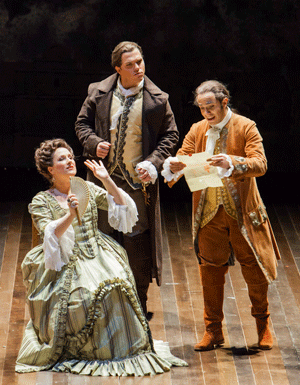 Diana Damrau as Philine, Paolo Fanale as Wilhelm Meister and Emilio Pons as Laërte
Paolo Fanale showed great promise as Wilhelm Meister. When Mr. Fanale sings at mezzo forte he impresses mightily with as creamy a lyric tenor as you are likely to hear. He also offers some superlative diminuendo effects that are cleanly executed. His upper range rings out freely and with amplitude well above the staff. However, at louder volumes in mid- and upper-range I had the impression that he was more forcing the placement into the mask than allowing it to simply be in the mask.
This is not to say it was unpleasant to the listener, but rather a bit worrisome for his future vocal health. Paolo is young, handsome, musical, and is possessed of a naturally glowing tenor. He is needed. While his Meister had much to recommend it, I would urge him to fine tune his vocal approach and liberate the tonal production in the passaggio. If more French opera is in his future, he might also be more attentive to his diction and nurture more comfort with the language.
Nicolas Courjal earned one of the biggest ovations of the night for his masterful Lothario. His gently throbbing vibrato and slightly grainy bass-baritone were perfectly matched to the rangy vocal lines of this highly sympathetic personage. Mr. Courjal was able to spin some flawless messa di voce effects and pour out any number of well-judged legato phrasings with a refinement that is not all that commonly encountered in this Fach.
Emilio Pons made his usual fine impression in the small-but-important role of Laérte. Mr. Pons was luxury casting, not only showing off an even, easily produced tenor of good ping and presence, but also declaiming some of the most idiomatic French dialogue of the cast, vivid and characterful. Emilio clearly relished his conspiratorial scene work with Diana’s Philine, who created real sparks as they prodded each other to ever more animated machinations.
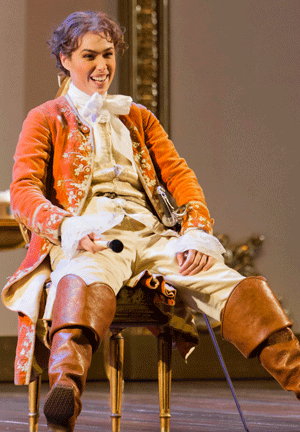 Carine Séchaye as Frédéric
Carine Séchaye had lots of fun with her goofy take on Frédéric. Her slightly steely mezzo had style and spunk, and her comic invention invested this suitor with a decidedly fresh perspective. As the meanie Jarno, Frédéric Goncalves avoided dramatic cliché and sang with an assured, virile baritone. In the inserted, mute role of the Servant, comic actor Laurent Delvert scored some good laughs as he set up ‘audience’ seating for the gypsy show during the overture’s Polonaise. The chairs were slid forcefully on stage on their backs from the wings, coming in ever-greater numbers and speed. Just as he finally got them all set up stage left, he suddenly realizes they should in fact be stage right. In a burst of manic madness he moved them all to the other side as the band played the frenetic finale.
Would that all of the stage direction had been similarly inspired. On the plus side director Jean-Louis Benoît did not get in the way of his first rate cast. Nor, however, did he add too much that was inventive or creative. He did manage the traffic well enough, groupings were clean and focused, and principal characters were never upstaged by irrelevant movement. Nor did the actors always seem to be fully connected, as Mr. Benoît was content to have them sing to us rather than each other, which was especially noticeable with Mignon and Wilhelm in Act Three.
While this did enable the singing to be heard to maximum effect, it did weaken the dramatic involvement in a piece that would benefit from more fully involved character interaction. “Je suis Titania” began with a very effective visual “build” which started with Philine on a platform up center and had her moving incrementally to the apron flanked by the chorus. But then the soprano was made to return way upstage for the finale, a visual, if not vocal retreat. The director might reconsider and let his star shine down stage through the end of the aria.
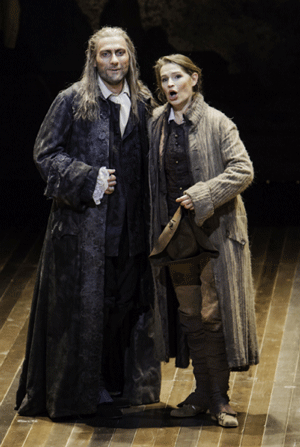 Nicolas Courjal as Lothario and Sophie Koch as Mignon
Laurent Peduzzi’s sets were not particularly detailed nor meant to be, but at least they did not distract. A false proscenium here, a drape there, a lone bed at one point, a sole armoire at another, all were carefully chosen and the whole was quite nicely showcased by Dominique Bruguiére’s well-judged lighting design.
The real design achievements of this production were the lavish, richly detailed period court costumes by Thibaut Welchlin. Too, the fanciful Shakespearean get-ups for A Midsummer Night’s Dream were delightfully eye-catching. What a shame then that this accomplished costumer made the miscalculation of dressing the title role in a well tailored man’s suit for her entrance (clambering out of a clothes hamper no less). Instead of looking like a somewhat androgynous, enigmatic gypsy girl, the lovely and statuesque Ms. Koch looked instead like Octavian wandered in from a bus and truck tour of Rosenkavalier. Mignon was thereby handicapped with attire that made her look more hangdog teenaged boy than melancholy love struck waif. And it made hash of the script’s requirement that Meister subsequently demand that Mignon indeed disguise herself as a man servant. Huh?
In the pit, Frédéric Chaslin made a strong case that he may just be the world’s leading conductor of this repertoire. The splendid Orchestre de la Suisse Romande collaborated with the Maestro to produce a reading that featured delicately refined solo work, richly rendered ensemble passages, and tremendously detailed layers of instrumental colors. The elegant harp solos alone were worth the price of admission. The chorus was meticulously prepared, tightly focused, and vibrantly emotive. Mr. Chaslin has elicited as persuasive a rendition of this gentle character study as will likely ever be heard, with an overall propulsive arc that was marvelously sustained for the entire evening.
Mignon’s starry cast, credible design elements, competent direction and superior musical values total up to a world-class opera-going experience.
James Sohre