02 May 2012
The Kathleen Ferrier Awards 2012
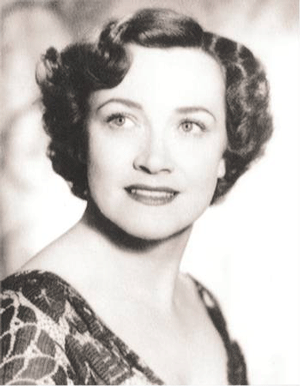
This year’s Kathleen Ferrier Awards final was both a competition and a celebration, marking as it did the centenary anniversary of the great singer’s birth.
English Touring Opera are delighted to announce a season of lyric monodramas to tour nationally from October to December. The season features music for solo singer and piano by Argento, Britten, Tippett and Shostakovich with a bold and inventive approach to making opera during social distancing.
This tenth of ten Live from London concerts was in fact a recorded live performance from California. It was no less enjoyable for that, and it was also uplifting to learn that this wasn’t in fact the ‘last’ LfL event that we will be able to enjoy, courtesy of VOCES8 and their fellow vocal ensembles (more below …).
Ever since Wigmore Hall announced their superb series of autumn concerts, all streamed live and available free of charge, I’d been looking forward to this song recital by Ian Bostridge and Imogen Cooper.
Although Stile Antico’s programme article for their Live from London recital introduced their selection from the many treasures of the English Renaissance in the context of the theological debates and upheavals of the Tudor and Elizabethan years, their performance was more evocative of private chamber music than of public liturgy.
Evidently, face masks don’t stifle appreciative “Bravo!”s. And, reducing audience numbers doesn’t lower the volume of such acclamations. For, the audience at Wigmore Hall gave soprano Elizabeth Llewellyn and pianist Simon Lepper a greatly deserved warm reception and hearty response following this lunchtime recital of late-Romantic song.
For this week’s Live from London vocal recital we moved from the home of VOCES8, St Anne and St Agnes in the City of London, to Kings Place, where The Sixteen - who have been associate artists at the venue for some time - presented a programme of music and words bound together by the theme of ‘reflection’.
'Such is your divine Disposation that both you excellently understand, and royally entertaine the Exercise of Musicke.’
‘And there was war in heaven: Michael and his angels fought against the dragon; and the dragon fought and his angels, And prevailed not; neither was their place found any more in heaven … that old serpent … Satan, which deceiveth the whole world: he was cast out into the earth, and his angels were cast out with him.’
There was never any doubt that the fifth of the twelve Met Stars Live in Concert broadcasts was going to be a palpably intense and vivid event, as well as a musically stunning and theatrically enervating experience.
‘Love’ was the theme for this Live from London performance by Apollo5. Given the complexity and diversity of that human emotion, and Apollo5’s reputation for versatility and diverse repertoire, ranging from Renaissance choral music to jazz, from contemporary classical works to popular song, it was no surprise that their programme spanned 500 years and several musical styles.
The Academy of St Martin in the Fields have titled their autumn series of eight concerts - which are taking place at 5pm and 7.30pm on two Saturdays each month at their home venue in Trafalgar Square, and being filmed for streaming the following Thursday - ‘re:connect’.
The London Symphony Orchestra opened their Autumn 2020 season with a homage to Oliver Knussen, who died at the age of 66 in July 2018. The programme traced a national musical lineage through the twentieth century, from Britten to Knussen, on to Mark-Anthony Turnage, and entwining the LSO and Rattle too.
With the Live from London digital vocal festival entering the second half of the series, the festival’s host, VOCES8, returned to their home at St Annes and St Agnes in the City of London to present a sequence of ‘Choral Dances’ - vocal music inspired by dance, embracing diverse genres from the Renaissance madrigal to swing jazz.
Just a few unison string wriggles from the opening of Mozart’s overture to Le nozze di Figaro are enough to make any opera-lover perch on the edge of their seat, in excited anticipation of the drama in music to come, so there could be no other curtain-raiser for this Gala Concert at the Royal Opera House, the latest instalment from ‘their House’ to ‘our houses’.
"Before the ending of the day, creator of all things, we pray that, with your accustomed mercy, you may watch over us."
The doors at The Metropolitan Opera will not open to live audiences until 2021 at the earliest, and the likelihood of normal operatic life resuming in cities around the world looks but a distant dream at present. But, while we may not be invited from our homes into the opera house for some time yet, with its free daily screenings of past productions and its pay-per-view Met Stars Live in Concert series, the Met continues to bring opera into our homes.
Music-making at this year’s Grange Festival Opera may have fallen silent in June and July, but the country house and extensive grounds of The Grange provided an ideal setting for a weekend of twelve specially conceived ‘promenade’ performances encompassing music and dance.
There’s a “slide of harmony” and “all the bones leave your body at that moment and you collapse to the floor, it’s so extraordinary.”
“Music for a while, shall all your cares beguile.”
The hum of bees rising from myriad scented blooms; gentle strains of birdsong; the cheerful chatter of picnickers beside a still lake; decorous thwacks of leather on willow; song and music floating through the warm evening air.
This year’s Kathleen Ferrier Awards final was both a competition and a celebration, marking as it did the centenary anniversary of the great singer’s birth.
First held in 1956, following Ferrier’s tragically early death on 22 April 1952, the competition has supported many young singers in their early years of training and, since 2009, has also offered additional support to its prize winners in the form of sponsoring a series of recitals around the UK, giving these singers public platforms to develop their recital skills. Recent prize recipients have included Emma Bell, Kate Royal, Elizabeth Watts, Martene Grimson, Andrew Kennedy and Robert Murray, and many others who have gone on to win considerable international acclaim.
The demands of the competition are rigorous: both first round and semi-final must include an operatic aria and art song, and singers must show appreciation of the musical and technical characteristics of different periods and styles. The final must contain at least one song in English and present a balance between opera and song.
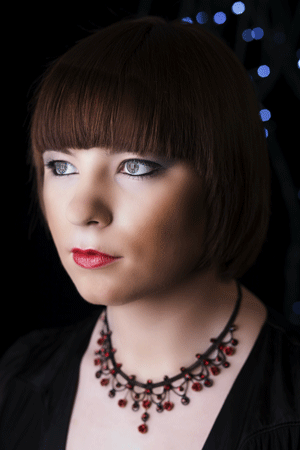 Natalya Romaniw [Photo by Patrick Allen, Opera Omnia, courtesy of Hazard Chase Limited]
This year’s winner, Welsh soprano Natalya Romaniw, offered a daring programme which played to her strengths — a big, richly coloured tone and a confident, mature dramatic presence. Opening with Tchaikovsky’s ‘Atchevo eta pryezhdye nye znala’ from Iolanta she exhibited a beautiful vocal lustre and a natural instinct for phrase shape, carefully modulating the dynamic expression to communicate textual meaning. Strauss’s ‘Ständchen’ showed off the glistening, exhilarating sheen of her upper notes, and its power, while the same composer’s ‘Ruhe meine seele’ demonstrated that Romaniw can sustain a centred, pleasing line in the lower register too. Jonathan Dove’s ‘Between your sheets’ was imaginative and adventurous programming, and here Romaniw adopted a more intimate tone, sensitively conveying the words. But, it was back into extrovert mode for Britten’s ‘Tell me the Truth about Love’: fortunately, she did not indulge in cabaret hyperbole, but enjoyed sharing the wit and humour of the song with the audience, in an appealing, engaging rendition which deservedly garnered the song prize for Romaniw too.
Baritone Ben McAteer and soprano Ruth Jenkins shared second prize. I felt that McAteer’s communication of the text, as he effortlessly embodied a range of characters in different dramatic and emotional situations, put him in the running for first prize. Whether outpouring Romantic angst or relishing the ironic wit of Classicism, every word was crystal clear and every musical gesture perfectly matched to the sentiments of the text. The gradation of dramatic moods in Schumann’s ‘Belsazar’ was superb, the phrase endings beautifully crafted, while ‘Kogda bï zhizn domashnim krugom’ from Eugene Onegin demonstrated the relaxed flexibility of McAteer’s warm baritone. Hamilton Harty’s setting of the traditional Irish song, ‘My Lagan Love’, made a moving conclusion to his programme; the tempo was audaciously slow, McAteer’s dark pianissimo deeply expressive, and the rhetorical power of the song instinctively conveyed.
Ruth Jenkins demonstrated variety of tone and a broad tessitura in an interesting programme which embraced Schubert, Wolf, Handel, James Macmillan and the Icelandic composer, Sigfús Einarsson. Seeming a little nervous at the start, Jenkins struggled to control her vibrato in the long sustained notes that open Schubert’s ‘Litanei auf das Fest Aller Seelen’, but she did show that she knows how to build through individual phrases to shape coherent larger structures. Her intonation settled, however, and Einarsson’s ‘Draumalandio’ was notable for its wistful, gentle ambience. Gaining confidence, Jenkins brought a translucent quality to the tranquil rocking intervals of Macmillan’s ‘The Children’. She skilfully controlled the repetitive vocal line, which, like a child’s song, employs only a few basic intervals, tenderly conveying the innocence of the child in contrast to the more sophisticated gestures of the sparse piano accompaniment.
There were three other finalists. Soprano Eleanor Dennis demonstrated plenty of sparkle in ‘Come Scoglio’ and a burnished lower range in Britten’s ‘Nocturne’ from On This Island. She blended folky gestures with virtuosity in Eva Dell’Acqua’s ‘Villanelle’ but, while this was an accurately performed programme Dennis, in the difficult ‘opening slot’, did not always have the stage presence to fully engage the audience. Dennis’s accompanist, Craig White, was awarded the accompanist’s prize.
The same lack of stage impact also characterised soprano Robyn Allegra Parton’s performance. Although her rendering of Quilter’s ‘Love’s Philosophy’ was exuberant, and ‘My heart leaps up’ from Britten’s Albert Herring carefully shaped, Parton’s performance was accurate, poised and pleasing rather than exciting and impactful.
The limitations of the countertenor repertoire inevitably affected Russell Harcourt’s programming; but while he attempted to introduce variety, juxtaposing Handel with Heggie, Harcourt’s light graceful voice ultimately lacked diversity of colour. This proved problematic in Bach’s renowned ‘Erbarme dich’ from the St. Matthew Passion, where he was unable to impose his presence in the strophic repetitions, following the long piano ‘between-verse’ passages. A burgeoning theatricality was evident in Handel’s ‘Vivi tiranno’ from Rodelinda, however, as well as superb breath control and an effective rhetorical style.
I’m sure we will be hearing much more from all these accomplished singers in future. And, the centenary celebrations continue at the Wigmore Hall on 28 June, when six recent winners — singers Sarah-Jane Brandon, Anna Stéphany, Ben Johnson, Jonathan McGovern, and pianists James Baillieu and John Read — come together to perform a programme of songs, duets and ensembles from Kathleen Ferrier’s repertoire, devised by Graham Johnson.
Claire Seymour