They’re alike in some key ways…
- Both operas are set in Florence
- They are roughly contemporary in composition from around 1917-1918
- Both operas have plots driven by avarice and disparities of wealth
Yet even so, …
- Zemlinsky is not well-known, while Puccini is arguably the most popular
composer of the 20th Century
- A Florentine Tragedy is dark, while Gianni Schicchi is
a comic masterpiece
- Notwithstanding the date of composition, Zemlinsky’s music is often
dissonant and disturbing, whereas Puccini’s occasional dissonances are
usually zany rather than disturbing, and serve to set up the luscious
melodies he spins. But Zemlinsky does offer a few wonderful climaxes.
Conducted by Andrew Davis, I believe this is the largest COC orchestral
complement we’ve seen in a long time, at least in the Zemlinsky. Huge as the
assembled forces may have been for most of the work, Davis held them delicately
in check, swelling only occasionally, particularly at the volcanic conclusion.
The Zemlinsky work sounds a lot like Richard Strauss, with the expressionist
flair we find from operas such as Elektra or Salome.
Wilson Chin’s set design captured these two very distinct worlds, allowing
them to cohere wonderfully as a satisfying evening of opera. The dark work
(called a “tragedy” but maybe not so tragic) unfolds as a love triangle on
a big bare stage, while the light comedy takes place in a cramped space full of
junk. Although they’re different the worlds of both are so preoccupied with
property and materialism that it’s manifested in the physical environment of
the set.
Bass-baritone Alan Held had a busy night. As Simone in the tragedy he’s
singing a great deal, much of it in a high register, followed by the role of
Gianni Schicchi, which isn’t much easier, also lying high. The teutonic style
of the Zemlinsky seems to be a better fit for Held’s voice than the
Italianate comedy, although true to his name he more than held his own.
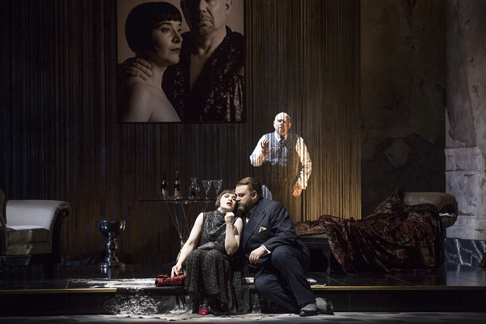 (l - r) Gun-Brit Barkmin as Bianca, Michael König as Guido Bardi and Alan Held as Simone (background) in the Canadian Opera Company production of A Florentine Tragedy, 2012. [Photo by Michael Cooper courtesy of the Canadian Opera Company]
While I laughed throughout the Puccini I enjoyed the dark opera more. For me
it’s a brand-new work, full of wonderful moments, luscious orchestral
sonorities, unexpected emotional turns, and a wonderful concluding five
minutes. Director Catherine Malfitano is to be congratulated for shaping this
complex and ambiguous work successfully. Bianca, Simone’s wife, is shown with
her husband in an oversize portrait centre stage (you can see it in the photo)
with her husband’s hand in a controlling position on her neck. In their first
encounter he gently seizes her -if that isn’t a complete oxymoron—by the
back of the neck. While this may seem obvious, the story is anything but.
Held’s physical presence is threatening even though he is subservient to the
Prince, who is busily cuckolding his subject right in Simone’s own home.
Gun-Brit Barkmin makes a wonderfully complex Bianca, surrendering to Michael
König’s Prince, yet seemingly in thrall to her husband’s complex
dominance. It should be no surprise that this twisted tale comes to us from
Oscar Wilde. Malfitano’s conclusion to A Florentine Tragedy provided
a wonderful echo of the cloak from one of the original Puccini triptych, namely
Il Tabarro ; where the cloak in the Puccini shocker conceals a dead
body, in this case the cloak leads to an unexpectedly loving and sensual
embrace.
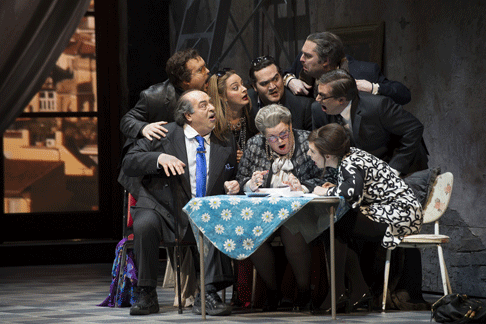 A scene from the Canadian Opera Company production of Gianni Schicchi, 2012. [Photo by Michael Cooper courtesy of the Canadian Opera Company]
While I found the Puccini a huge relief after the darkness of Zemlinsky, I
wasn’t sure about the updating. Instead of Medieval Florence we get something
closer to Jersey Shore: which is apt I suppose considering that Malfitano is
both American and Italian. Sometimes the updating was very good, as for
instance when René Barbera as Rinuccio sang his big paean to Florence from
atop a pile of junk. I worried for his safety -and no this isn’t to be
mistaken for Spiderman—with the young tenor perched easily twenty
feet above the stage floor. I reminded myself that while the set appeared
rickety of course it was carefully constructed to support him. Overall I found
that the modernization made the show warm & fuzzy rather than edgy,
defusing some of the laughter that the opera can sometimes generate. It’s
still lots of fun though and especially delightful after the Zemlinsky.
Barbera’s singing was one of the highlights of the evening, along with the
Lauretta of Simone Osborne, singing “Oh mio babbino caro”. I felt Davis was
channelling Toscanini, imbuing the operas with wonderful pace & verve, but
also sometimes challenging the singers to perhaps sing faster than they might
have wished.
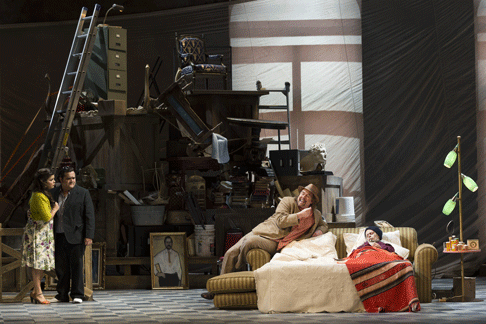 (l - r) Simone Osborne as Lauretta, René Barbera as Rinuccio and Alan Held as Gianni Schicchi in the Canadian Opera Company production of Gianni Schicchi, 2012. [Photo by Michael Cooper courtesy of the Canadian Opera Company]
Held, Barbera & Osborne make a loveable family unit, in this
crowd-pleaser of an opera. I hope no one is scared off by the opera composed by
a guy whose name starts with a Z. This double bill deserves to score well with
the Toronto audience.
The Canadian Opera Company production of A Florentine Tragedy
andGianni Schicchi continue at the Four Seasons Centre in Toronto
until May 25th.
Leslie Barcza
This review first appeared at barczablog. It is reprinted with the
author’s permission.
![Alan Held as Simone and Gun-Brit Barkmin as Bianca in the Canadian Opera Company production of A Florentine Tragedy Alan Held as Simone and Gun-Brit Barkmin as Bianca in the Canadian Opera Company production of <em>A Florentine Tragedy</em> [Photo by Chris Hutcheson courtesy of the Canadian Opera Company]](http://www.operatoday.com/florentine-COC_01.gif)