Subscribe to
Opera Today

Receive articles and news via RSS feeds or email subscription.


twitter_logo[1].gif


UCP_9780226043425.gif

Recently in Performances

Domingo Conducts Holdridge’s New Opera Dulce Rosa

Dulce Rosa, a brand new opera, had its world premiere Friday night, May 17, 2013 at the Broad Stage in Santa Monica, California. It was produced by Los Angeles Opera, but staged in the smaller theater.

Verdi’s Falstaff at Glyndebourne

Richard Jones’ 2009 production of Verdi’s Falstaff translates the action from the first Elizabethan age to the start of the second.

Gareth John, Wigmore Hall

Baritone Gareth John is rapidly accumulating a war-chest of honours. Winner of the 2013 Kathleen Ferrier Award, he recently won the Royal Academy of Music Patrons’ Award and was presented the Silver Medal by the Worshipful Company of Musicians.

La bohème at ENO

This second revival of Jonathan Miller’s La bohème was the first time I had caught the production.

Rolando Villazón: Verdi (International Opera Stars Series 2013)

It’s Verdi’s bicentenary year and Rolando Villazón has two new CDs to plug — titled somewhat confusingly, ‘Villazón: Verdi’ and ‘Villazón’s Verdi’, the latter a ‘personal selection’ of favourite numbers performed by stars of the past and present.

Brahms Third in San Francisco

Nicola Luisotti and the San Francisco Opera Orchestra climbed out of the War Memorial pit, braved the wind whipped bay and held spellbound an audience at Cal Performances’ Zellerbach Auditorium at UC Berkeley.

Glyndebourne: Ariadne auf Naxos

Utterly mad but absolutely right — Richard Strauss’s Ariadne auf Naxos started the Glyndebourne 2013 season with an explosion. Strauss could hardly have made his intentions more clear. Ariadne auf Naxos is not “about” Greek myth so much as a satire on art and the way art is made.

Wozzeck at ENO

“Man is an abyss. It makes one dizzy to look into it.” So utters Georg Büchner’s Woyzeck, repeating what was also a recurring motif in the playwright’s own letters.

Mulhouse: Rare Britten Well Done

National Opera Company of the Rhine has marked this year’s Benjamin Britten celebration with a remarkably compelling, often gripping new production of the seldom-seen Owen Wingrave.

Frankfurt's Intriguing Idomeneo

Once upon a time, Frankfurt Opera had the baddest ass reputation in Germany as “the” cutting edge producer of must-see opera.

Rigoletto at Lyric Opera of Chicago

Productions of Giuseppe Verdi’s Rigoletto can serve as a vehicle for individual singers to make a strong impression and become afterward associated with specific roles in the opera.

Britten Sinfonia with Ian Bostridge

Just in case we were not aware that the evening’s programme was ‘themed’, the Britten Sinfonia designed a visual accompaniment to their musical exploration of night, sleep and dreams.

Aida, Manitoba Opera

Poor Aida! She never seems to have anything go her way.

Superlative singing: Don Carlo, Royal Opera House

Is it possible to upstage Jonas Kaufmann? Kaufmann was brilliant in this Verdi Don Carlo at the Royal Opera House, London, but the rest of the cast was so good that he was but first among equals. Don Carlo is a vehicle for stars, but this time the stars were everyone on stage and in the pit. Even the solo arias, glorious as they are, grow organically out of perfect ensemble. This was a performance that brought out the true beauty of Verdi's music.

Sarah Connolly: French Song at Wigmore Hall

The big names were absent: Duparc, D’Indy, Debussy, Ravel … and while Fauré, Chausson, Roussel and several members of Les Six put in an appearance, in less than familiar guises, this survey of French song of the early 20th century and interwar years deliberately took us on a journey through infrequently travelled terrain.

Rare restoration: Handel’s Esther 1720

Composed between 1718 and 1720, Handel’s Esther is sometimes described as the ‘first English Oratorio’, but is in fact a hybrid form, mixing elements of oratorio, masque, pastoral and opera.

The Damnation of Faust, London

Hector Berlioz's légende dramatique, La Damnation de Faust, exists somewhere between cantata and opera. Berlioz's flexible attitude to dramatic form made the piece unworkable on the stages of early 19th century Paris and his music is so vivid that you wonder whether the piece needs staging at all.

Elizabeth Connell Memorial Concert, St John's Smith Square

St. John’s Smith Square was the site of Elizabeth Connell’s final London concert, intended as a farewell to London on her moving to Australia. It was rendered ultimately final by her unexpected death.

Aida with all the Trimmings, Even a Blue Silk Elephant!

With the building of the Suez Canal, Egypt became more interesting to Western Europeans. Khedive Ismail Pasha wanted a hymn by Verdi for the opening of a new opera house in Cairo, but the composer said he did not write occasional pieces.

Die Zauberflöte, Royal Opera

Back for its fourth revival, David McVicar’s 2003 production of Mozart’s Die Zauberflöte has much charm, beauty and artistry.

OPERA TODAY ARCHIVES »

Performances

Scene from Les Troyens [Photo by Bill Cooper courtesy of Royal Opera House]
27 Jun 2012

Les Troyens, Royal Opera House London

A sensational Les Troyens at the Royal Opera House, London. Berlioz, who understood theatrical gestures so well, builds his opera around the most audacious dramatic device in ancient history: the Trojan Horse.

Hector Berlioz: Les Troyens

Soldier: Daniel Grice, Cassandre: Anna Caterina Antonacci, Corebe: Fabio Capitanucci, Panthée: Ashley Holland, Hélénus: Ji Hyun Kim, Ascagne: Barabar Senator, Hécube: Pamela Helen Stephenson, King Priam: Robert Lloyd; Plyxéne: Jenna Sloan; Andromaque: Sophia McGregor; Énée: Bryan Hymel; Ghost of Hector: Jihoon Kim; Greek Captain: Lucas Jaconi; Dodon: Eva-Maria Westbroek; Anna: Hanna Hipp; Iopas: Ji-min Park; Narbal: Brindley Sherratt; Hylas: Ed Lyon; Soldiers: Adrian Clarke; Jeremy White. Conductor: Antonio Pappano. Director: David McVicar. Set designer: Es Devlin. Costume designer: Moritz Junge. Lighting: Wolfgang Göbbel. Choreography: Andrew George. Royal Opera House, London, 25th June 2012.

Above: Scene from Les Troyens

Photos by Bill Cooper courtesy of Royal Opera House


The population of Troy delights in the spectacle, but then all hell breaks loose and the city is destroyed. David McVicar’s new production is similarly audacious. The orchestra roars full tilt. Even the instrumentation is extravagant — the ophicleide wails like a strange monster. Then the Horse looms into view, moving in a surprisingly realistic way. its eyes shining as if the creature were alive, which adds a poignant twist.
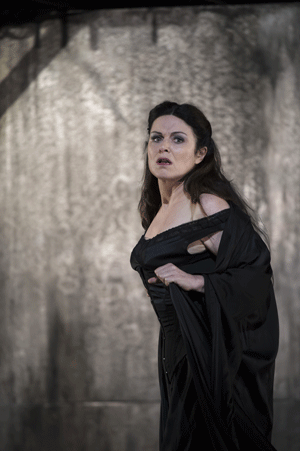
LesTroyens_474-ANTONACCI.gifAnna Caterina Antonacci as Cassandra

The Greeks and Trojans had much in common with the age of Napoleon III. David McVicar and his team (Es Devlin, Moritz Junge, Wolgang Göbbel) brilliantly capture the expansive, extravagant spirit of Berlioz’s time. France at its imperial peak, colonizing Africa and Asia. Paris was being rebuilt on a grand scale. Berlioz wasn’t doing history re-enactment but writing to stun Paris with its audacity. His orchestration isn’t the music of antiquity, but the most advanced and adventurous of its time. Berlioz isn’t doing history re-enactment, and his audiences interpreted Virgil through the filters of Claude and Poussin.

Grecian pottery depicts figures with minimal background: in Berlioz, the background is extreme and densely textured. The principals and secondary parts have to be strongly cast to stand out. Berlioz writes psychological depth in the music rather than in the text, so a strong casting and good direction are of the essence. At The Royal Opera House, the singing and acting was superb, thus expanding the spirit of the roles for maximum dramatic impact.
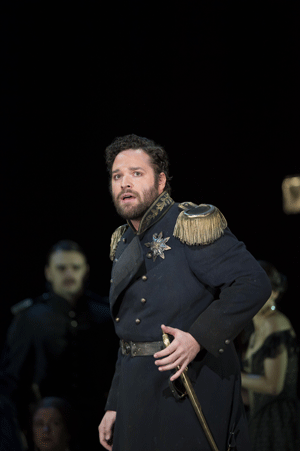
LesTroyens_583-HYMEL.gifBryan Hymel as Aeneas

Anna Caterina Antonacci created the part of Cassandre with John Eliot Gardiner in Paris in 2003. She’s pitted, alone, against the hysteria in the chorus, and the militaristic violence in the orchestra, but her voice holds its own and soars through with dark intensity. Cassandre and Chorèbe (Fabio Capitanucci) are counterparts to Didon and Énée, but Eva-Maria Westbroek’s Didon and Bryan Hymel’s Enée were more than a match for the sheer passion of their characterization.

Eva-Marie Westbroek sang Cassandre in the Amsterdam Les Troyens in 2011 (Pierre Audi). She’s also a natural for the warm, happy Didon we see in Carthage (the desert city brilliantly depicted in multi dimensions so we get a sense of its teeming activity). This throws her portrayal of Didon’s extreme grief into sharp relief. When Westbroek sings of her anguish, the set is bare but for blue-grey curtain, the staging speaking for her as much as the orchestration. Westbroek’s such a sympathetic Didon, we feel her agony.

Bryan Hymel sang Énée in the Amsterdam production last year, and brings experience to the role. Anyone who bought tickets expecting Jonas Kaufmann would not have been disappointed. If anything, Hymel’s bright lyric tenor suits the part better. In the duet “Nuit d’ivresse et d’extase infinie!” he conveyed such beauty and sensitivity that he fleshed out the action man hero side of Énée, and the role became a real personality. Hymel’s Farewell aria was stunning, and ended with an exuberant flourish that was both heroic and tragic. The audience burst into spontaneous applause for the first time. Some audiences clap at anything, but this audience was far more sophisticated. You don’t do a demanding five-hour opera unless you really care. Hymel is still only 32, and has years of potential ahead.
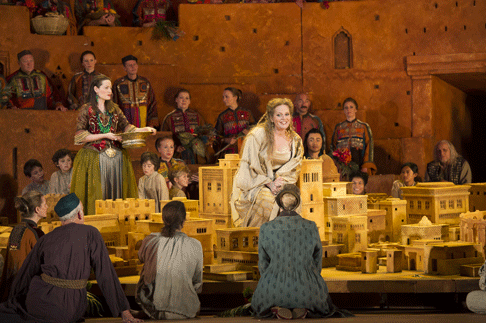
LesTroyens_246.gifEva-Maria Westbroek as Dido and Hanna Hipp as Anna

Brindley Sherratt’s Nabal was powerful, setting the opera in context. Duty, fate and tragedy, love cannot compete except in death. Also outstanding was Ji-min Park as Iopas, singing the plangently lovely “O Blonde Cérès”. Park is only two years out of the Jette Parker Young Artists Programme but a singer who should go far. Indeed, all the singing and acting was top notch, the entire cast on message, the chorus well blocked and expressive.

Coming from a background in Berlioz songs, I can’t bear the bombast some like in Les Troyens, but Antonio Pappano’s approach is more perceptive. He understand that what makes this opera work is its variety. Berlioz is flashing his virtuosity. The carnage music must be strident, but Berlioz writes music of surprising delicacy, and even humour. Pappano characterized the ballet scenes sensitively. These are important, not mere filler, for they set the context of the opera. Berlioz’s Paris audiences would have liked this exotic orientalism had they heard it, for it fitted their image of themselves as rulers of North Africa and beyond. Wisely, McVicar and his team used the exotic theme in the set, where the “world” (ie the model of Carthage) floats in a magical cosmos of blue, green and red light, illuminated by stars. Perfect union of music, staging and meaning.

This Berlioz Les Troyens is an experience no-one should miss. Alas, performances are sold out solid and you might have to pay way over the odds to get in. Luckily, it’s being filmed and will be in cinemas in November and hopefully out on DVD. it’s a milestone for the Royal Opera House and they’d be mad not to revive it soon. View it live on Mezzo TV on 5th July here and listen to the Proms semi-staging on 22nd July.

Anne Ozorio
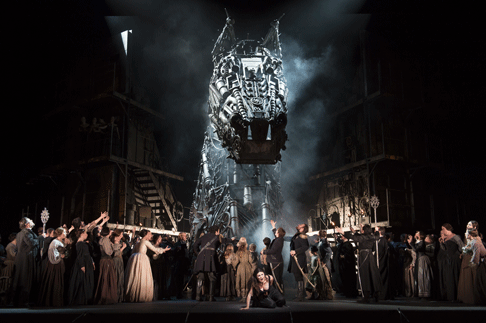
LesTroyens_1198.gifScene from Les Troyens

Send to a friend

Send a link to this article to a friend with an optional message.

Friend's Email Address: (required)

Your Email Address: (required)

Message (optional):