![Julia Riley as Dorabella and Elizabeth Llewellyn as Fiordiligi [Photo by Fritz Curzon courtesy of Opera Holland Park]](http://www.operatoday.com/Cosi2012-159a.gif)
11 Jun 2012
Così fan tutte, Holland Park
Are my expectations too high when it comes to Mozart’s operas in general, and to Così fan tutte in general? Probably. Should they be? Certainly.
English Touring Opera are delighted to announce a season of lyric monodramas to tour nationally from October to December. The season features music for solo singer and piano by Argento, Britten, Tippett and Shostakovich with a bold and inventive approach to making opera during social distancing.
This tenth of ten Live from London concerts was in fact a recorded live performance from California. It was no less enjoyable for that, and it was also uplifting to learn that this wasn’t in fact the ‘last’ LfL event that we will be able to enjoy, courtesy of VOCES8 and their fellow vocal ensembles (more below …).
Ever since Wigmore Hall announced their superb series of autumn concerts, all streamed live and available free of charge, I’d been looking forward to this song recital by Ian Bostridge and Imogen Cooper.
Although Stile Antico’s programme article for their Live from London recital introduced their selection from the many treasures of the English Renaissance in the context of the theological debates and upheavals of the Tudor and Elizabethan years, their performance was more evocative of private chamber music than of public liturgy.
Evidently, face masks don’t stifle appreciative “Bravo!”s. And, reducing audience numbers doesn’t lower the volume of such acclamations. For, the audience at Wigmore Hall gave soprano Elizabeth Llewellyn and pianist Simon Lepper a greatly deserved warm reception and hearty response following this lunchtime recital of late-Romantic song.
For this week’s Live from London vocal recital we moved from the home of VOCES8, St Anne and St Agnes in the City of London, to Kings Place, where The Sixteen - who have been associate artists at the venue for some time - presented a programme of music and words bound together by the theme of ‘reflection’.
'Such is your divine Disposation that both you excellently understand, and royally entertaine the Exercise of Musicke.’
‘And there was war in heaven: Michael and his angels fought against the dragon; and the dragon fought and his angels, And prevailed not; neither was their place found any more in heaven … that old serpent … Satan, which deceiveth the whole world: he was cast out into the earth, and his angels were cast out with him.’
There was never any doubt that the fifth of the twelve Met Stars Live in Concert broadcasts was going to be a palpably intense and vivid event, as well as a musically stunning and theatrically enervating experience.
‘Love’ was the theme for this Live from London performance by Apollo5. Given the complexity and diversity of that human emotion, and Apollo5’s reputation for versatility and diverse repertoire, ranging from Renaissance choral music to jazz, from contemporary classical works to popular song, it was no surprise that their programme spanned 500 years and several musical styles.
The Academy of St Martin in the Fields have titled their autumn series of eight concerts - which are taking place at 5pm and 7.30pm on two Saturdays each month at their home venue in Trafalgar Square, and being filmed for streaming the following Thursday - ‘re:connect’.
The London Symphony Orchestra opened their Autumn 2020 season with a homage to Oliver Knussen, who died at the age of 66 in July 2018. The programme traced a national musical lineage through the twentieth century, from Britten to Knussen, on to Mark-Anthony Turnage, and entwining the LSO and Rattle too.
With the Live from London digital vocal festival entering the second half of the series, the festival’s host, VOCES8, returned to their home at St Annes and St Agnes in the City of London to present a sequence of ‘Choral Dances’ - vocal music inspired by dance, embracing diverse genres from the Renaissance madrigal to swing jazz.
Just a few unison string wriggles from the opening of Mozart’s overture to Le nozze di Figaro are enough to make any opera-lover perch on the edge of their seat, in excited anticipation of the drama in music to come, so there could be no other curtain-raiser for this Gala Concert at the Royal Opera House, the latest instalment from ‘their House’ to ‘our houses’.
"Before the ending of the day, creator of all things, we pray that, with your accustomed mercy, you may watch over us."
The doors at The Metropolitan Opera will not open to live audiences until 2021 at the earliest, and the likelihood of normal operatic life resuming in cities around the world looks but a distant dream at present. But, while we may not be invited from our homes into the opera house for some time yet, with its free daily screenings of past productions and its pay-per-view Met Stars Live in Concert series, the Met continues to bring opera into our homes.
Music-making at this year’s Grange Festival Opera may have fallen silent in June and July, but the country house and extensive grounds of The Grange provided an ideal setting for a weekend of twelve specially conceived ‘promenade’ performances encompassing music and dance.
There’s a “slide of harmony” and “all the bones leave your body at that moment and you collapse to the floor, it’s so extraordinary.”
“Music for a while, shall all your cares beguile.”
The hum of bees rising from myriad scented blooms; gentle strains of birdsong; the cheerful chatter of picnickers beside a still lake; decorous thwacks of leather on willow; song and music floating through the warm evening air.
Are my expectations too high when it comes to Mozart’s operas in general, and to Così fan tutte in general? Probably. Should they be? Certainly.
For the problem remains, as I have doubtless said far too many times before, Mozart’s music, and not just his operas, requires but one thing: perfection. It is the most unsparing music of all, with nowhere, but nowhere, to hide. Every note must be considered and sounded both in itself and in connection to every other. Place a wrong or even slightly excessive accent upon a single note and the fault will be glaringly magnified; misjudge a tempo, which is not to say that there is only one ‘correct’ tempo, and the entire apple-cart will be upset. However, conduct Così fan tutte like Sir Colin Davis — or rather, as Sir Colin Davis — and it is an experience that will remain with an audience for the rest of its life, opening doors one had never expected to be there in the first place.
Yes, the comparison is odious, but Thomas Kemp — a name new to me though his biography suggests considerable experience in houses across Europe and beyond — is no Colin Davis. I have heard worse, most obviously from the aggressively ‘authenticke’ brigade; Kemp did not seem actively to be trying to make Mozart’s music sound unpleasant. Nevertheless, on this evidence, he is not a conductor who could claim any particular or even general sympathy with Mozart. The opening bars of the Overture were taken far too fast; thereafter, far too many numbers never hit upon the just tempo. (It is worth repeating at this point that I do not for a moment think there is one ‘correct’ tempo; the trick is to make whatever is chosen sound right, to perform with conviction, sympathy, understanding, and of course, a sense of connection to a greater whole.) ‘Smanie implacibilie’ was breathless in quite the wrong way. Other sections of the score dragged, not so much because they were slow — I doubt that anything was as ravishingly, heart-stoppingly lingering as Davis would so often nowadays present it — but because the tempo seemed arbitrary, applied from without, with little connection to anything else, above all with little or no sense of harmonic motion.
The City of London Sinfonia played decently, though the strings could tend somewhat towards the anonymous. (At least they lacked the acerbic nature of a ‘period’ orchestra.) For the most part, as so often in Mozart, it was the woodwind section that most delighted; there was some fine work indeed here from a number of principals. The kettledrums, however, were often bizarrely prominent, not helped by the employment of hard sticks. Karl Böhm would have rolled in his grave.
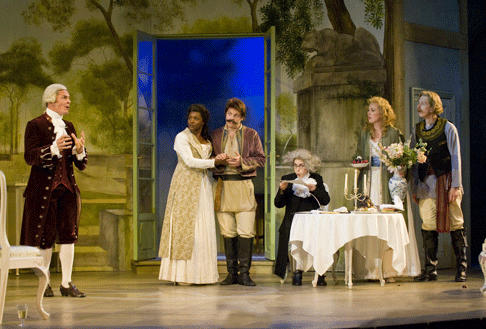 (Left-Right) Nicholas Garrett as Alfonso, Elizabeth Llewellyn as Fiordiligi, Andrew Staples as Ferrando, Joana Seara as Despina, Julia Riley as Dorabella and Dawid Kimberg as Guglielmo
Had they been supported by a more sympathetic conductor, the cast of young singers would doubtless have appeared in a stronger light. As it was, there was nothing really to which one could object, but there remained a sense that things might have been better. (Perhaps that will dissipate during the run; first nights are rarely the best time to catch singers in particular.) Elizabeth Llewellyn, whom I admired greatly last year at Holland Park as the Countess, delivered what was probably the strongest performance overall, as Fiordiligi. The beauty of her tone-production could not be gainsaid, though her diction was sometimes, for instance in ‘Per pietà’, occluded. Julia Riley’s Dorabella sometimes lacked focus, though when that was achieved, showed considerable promise. Hers was a forthright portrayal, doubtless in part so as to achieve greater contrast with Fiordiligi, but was it sometimes excessively so? There second act duet between the two veered dangerously close to crudity on Dorabella’s part. Andrew Staples’s tone is very much of the ‘English tenor’ variety. I was not always convinced that this served Ferrando so well, but it is a very difficult role to get right; in other cases, often one ends up thinking the music sounds too close to Puccini. ‘Un’ aura amoroso’ was beautifully sung, though there were times elsewhere when greater presence might have been achieved. Dawid Kimberg’s Guglielmo was blustering, swaggering even, able to call upon considerable vocal reserves. Joana Seara offered a lively Despina, though her tuning sometimes went a little awry. Nicholas Garrett, 2010’s Don Giovanni, presented an intelligent portrayal of Don Alfonso.
What of the production? It was, for the most part, difficult to say anything much about it at all. I do not doubt that it would have pleased self-proclaimed ‘traditionalists’, since the costumes were all impeccably, almost aggressively, ‘period’ — if hardly Neapolitan. Of course, Così is in no sense whatsoever ‘about’ eighteenth-century Naples, but the logic of the literalist position is that it must be. It was difficult to detect in Harry Fehr’s production any idea of what Così might be about, any attempt to probe beneath its painfully beautiful surfaces, or even to celebrate the pain upon the surface. We had a ‘period’ set, ‘period’ costumes, and that was really just about it. There was a nod to directorial cliché in placing an audience on stage, supposedly ‘reacting’ to the events witnessed, but have we not seen that sort of thing far too many times before? Such framing can be interesting, even refreshing: I think, for instance, of Nicholas Hytner’s production of Handel’s Serse for ENO. However, if the intention were to highlight the artificiality of the drama — the artificiality is absolutely necessary to permit Mozart’s agonising psychological explorations — then it failed to come across; it appeared instead rather more as an attempt to generate stage ‘business’ in the absence of any other ideas. That is, until, part way through the second act, Fehr suddenly decided to add a few more, which jarred hopelessly given the uninvolving nature of what we had seen hitherto. Ferrando was laughed at by members of the ‘audience’: it might have been movingly cruel, yet here simply came across as an intrusion upon the music. Fiordiligi took off her dress, put on a soldier’s uniform — a very odd, quasi-literalist interpretation of her attempt to persuade herself to find her (erstwhile) lover — and then had that taken off by Ferrando. (No need to worry: there was plenty beneath the dress and the uniform.) Such ‘action’ merely came across as a realisation, too late in the day, that nothing much had happened. This is, of course, an extremely difficult opera to direct, yet Lloyd-Evans barely seemed to have tried.
Mark Berry