![Brian Mulligan as Richard Nixon [Photo by Cory Weaver. courtesy of San Francisco Opera]](http://www.operatoday.com/Nixon-2.gif)
09 Jun 2012
Nixon in China, San Francisco
John Adams’ Nixon in China is an amazing, riveting piece of music, and compelling theater to boot.
English Touring Opera are delighted to announce a season of lyric monodramas to tour nationally from October to December. The season features music for solo singer and piano by Argento, Britten, Tippett and Shostakovich with a bold and inventive approach to making opera during social distancing.
This tenth of ten Live from London concerts was in fact a recorded live performance from California. It was no less enjoyable for that, and it was also uplifting to learn that this wasn’t in fact the ‘last’ LfL event that we will be able to enjoy, courtesy of VOCES8 and their fellow vocal ensembles (more below …).
Ever since Wigmore Hall announced their superb series of autumn concerts, all streamed live and available free of charge, I’d been looking forward to this song recital by Ian Bostridge and Imogen Cooper.
Although Stile Antico’s programme article for their Live from London recital introduced their selection from the many treasures of the English Renaissance in the context of the theological debates and upheavals of the Tudor and Elizabethan years, their performance was more evocative of private chamber music than of public liturgy.
Evidently, face masks don’t stifle appreciative “Bravo!”s. And, reducing audience numbers doesn’t lower the volume of such acclamations. For, the audience at Wigmore Hall gave soprano Elizabeth Llewellyn and pianist Simon Lepper a greatly deserved warm reception and hearty response following this lunchtime recital of late-Romantic song.
For this week’s Live from London vocal recital we moved from the home of VOCES8, St Anne and St Agnes in the City of London, to Kings Place, where The Sixteen - who have been associate artists at the venue for some time - presented a programme of music and words bound together by the theme of ‘reflection’.
'Such is your divine Disposation that both you excellently understand, and royally entertaine the Exercise of Musicke.’
‘And there was war in heaven: Michael and his angels fought against the dragon; and the dragon fought and his angels, And prevailed not; neither was their place found any more in heaven … that old serpent … Satan, which deceiveth the whole world: he was cast out into the earth, and his angels were cast out with him.’
There was never any doubt that the fifth of the twelve Met Stars Live in Concert broadcasts was going to be a palpably intense and vivid event, as well as a musically stunning and theatrically enervating experience.
‘Love’ was the theme for this Live from London performance by Apollo5. Given the complexity and diversity of that human emotion, and Apollo5’s reputation for versatility and diverse repertoire, ranging from Renaissance choral music to jazz, from contemporary classical works to popular song, it was no surprise that their programme spanned 500 years and several musical styles.
The Academy of St Martin in the Fields have titled their autumn series of eight concerts - which are taking place at 5pm and 7.30pm on two Saturdays each month at their home venue in Trafalgar Square, and being filmed for streaming the following Thursday - ‘re:connect’.
The London Symphony Orchestra opened their Autumn 2020 season with a homage to Oliver Knussen, who died at the age of 66 in July 2018. The programme traced a national musical lineage through the twentieth century, from Britten to Knussen, on to Mark-Anthony Turnage, and entwining the LSO and Rattle too.
With the Live from London digital vocal festival entering the second half of the series, the festival’s host, VOCES8, returned to their home at St Annes and St Agnes in the City of London to present a sequence of ‘Choral Dances’ - vocal music inspired by dance, embracing diverse genres from the Renaissance madrigal to swing jazz.
Just a few unison string wriggles from the opening of Mozart’s overture to Le nozze di Figaro are enough to make any opera-lover perch on the edge of their seat, in excited anticipation of the drama in music to come, so there could be no other curtain-raiser for this Gala Concert at the Royal Opera House, the latest instalment from ‘their House’ to ‘our houses’.
"Before the ending of the day, creator of all things, we pray that, with your accustomed mercy, you may watch over us."
The doors at The Metropolitan Opera will not open to live audiences until 2021 at the earliest, and the likelihood of normal operatic life resuming in cities around the world looks but a distant dream at present. But, while we may not be invited from our homes into the opera house for some time yet, with its free daily screenings of past productions and its pay-per-view Met Stars Live in Concert series, the Met continues to bring opera into our homes.
Music-making at this year’s Grange Festival Opera may have fallen silent in June and July, but the country house and extensive grounds of The Grange provided an ideal setting for a weekend of twelve specially conceived ‘promenade’ performances encompassing music and dance.
There’s a “slide of harmony” and “all the bones leave your body at that moment and you collapse to the floor, it’s so extraordinary.”
“Music for a while, shall all your cares beguile.”
The hum of bees rising from myriad scented blooms; gentle strains of birdsong; the cheerful chatter of picnickers beside a still lake; decorous thwacks of leather on willow; song and music floating through the warm evening air.
John Adams’ Nixon in China is an amazing, riveting piece of music, and compelling theater to boot.
It was an uncanny fit in the War Memorial opera house, our residual banking and energy tycoons superimposed onto our tech billionaires, the old guard and the young Turks all sitting there in our stodgy old opera house mesmerized by a brash young opera (well, young relative to our 400 year old repertory).
Not to mention Nixon and Mao, Pat and Chiang Ch’ing, Henry and Chou. How many ways could composer Adams find to make two against three, four against three, everything over anything go together and not go together during the three fleet hours it took a virtuoso orchestra to navigate this treacherous score?
Over this but more so within this score lies Alice Goodman’s libretto that juxtaposes mind-boggling and mind-numbing banalities with metaphors of grace and intelligence and flights of lyricism that float in and out of comprehension and are the motor of the mind-bogglingly richness of energy and color, ebb and swell, the sure sonic embodiment of one of the more bizarre moments of human history. And finally what it means. This seems to be found in a few tiny moments of personal reminiscences that are nothing and everything.
Nixon in China is a masterpiece, and if you did not know what theory of binary opposition is at least now you know what it feels like.
Of course there is the back story of the West once again discovering the East, though it dims as time goes on. It is history that will be vaguely known by few of the new generation of opera goers. What really was is no longer of concern to this opera that seems to have joined Simon Boccanegra in the core repertory (36 productions worldwide in its 25 years of existence). Nixon in China is now an operatically consecrated human document, not an historical document.
Like Verdi, Adams knows that politics are loud, and Nixon in China was plenty loud, belying its relatively modest resources — only double or triple winds and a reduced string contingent. But Adams adds a chorus of saxophones to traverse musical prerogatives, plus some rare sharp percussive sounds to throw listener sensibilities off-balance. It was already the digital age back in 1987 so there is a synthesizer, and there is electronic manipulation of all natural instrumental and vocal sound. Get it? — Adams’ amplifies his voices and orchestra!
He is thereby able to insert Wagner’s apocalyptic resolution into Madame Mao’s ballet with a richness maybe known only by 110 players in Bayreuth. Luckily next up this spring is Verdi’s Attila with Maestro Luisotti so there should not be too much of a sonic letdown.
Masterminding this cold war götterdämmerung was Dutch conductor Lawrence Renes who imposed a sense of rhythmic precision that immediately gripped and never flagged over the duration, evoking sounds that made the excitement of space exploration in the late twentieth century as alive and provocative as its accompanying politics. It was masterful conducting.
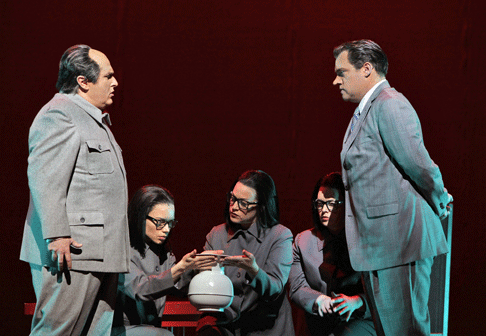 Simon O’Neill as Mao Tse-tung; Ginger Costa-Jackson, Buffy Baggott and Nicole Birkland as Mao’s secretaries; and Brian Mulligan as Richard Nixon
It was a cast of singers rather than singing actors. Some voices were larger than others, but with the help of sensitive sound design (amplification) all of these fine and beautiful voices melded magically with the sonorities created in the pit to create opera that was pleasing rather than provocative.
San Francisco Opera regular Brian Mulligan effected a fairly reasonable profile as Richard Nixon but captured nothing of the charisma of such a political personality. Tenor Simon O’Neill achieved a Mao of effective proportion though without messianic sense. Both soprano Maria Kanyova and baritone Chen-Ye Yuan are making a sizable careers as Pat Nixon and Chou En-lai having already performed the roles in many productions around the country. Mr. Yuan brings particular sensitivity and solidity to Chou En-lai. Patrick Carfizzi did not find a persona as Henry Kissinger though he provided good fun. Watch soprano Hye Jung Lee sing Madame Mao’s aria on YouTube, www.youtube.com/watch?v=IwHxvRJ_vPMto, to understand why she got the role even though she is way too young.
As in the recent production of The Death of Klinghoffer at the English National Opera the biggest and finest moments of lyric transport occurred not vocally but in dance. The relentless obscurity of the Alice Goodman libretto suspended, Adams unfettered by need to support vocal line, music and movement united to become one in the plight of the poor peasant girl, splendidly danced en point by ballerina Chirharu Shibata to the choreography of Wen Wei Wang, supported by her savior, dancer Bryan Ketron.
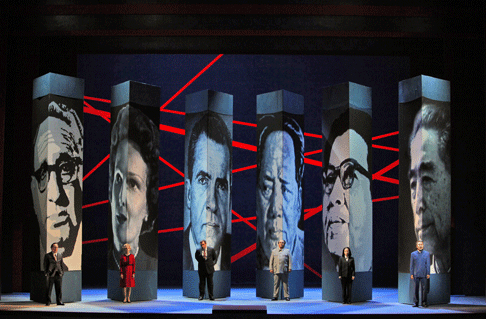 Patrick Carfizzi as Henry Kissinger, Maria Kanyova as Pat Nixon, Brian Mulligan as Richard Nixon, Simon O’Neill as Mao Tse-tung, Hye Jung Lee as Madame Mao and Chen-Ye Yuan as Chou En-lai
The performance was an un-nerving experience, exacerbated by the absence of its primary creator, Peter Sellers. It was after all his idea. It is inexplicable why San Francisco Opera eschewed the genius of this major American director for its premiere of one of the most important operas of the twentieth century.
As it was San Francisco Opera opted for a production from Vancouver Opera that most recently visited Kansas City. It is a fine, good looking production of theatrical savvy by Canadian director Michael Cavanagh. It is straightforward and workmanlike. It did not approach the opposites of the abstract, structuralist theatrical world of Sellers, Goodman and Adams.
Michael Milenski