15 Jun 2012
Oliver Knussen’s Sendak operas launch the Aldeburgh Music festival
Oliver Knussen’s two operas based on books by Maurice Sendak opened this year’s Aldeburgh Music Festival in exuberant style.
English Touring Opera are delighted to announce a season of lyric monodramas to tour nationally from October to December. The season features music for solo singer and piano by Argento, Britten, Tippett and Shostakovich with a bold and inventive approach to making opera during social distancing.
This tenth of ten Live from London concerts was in fact a recorded live performance from California. It was no less enjoyable for that, and it was also uplifting to learn that this wasn’t in fact the ‘last’ LfL event that we will be able to enjoy, courtesy of VOCES8 and their fellow vocal ensembles (more below …).
Ever since Wigmore Hall announced their superb series of autumn concerts, all streamed live and available free of charge, I’d been looking forward to this song recital by Ian Bostridge and Imogen Cooper.
Although Stile Antico’s programme article for their Live from London recital introduced their selection from the many treasures of the English Renaissance in the context of the theological debates and upheavals of the Tudor and Elizabethan years, their performance was more evocative of private chamber music than of public liturgy.
Evidently, face masks don’t stifle appreciative “Bravo!”s. And, reducing audience numbers doesn’t lower the volume of such acclamations. For, the audience at Wigmore Hall gave soprano Elizabeth Llewellyn and pianist Simon Lepper a greatly deserved warm reception and hearty response following this lunchtime recital of late-Romantic song.
For this week’s Live from London vocal recital we moved from the home of VOCES8, St Anne and St Agnes in the City of London, to Kings Place, where The Sixteen - who have been associate artists at the venue for some time - presented a programme of music and words bound together by the theme of ‘reflection’.
'Such is your divine Disposation that both you excellently understand, and royally entertaine the Exercise of Musicke.’
‘And there was war in heaven: Michael and his angels fought against the dragon; and the dragon fought and his angels, And prevailed not; neither was their place found any more in heaven … that old serpent … Satan, which deceiveth the whole world: he was cast out into the earth, and his angels were cast out with him.’
There was never any doubt that the fifth of the twelve Met Stars Live in Concert broadcasts was going to be a palpably intense and vivid event, as well as a musically stunning and theatrically enervating experience.
‘Love’ was the theme for this Live from London performance by Apollo5. Given the complexity and diversity of that human emotion, and Apollo5’s reputation for versatility and diverse repertoire, ranging from Renaissance choral music to jazz, from contemporary classical works to popular song, it was no surprise that their programme spanned 500 years and several musical styles.
The Academy of St Martin in the Fields have titled their autumn series of eight concerts - which are taking place at 5pm and 7.30pm on two Saturdays each month at their home venue in Trafalgar Square, and being filmed for streaming the following Thursday - ‘re:connect’.
The London Symphony Orchestra opened their Autumn 2020 season with a homage to Oliver Knussen, who died at the age of 66 in July 2018. The programme traced a national musical lineage through the twentieth century, from Britten to Knussen, on to Mark-Anthony Turnage, and entwining the LSO and Rattle too.
With the Live from London digital vocal festival entering the second half of the series, the festival’s host, VOCES8, returned to their home at St Annes and St Agnes in the City of London to present a sequence of ‘Choral Dances’ - vocal music inspired by dance, embracing diverse genres from the Renaissance madrigal to swing jazz.
Just a few unison string wriggles from the opening of Mozart’s overture to Le nozze di Figaro are enough to make any opera-lover perch on the edge of their seat, in excited anticipation of the drama in music to come, so there could be no other curtain-raiser for this Gala Concert at the Royal Opera House, the latest instalment from ‘their House’ to ‘our houses’.
"Before the ending of the day, creator of all things, we pray that, with your accustomed mercy, you may watch over us."
The doors at The Metropolitan Opera will not open to live audiences until 2021 at the earliest, and the likelihood of normal operatic life resuming in cities around the world looks but a distant dream at present. But, while we may not be invited from our homes into the opera house for some time yet, with its free daily screenings of past productions and its pay-per-view Met Stars Live in Concert series, the Met continues to bring opera into our homes.
Music-making at this year’s Grange Festival Opera may have fallen silent in June and July, but the country house and extensive grounds of The Grange provided an ideal setting for a weekend of twelve specially conceived ‘promenade’ performances encompassing music and dance.
There’s a “slide of harmony” and “all the bones leave your body at that moment and you collapse to the floor, it’s so extraordinary.”
“Music for a while, shall all your cares beguile.”
The hum of bees rising from myriad scented blooms; gentle strains of birdsong; the cheerful chatter of picnickers beside a still lake; decorous thwacks of leather on willow; song and music floating through the warm evening air.
Oliver Knussen’s two operas based on books by Maurice Sendak opened this year’s Aldeburgh Music Festival in exuberant style.
Where the Wild Things Are and Higgelty Piggelty Pop! are based on the books by Maurice Sendak, which presumably Knussen read with his daughter, Sonya. But Sendak’s books themselves spring from primeval sources. Nursery stories aren’t lullabies. They’re sinister. But children are fascinated. Perhaps when they go to sleep they need to be reassured that the dreams they encounter are just “stories” that they’ll wake from. Fantasy stimulates creativity. Knussen’s operas are for anyone of any age, who values imagination. Operas like these are good for our artistic (and mental) health. Britten wanted Aldeburgh to stimulate creative growth. Whether Knussen completes new work or not, he makes it possible for others to catch the spark.
In Sendak’s Where the Wild Things Are, a boy called Max is punished for dressing up as a wolf and escapes to a world of monsters. Sendak’s illustrations tell the story even more than the words do, so Netia Jones’s staging uses projections straight from the book. The staging’s not literal though, and incorporates the reality of theatre. Figures appear in silhouette and in ordinary clothes, but act and sing in character, so the video projections aren’t obscured. The orchestra can be seen clearly, so you can close your eyes and absorb the music, which is strikingly inventive. Four double basses and contrabassoon make the Wild Things roar, but Max (the vivacious Claire Booth) stands up to them. They look fierce but are rather cuddly. A bit like Knussen himself.
There were many children at the matinee I attended (ironically on what would have been Sendak’s 84th birthday), all of them attentive and well behaved. I asked two lads (8 and 11) how they felt. “I loved it when they appeared behind the screen” said one, while the other was fascinated by the instrumentation. They seem to have got a lot out of the experience. These are the kind of audiences we need, people who enjoy without prejudgement and respond imaginatively. Even when some children shouted, it added to the atmosphere.
Higgelty Piggelty Pop! was more subtle and communicated on many levels. It starts with a Pig-in-Sandwich Boards (Graeme Danby) offering ham sandwiches to those in the audience too young to appreciate the irony. The sandwiches also serve to keep the kids occupied when Jenny the Sealyham Terrier (Lucy Schaufer) sings a long, sophisticated aria, wondering if there’s “More to Life”. The projection behind shows the cartoon Jenny with a film of Schaufer’s mouth singing. Gradually voice and image begin singing different lines: fascinating, and musically astute. Jenny can’t get a job in the Mother Goose World Theatre until she gets “experience” whatever that might be. Whatever the Mother Goose World Theatre may be, for that matter. Logic is the enemy of imagination! Knussen fills the music with loony cross-references, like bits from Tchaikovsky and Mozart, barbershop quartets, brass bands evoking circuses. all woven into his distinctively intricate multi-layers. Like Birtwistle, Knussen loves mind games and multi levels. The effect is manic, the images anarchic, but the music is elegantly crafted, and played with complete conviction by the Britten Sinfonia, conducted by Ryan Wigglesworth.
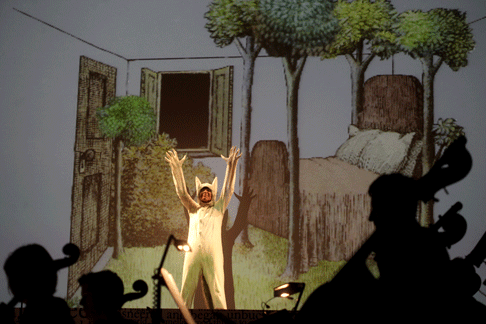 Claire Booth as Max in Where the Wild Things Are
Jenny’s transported by a cat (Christopher Lemmings) in a milk float to nurse a baby with a savage, demented glare. At least on the Sendak illustration. The Baby (Susana Andersson) is an adult with a piercing scream. How can Jenny placate this beast? Sendak’s images may be pretend Victorian, but these aren’t Victorian values. The Baby’s Mother (Claire Booth) tells Jenny to let a Lion (Graeme Broadbent) bring the Baby back to her, and so the story ends happily ever after. Or does it? Three surprise “endings” to whip up excitement. It’s perfectly in order to laugh and clap as we emerge from the fantasy of the story to the fantasy of the mock toy theatre proscenium. Has Jenny, and have we, found the Mother Goose World Theatre?
This Knussen double bill will be repeated at the Barbican Hall, London in November, with Netia Jones’s multimedia presentation. Don’t be put off if you can’t go with a child. Go with the Child in Yourself, and benefit even more. Netia Jones’s Before Life and After comes to Aldeburgh from 20 to 22nd June and moves to the Cheltenham Music Festival thereafter. This is a show built round Britten’s Winter Words, Finzi’s A Young Man’s Exhortation and Tippett’s Boyhood’s End. James Gilchrist sings. It’s a tour de force.
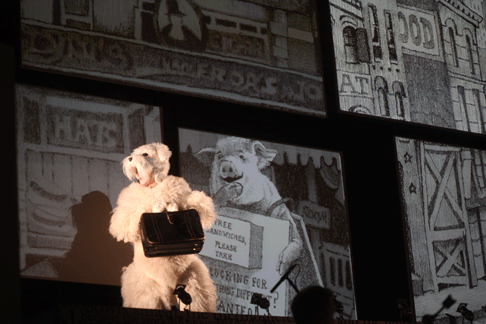 Lucy Schaufer as Jennie in Higgelty Piggelty Pop!
Oliver Knussen conducted the Scottish Chamber Orchestra the previous evening in a typically intricate puzzle of a programme. Charles Ives’s Washington’s Birthday, rather appropriate as Aldeburgh’s celebrating Knussen’s birthday this year. Diaphanous textures, exquisitely defined by this excellent orchestra. Very similar orchestration (harp and piano on concerto) to Alexander Goehr’s Marching to Carcassonne (2002 rev 2005) with Peter Serkin, with whom Knussen has been closely connected for many years. Serkin understands the Don Quixote spirit of the piece, where Knights march into battle but go round in circles, never reaching their goal. The harpist is Serkin’s Sancho Panza, the harp’s pedal held down so the strings play tautly, like a medieval stringed instrument. Goehr’s sense of humour, which Knussen has inherited. Surprise non-endings, as in Higgelty Piggelty Pop! Goehr was roundly applauded, and beamed.
Stravinsky’s Movements for piano and orchestra followed, and three movements from Alban Berg’s Lyric Suite, superbly played. We don’t hear the SCO nearly often enough in London (though there’s a lot about them on this site, as they are favourites). Then Geoffrey Norris appeared and presented Knussen with a Critics’ Circle award for Outstanding Musician. “But I didn’t finish the piece I was planning” said Knussen. It hardly matters. Quality is better than quantity, and there are many ways of being a true musician.
Anne Ozorio