![Albina Shagimuratova as The Queen of the Night [Photo by Cory Weaver courtesy of San Francisco Opera]](http://www.operatoday.com/Flute-05.gif)
15 Jun 2012
The Magic Flute in San Francisco
A feast for the eyes, a feast for the ears, a Flute from America’s heartland that goes directly to your heart.
English Touring Opera are delighted to announce a season of lyric monodramas to tour nationally from October to December. The season features music for solo singer and piano by Argento, Britten, Tippett and Shostakovich with a bold and inventive approach to making opera during social distancing.
This tenth of ten Live from London concerts was in fact a recorded live performance from California. It was no less enjoyable for that, and it was also uplifting to learn that this wasn’t in fact the ‘last’ LfL event that we will be able to enjoy, courtesy of VOCES8 and their fellow vocal ensembles (more below …).
Ever since Wigmore Hall announced their superb series of autumn concerts, all streamed live and available free of charge, I’d been looking forward to this song recital by Ian Bostridge and Imogen Cooper.
Although Stile Antico’s programme article for their Live from London recital introduced their selection from the many treasures of the English Renaissance in the context of the theological debates and upheavals of the Tudor and Elizabethan years, their performance was more evocative of private chamber music than of public liturgy.
Evidently, face masks don’t stifle appreciative “Bravo!”s. And, reducing audience numbers doesn’t lower the volume of such acclamations. For, the audience at Wigmore Hall gave soprano Elizabeth Llewellyn and pianist Simon Lepper a greatly deserved warm reception and hearty response following this lunchtime recital of late-Romantic song.
For this week’s Live from London vocal recital we moved from the home of VOCES8, St Anne and St Agnes in the City of London, to Kings Place, where The Sixteen - who have been associate artists at the venue for some time - presented a programme of music and words bound together by the theme of ‘reflection’.
'Such is your divine Disposation that both you excellently understand, and royally entertaine the Exercise of Musicke.’
‘And there was war in heaven: Michael and his angels fought against the dragon; and the dragon fought and his angels, And prevailed not; neither was their place found any more in heaven … that old serpent … Satan, which deceiveth the whole world: he was cast out into the earth, and his angels were cast out with him.’
There was never any doubt that the fifth of the twelve Met Stars Live in Concert broadcasts was going to be a palpably intense and vivid event, as well as a musically stunning and theatrically enervating experience.
‘Love’ was the theme for this Live from London performance by Apollo5. Given the complexity and diversity of that human emotion, and Apollo5’s reputation for versatility and diverse repertoire, ranging from Renaissance choral music to jazz, from contemporary classical works to popular song, it was no surprise that their programme spanned 500 years and several musical styles.
The Academy of St Martin in the Fields have titled their autumn series of eight concerts - which are taking place at 5pm and 7.30pm on two Saturdays each month at their home venue in Trafalgar Square, and being filmed for streaming the following Thursday - ‘re:connect’.
The London Symphony Orchestra opened their Autumn 2020 season with a homage to Oliver Knussen, who died at the age of 66 in July 2018. The programme traced a national musical lineage through the twentieth century, from Britten to Knussen, on to Mark-Anthony Turnage, and entwining the LSO and Rattle too.
With the Live from London digital vocal festival entering the second half of the series, the festival’s host, VOCES8, returned to their home at St Annes and St Agnes in the City of London to present a sequence of ‘Choral Dances’ - vocal music inspired by dance, embracing diverse genres from the Renaissance madrigal to swing jazz.
Just a few unison string wriggles from the opening of Mozart’s overture to Le nozze di Figaro are enough to make any opera-lover perch on the edge of their seat, in excited anticipation of the drama in music to come, so there could be no other curtain-raiser for this Gala Concert at the Royal Opera House, the latest instalment from ‘their House’ to ‘our houses’.
"Before the ending of the day, creator of all things, we pray that, with your accustomed mercy, you may watch over us."
The doors at The Metropolitan Opera will not open to live audiences until 2021 at the earliest, and the likelihood of normal operatic life resuming in cities around the world looks but a distant dream at present. But, while we may not be invited from our homes into the opera house for some time yet, with its free daily screenings of past productions and its pay-per-view Met Stars Live in Concert series, the Met continues to bring opera into our homes.
Music-making at this year’s Grange Festival Opera may have fallen silent in June and July, but the country house and extensive grounds of The Grange provided an ideal setting for a weekend of twelve specially conceived ‘promenade’ performances encompassing music and dance.
There’s a “slide of harmony” and “all the bones leave your body at that moment and you collapse to the floor, it’s so extraordinary.”
“Music for a while, shall all your cares beguile.”
The hum of bees rising from myriad scented blooms; gentle strains of birdsong; the cheerful chatter of picnickers beside a still lake; decorous thwacks of leather on willow; song and music floating through the warm evening air.
A feast for the eyes, a feast for the ears, a Flute from America’s heartland that goes directly to your heart.
Maybe it’s those three boy sopranos who impeccably deliver the words and tones of Mozart’s three spirits and in their innocence make the hopes of mankind so real.
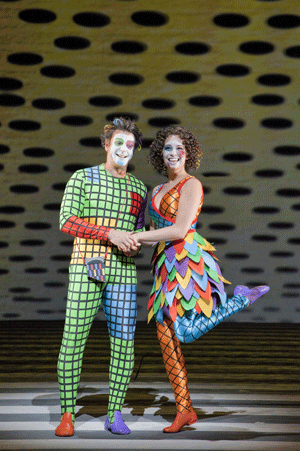 Nathan Gunn as Papageno and Nadine Sierra as Papagena
Maybe it’s the rhyming couplets of David Gockley’s new translation of the lyrics, and the rhythm and flow, and the internal and period rhymes of his dialogues that harmonize like square dance calls. It’s somewhere between cradle, pub and couch and makes you feel really good.
Certainly it’s the kaleidoscope of lines and dots and a thousand colors, maybe more that percolate across the proscenium canvas in always changing, never ending orders that make you feel that the good life will never end, and that, well, even if life may not always be that simple it keeps moving. Finally all those lines and all those dots will become a perfect circle!
This new Magic Flute is indeed a perfect circle, a masterpiece of conception and execution. There is even an illustrated book that engagingly documents the massive scope of a production process that traces the circle from idea to fact and makes artistic creation seem like a piece of cake.
Some of us like to think of San Francisco Opera as synonymous with Covent Garden and Vienna, like sharing productions with, uhm, La Scala (Attila for example) so it comes as a bit of a shock to realize that SFO is sharing productions with Omaha and Kansas City. In fact Japanese born artist Jun Kaneko, the creative force behind the sets and costumes of this production, makes his home in Omaha where he makes ceramics, conceives massive public art projects and designed Madama Butterfly for Opera Omaha.
San Francisco Opera has distinguished precedent for productions based on visual rather than theatrical art, like David Hockney’s Turandot, and even like Marc Chagall’s Magic Flute. And speaking of the Flute, South African artist William Kentridge created one for Brussels' Monnaie about a decade ago that set the benchmark pretty high.
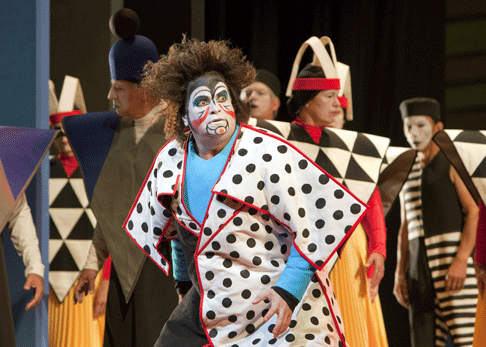 Greg Fedderly as Monostatos
But middle America has its own things to say these days, like Picasso’s French Riviera had its things to say a hundred years ago at the Opéra de Monte Carlo. Maybe it says most about the America that looks westward to Asia for so much of its persona that remains so hidden. Artist Kaneko who emigrated to the U.S. in 1961 creates an endless landscape, like the American Midwest, but in Asian lines and colors. He constructs a Chinese puppet dragon and draws costumes that seem made of glazed clay or painted porcelain. In fact we felt quite at home as all of this is so much a part of our national heritage. Come to think of it.
Within this visual realm stage director Harry Silverstein finds constant movements and antics to enliven Gockley’s earthy contemporary banter. Things are left pretty basic, the cosmic conflict between Sarastro and the Queen of the Night has the weight of a domestic spat. It is taken for granted that women need to be put in their place, not to mention that people of color exhibit libidos that are not philosophic and that love conquers all obstacles, like fire and water.
Casting was young and fun. Rather than attempt the more usual and appropriate jugendliche dramatic voices for Tamino and Pamina, San Francisco Opera cast light lyric tenor Alex Shrader and soubrette Heidi Stober. The fine singers brought youth and lightness and consummate charm to Mozart’s young lovers, plus they seemed the very embodiment of corporate promise. Baritone Nathan Gunn was Tamino’s cool sidekick Papageno, everyone’s good friend who isn’t going to make it out of the warehouse.
Russian dramatic coloratura Albina Shagimuratova with her threatening accent (even if slight — she is an alumna of the Houston Opera Studio) was the appropriately toned Queen of the Night. Like nearly always this role gets the biggest ovation because she has the highest notes, and of course the niftiest arias as well. Mlle. Shagimuratova well earned her ovation with extraordinarily clean delivery of her stratospheric notes. Iceland born bass Kristinn Sigmundsson used his Germanic accented English to add more imperative to righteousness though vocally he no longer has the equipment to embody such depth and authority.
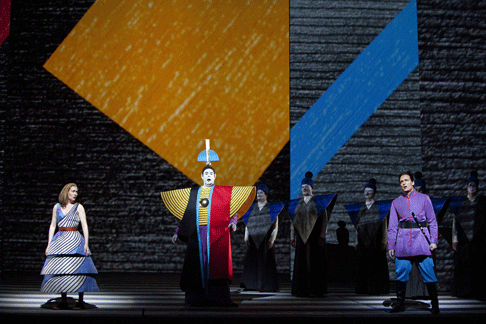 Heidi Stober as Pamina, Kristinn Sigmundsson as Sarastro and Alek Shrader as Tamino
Baritone Greg Fedderly made Monostatos absolutely delightfully unthreatening, because as we all now know libido is fun after all. Mr. Fedderly is in good voice. Melody Moore Lauren McNeese and Renée Tatum were First, Second and Third Ladies, lighter voiced than the usual specimens, appropriate to convey the Valley Girl syndrome they knowingly managed.
Not least were the Three Spirits, Etienne Julius Valdez, Joshua Reinier and John Walsh who have to have been the best Three Spirits that ever hit the earth.
Where was the music in all of this, you ask. Well, we were having so much fun that we almost didn’t notice it. But when we did it seemed to support the words with grace and ease and the San Francisco Opera Orchestra did play with lovely sterling tone. British Conductor Rory Macdonald felt tempos that seemed quite slow, but they were tempos that allowed the words to sail across the pit and amuse us. Mozart’s ultimate symphonic thrust, the sublime musical process that propels Tamino and Pamina to an advanced humanity sadly did not happen.
Michael Milenski