![Adam Plachetka as Count Almaviva and Hélène Guilmette as Susanna [Photo courtesy of Opéra Orchestra National Montpellier]](http://www.operatoday.com/_MG10323a.gif)
02 Jul 2012
The Marriage of Figaro in Montpellier
Perfection. A seldom used term in critiques of opera performances. There it was, almost (and will be, maybe).
English Touring Opera are delighted to announce a season of lyric monodramas to tour nationally from October to December. The season features music for solo singer and piano by Argento, Britten, Tippett and Shostakovich with a bold and inventive approach to making opera during social distancing.
This tenth of ten Live from London concerts was in fact a recorded live performance from California. It was no less enjoyable for that, and it was also uplifting to learn that this wasn’t in fact the ‘last’ LfL event that we will be able to enjoy, courtesy of VOCES8 and their fellow vocal ensembles (more below …).
Ever since Wigmore Hall announced their superb series of autumn concerts, all streamed live and available free of charge, I’d been looking forward to this song recital by Ian Bostridge and Imogen Cooper.
Although Stile Antico’s programme article for their Live from London recital introduced their selection from the many treasures of the English Renaissance in the context of the theological debates and upheavals of the Tudor and Elizabethan years, their performance was more evocative of private chamber music than of public liturgy.
Evidently, face masks don’t stifle appreciative “Bravo!”s. And, reducing audience numbers doesn’t lower the volume of such acclamations. For, the audience at Wigmore Hall gave soprano Elizabeth Llewellyn and pianist Simon Lepper a greatly deserved warm reception and hearty response following this lunchtime recital of late-Romantic song.
For this week’s Live from London vocal recital we moved from the home of VOCES8, St Anne and St Agnes in the City of London, to Kings Place, where The Sixteen - who have been associate artists at the venue for some time - presented a programme of music and words bound together by the theme of ‘reflection’.
'Such is your divine Disposation that both you excellently understand, and royally entertaine the Exercise of Musicke.’
‘And there was war in heaven: Michael and his angels fought against the dragon; and the dragon fought and his angels, And prevailed not; neither was their place found any more in heaven … that old serpent … Satan, which deceiveth the whole world: he was cast out into the earth, and his angels were cast out with him.’
There was never any doubt that the fifth of the twelve Met Stars Live in Concert broadcasts was going to be a palpably intense and vivid event, as well as a musically stunning and theatrically enervating experience.
‘Love’ was the theme for this Live from London performance by Apollo5. Given the complexity and diversity of that human emotion, and Apollo5’s reputation for versatility and diverse repertoire, ranging from Renaissance choral music to jazz, from contemporary classical works to popular song, it was no surprise that their programme spanned 500 years and several musical styles.
The Academy of St Martin in the Fields have titled their autumn series of eight concerts - which are taking place at 5pm and 7.30pm on two Saturdays each month at their home venue in Trafalgar Square, and being filmed for streaming the following Thursday - ‘re:connect’.
The London Symphony Orchestra opened their Autumn 2020 season with a homage to Oliver Knussen, who died at the age of 66 in July 2018. The programme traced a national musical lineage through the twentieth century, from Britten to Knussen, on to Mark-Anthony Turnage, and entwining the LSO and Rattle too.
With the Live from London digital vocal festival entering the second half of the series, the festival’s host, VOCES8, returned to their home at St Annes and St Agnes in the City of London to present a sequence of ‘Choral Dances’ - vocal music inspired by dance, embracing diverse genres from the Renaissance madrigal to swing jazz.
Just a few unison string wriggles from the opening of Mozart’s overture to Le nozze di Figaro are enough to make any opera-lover perch on the edge of their seat, in excited anticipation of the drama in music to come, so there could be no other curtain-raiser for this Gala Concert at the Royal Opera House, the latest instalment from ‘their House’ to ‘our houses’.
"Before the ending of the day, creator of all things, we pray that, with your accustomed mercy, you may watch over us."
The doors at The Metropolitan Opera will not open to live audiences until 2021 at the earliest, and the likelihood of normal operatic life resuming in cities around the world looks but a distant dream at present. But, while we may not be invited from our homes into the opera house for some time yet, with its free daily screenings of past productions and its pay-per-view Met Stars Live in Concert series, the Met continues to bring opera into our homes.
Music-making at this year’s Grange Festival Opera may have fallen silent in June and July, but the country house and extensive grounds of The Grange provided an ideal setting for a weekend of twelve specially conceived ‘promenade’ performances encompassing music and dance.
There’s a “slide of harmony” and “all the bones leave your body at that moment and you collapse to the floor, it’s so extraordinary.”
“Music for a while, shall all your cares beguile.”
The hum of bees rising from myriad scented blooms; gentle strains of birdsong; the cheerful chatter of picnickers beside a still lake; decorous thwacks of leather on willow; song and music floating through the warm evening air.
Perfection. A seldom used term in critiques of opera performances. There it was, almost (and will be, maybe).
Haute couture designer Jean Paul Gaultier created costumes for Mozart’s masterpiece in this new production of Le Nozze di Figaro at the Opéra National de Montpellier with set design and stage direction by Jean-Paul Scarpita. The most theatrical among haute couture stars Gaultier is uniquely suited to Mozart comedy, sharing with the venerated composer both sharp wit and a preoccupation and fascination for women.
Gaultier had a particular fascination for his grandmother’s underclothes, structural corsets above all, and this preoccupation with structure permeates his oeuvre (currently on exposition at the De Young Museum in San Francisco, through August 19). In Montpellier he literally exposed the understructure of late 18th century couture in visible linear sculptures that resonated wittily with Mozartian musical structures.
Like all haute couture that of Gaultier is elegant and luxurious. In Montpellier (France’s most elegant city) Mozart too became haute couture of rarefied elegance and luxury. The reduced Orchestra National de Montpellier was in splendid form responding to Austrian conductor Sascha Goetzel’s delicate and obsessive shaping of the multiple instrumental voices that sang out in flights of studied splendor. Mo. Goetzel evoked a multitude of unusual colors and musical shapes by exploiting the sharper sounds we associate with early music rendered by the virtuoso forces of this exceptionally fine modern French orchestra.
Now let us talk about true perfection (and the suspicion that you had to fit the clothes to get the role). Czech baritone Adam Plachetka was the epitome of the libidinous Almaviva, in a costume masterpiece that resonated with the darkness of a Don Juan figure. Mr. Plachetka towered as the male, thirty-ish libido in full force, his voice with a sharp, maybe sadistic edge, and power, know-how and vulnerability. Svelte blond Italian soprano Erkia Grimaldi countered with a precociously full lyric thirty-ish Rosina and an astounding vocal technique (the reprise of Dove sono sung in a sleepy pianissimo). When not the sensuous woman in a form-fitting white early Hollywood gown lying on the floor or petting in a corner with Cherubino she donned a towering white wig-like construction to become the Countess.
Cherubino, young Israeli soprano Rachel Frenkel entered in white underclothes eschewing all trouser affectation. She was soon dressed by Rosina and Susanna to be Cupid himself as he remained for the rest of the opera. This Cherubino sung in an unusually lyric fashion was an ephemeral blue presence. Bartolo, Italian basso Antonio Abete, and Marcellina, svelte, not-at-all tall French mezzo Virginie Pochon were dressed in brilliant crimsons and were colorful rather than buffo objects, as was the brilliant yellow Basilio of French tenor Loîc Félix.
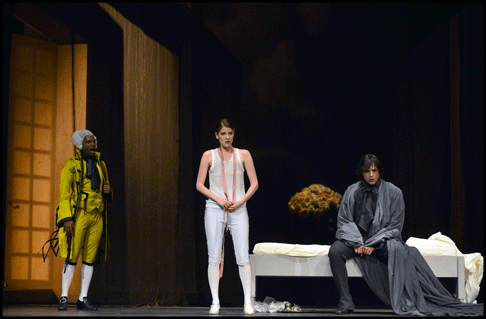 Loïc Félix as Basilio, Rachel Frenkel as Cherubino and Adam Plachetka as Count Almaviva
Both Figaro and Susanna were light on their feet, German baritone Konstantin Wolff effecting a few very graceful full body falls (not to ignore a spectacular body roll over the fourth act bench by Almavia himself). Mr. Wolff was in black leather pants and white shirt with criss crossing details that hinted Harlequin. An exquisite actor and fine singer he created a Figaro of genuine, even moving innocence, assuming finally the fetal position next to Marcellina during her fourth act aria. Québécoise soprano Hélène Guilmette, Susanna, carried an exposed traverse bustle under construction on her hips for most of the opera. The opera’s catalyst, its constructive and destructive forces she delivered her Deh, vieni alla fenestra with consummate innocence, its words emerging with such vocal naturalness that it seemed nearly spoken.
Designer and stage director Scarpita offered a vaguely detailed architectural space of neutral color in which the vividly costumed actors assumed high relief. There were very few props — an abstracted Susanna/Figaro bed subsequently also served as the chair for the first act trio (though the only idea of a bed in the Countess’ boudoir was the Countess lying on the floor). There was no window for Cherubino’s escape (he ran off stage right), and there was no shrubbery to hide behind in the fourth act. This minimalism was strikingly elegant, and carried into Mr. Scarpita’s story telling by his omission of most gestural detail, streamlining the action into fleet, sometimes abstractly narrative lines.
There were some real problems in the performance on June 26. Conductor Goetzel concentrated his attention on his instrumental voices, the stage voices left to fend for themselves. But sometimes these brilliant young artists missed the dramatic and musical confidence to be on their own, and, well, maybe opera does need an opera conductor after all. At the worst moments, and there were many, the pit and stage seemed absolutely unconnected (at best, in the fourth act, Mozart was more magical than ever).
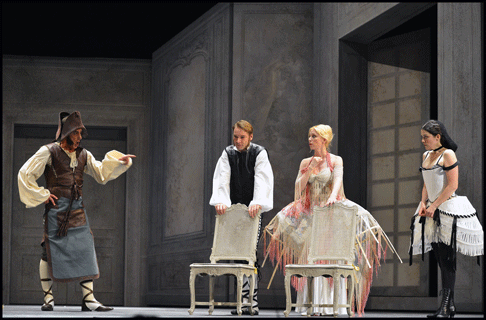 Peter Longauer as Antonio, Konstantin Wolff as Figaro, Erika Grimaldi as Countess Almaviva and Hélène Guilmette as Susanna
The brilliance of the costume design and the refinement of the staging seemed to overwhelm the simple humanity of the repertoire’s most succinctly human opera.
It could be that everyone’s game was a bit off that evening. The performance was postponed for 30 minutes so that the chorus, orchestra and stage hands could make the audience aware of their dissatisfaction with Jean-Paul Scarpita as general director of the Opéra National de Montpellier. Among the complaints was that Mr. Scarpita had banished the chorus to the pit for this production because he did not want “fat cows” (des vaches grasses they said he said) on the stage, replacing them with the lithe bodies of supernumeraries who presumably fit more suitably into haute couture.
Such artistic considerations would have been more commendable had Mr. Scarpita used a corps de ballet (even better bodies than his supernumeraries) and a choreographer for his servants and peasants. These scenes were regretful, clumsy moments.
There are two more performances as part of the Montpellier Radio France Festival, July 14 and 15. It is quite possible that stars may align and forces may converge to achieve the perfection we imagined on June 26.
Michael Milenski