Recently in Performances
English Touring Opera are delighted to announce a season of lyric monodramas to tour nationally from October to December. The season features music for solo singer and piano by Argento, Britten, Tippett and Shostakovich with a bold and inventive approach to making opera during social distancing.
This tenth of ten Live from London concerts was in fact a recorded live performance from California. It was no less enjoyable for that, and it was also uplifting to learn that this wasn’t in fact the ‘last’ LfL event that we will be able to enjoy, courtesy of VOCES8 and their fellow vocal ensembles (more below …).
Ever since Wigmore Hall announced their superb series of autumn concerts, all streamed live and available free of charge, I’d been looking forward to this song recital by Ian Bostridge and Imogen Cooper.
Although Stile Antico’s programme article for their Live from London recital introduced their selection from the many treasures of the English Renaissance in the context of the theological debates and upheavals of the Tudor and Elizabethan years, their performance was more evocative of private chamber music than of public liturgy.
Evidently, face masks don’t stifle appreciative “Bravo!”s. And, reducing audience numbers doesn’t lower the volume of such acclamations. For, the audience at Wigmore Hall gave soprano Elizabeth Llewellyn and pianist Simon Lepper a greatly deserved warm reception and hearty response following this lunchtime recital of late-Romantic song.
For this week’s Live from London vocal recital we moved from the home of VOCES8, St Anne and St Agnes in the City of London, to Kings Place, where The Sixteen - who have been associate artists at the venue for some time - presented a programme of music and words bound together by the theme of ‘reflection’.
'Such is your divine Disposation that both you excellently understand, and royally entertaine the Exercise of Musicke.’
‘And there was war in heaven: Michael and his angels fought against the dragon; and the dragon fought and his angels, And prevailed not; neither was their place found any more in heaven … that old serpent … Satan, which deceiveth the whole world: he was cast out into the earth, and his angels were cast out with him.’
There was never any doubt that the fifth of the twelve Met Stars Live in Concert broadcasts was going to be a palpably intense and vivid event, as well as a musically stunning and theatrically enervating experience.
‘Love’ was the theme for this Live from London performance by Apollo5. Given the complexity and diversity of that human emotion, and Apollo5’s reputation for versatility and diverse repertoire, ranging from Renaissance choral music to jazz, from contemporary classical works to popular song, it was no surprise that their programme spanned 500 years and several musical styles.
The Academy of St Martin in the Fields have titled their autumn series of eight concerts - which are taking place at 5pm and 7.30pm on two Saturdays each month at their home venue in Trafalgar Square, and being filmed for streaming the following Thursday - ‘re:connect’.
The London Symphony Orchestra opened their Autumn 2020 season with a homage to Oliver Knussen, who died at the age of 66 in July 2018. The programme traced a national musical lineage through the twentieth century, from Britten to Knussen, on to Mark-Anthony Turnage, and entwining the LSO and Rattle too.
With the Live from London digital vocal festival entering the second half of the series, the festival’s host, VOCES8, returned to their home at St Annes and St Agnes in the City of London to present a sequence of ‘Choral Dances’ - vocal music inspired by dance, embracing diverse genres from the Renaissance madrigal to swing jazz.
Just a few unison string wriggles from the opening of Mozart’s overture to Le nozze di Figaro are enough to make any opera-lover perch on the edge of their seat, in excited anticipation of the drama in music to come, so there could be no other curtain-raiser for this Gala Concert at the Royal Opera House, the latest instalment from ‘their House’ to ‘our houses’.
"Before the ending of the day, creator of all things, we pray that, with your accustomed mercy, you may watch over us."
The doors at The Metropolitan Opera will not open to live audiences until 2021 at the earliest, and the likelihood of normal operatic life resuming in cities around the world looks but a distant dream at present. But, while we may not be invited from our homes into the opera house for some time yet, with its free daily screenings of past productions and its pay-per-view Met Stars Live in Concert series, the Met continues to bring opera into our homes.
Music-making at this year’s Grange Festival Opera may have fallen silent in June and July, but the country house and extensive grounds of The Grange provided an ideal setting for a weekend of twelve specially conceived ‘promenade’ performances encompassing music and dance.
There’s a “slide of harmony” and “all the bones leave your body at that moment and you collapse to the floor, it’s so extraordinary.”
“Music for a while, shall all your cares beguile.”
The hum of bees rising from myriad scented blooms; gentle strains of birdsong; the cheerful chatter of picnickers beside a still lake; decorous thwacks of leather on willow; song and music floating through the warm evening air.
Performances
![Piotr Beczala as Rodolfo and Anna Netrebko as Mimi [Photo © Silvia Lelli courtesy of Salzburger Festival]](http://www.operatoday.com/hires-28Jul2012__Silvia_Lel.gif)
28 Aug 2012
La bohème at the Salzburg Festival
It is difficult to speak with excessive enthusiasm of the programming of a Salzburg Festival that included both Carmen and La bohème, though it would subsequently be redeemed in part by a staging of Die Soldaten.
That said, La bohème proved more successful in almost every way than the relatively disappointing Carmen seen earlier in the week.
Above all, this was a triumph — perhaps predictable, but none the less worth of mention for that — for Daniele Gatti and the Vienna Philharmonic. This was the first time during this year’s Festival in which I had heard the VPO on top form — though it would not be the last. The comparison may be odious but it made me realise quite what had been missing in the Welsh National Opera performance I had heard in June. Wagnerisms abound, of course, but it takes a great conductor truly to relish them like this and to transmute them into something quite personal to Puccini. Harmony and orchestration are really what is most interesting about the composer’s work, however naggingly memorable some of his melodies might be. Gatti presided over an orchestral performance comparable to his Salzburg Elektra a couple of years ago, the sheer depth of tone resounding throughout the Grosses Festspielhaus as impressive as the shimmering, translucent beauties of Puccini’s more modernistic passages. Pacing was irreproachable, permitting the story and, most important, the score to unfold as they would, rather than imposing an irrelevant external framework upon them; unity was thereby enhanced rather than detracted from.
The cast was first-rate too. Piotr Beczala has often sounded too Italianate, indeed too Puccini-like, in much of the repertoire in which I have heard him; this is clearly where he is most at home. The odd moment at which I thought less might have been more aside, there was nothing for which to reproach him here and much to laud. If ultimately Rodolfo is hardly the most interesting of roles, Beczala did what he could with it, dynamic range and shading especially noteworthy. Likewise, unsurprisingly, for Anna Netrebko’s Mimi, a star turn if ever there were one. Netrebko truly inhabited the role, both more generally and with particular reference to Damiano Michieletto’s production too. Many of the more celebrated opera singers in this repertoire might have disdained a production that failed vulgarly to flatter them ; Netrebko relished the contemporary setting and the emphasis upon Mimi as disadvantaged. Her voice was in excellent repair, soaring gloriously above the equally glorious orchestra. I had not come across Nino Machaidze before, but her sexy, intelligent Musetta made me hope that I shall do so again soon. Massimo Cavalletti’s Marcello put not a foot wrong; nor indeed did any member of the ‘supporting’ cast. Choral singing was of the highest standard throughout — an often overlooked aspect, crucial to a successful performance of this opera.
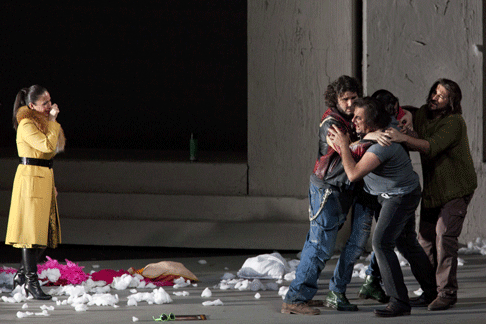 Nino Machaidze as Musetta, Massimo Cavalletti as Marcello, Marcello Giordani as Rodolfo, Alessio Arduini as Schaunard and Carlo Colombara as Colline
In a sense, there was nothing especially radical about Michieletto’s production, though given what most houses present for La bohème, one could say that even the very fact of moving the action to the twenty-first century shows a thirst for adventure. (In this of all operas, there is surely an imperative, albeit incessantly flouted, to rid a staging of every last ounce of sentimentality.) Costumes alone, designed with flair by Carla Teti, would doubtless have had self-appointed ‘traditionalists’ spluttering: a good in itself, though hardly enough. Designs were splendid: spectacular in a good rather than vulgar-Zeffirelli sense. The Paris street and metro map that unfolded from time to time was really rather fun. Act Three’s sense of an urban, frozen wasteland, replete with obligatory burger van, was chilling, in more than one sense. Yet the production had subtler virtues too, foremost amongst which should be accounted the space it permitted one to question the work and assumptions one might hold about it. Whilst I cannot (yet?) bring myself quite to accept the metatheatrical claims made for the opera by some, however much more interesting they might make it, there was to be discovered here, even if this were not the director’s intention, an indictment of the selfishness of youth. Where Michieletto spoke of celebration, it was equally possible, and indeed in my case more so, to recognise from experience the shallow posing and disingenuousness of student-style declarations of love, purpose, and principle. Mimi became a more interesting victim, or perhaps better, the circumstances that brought about her fate became sharpened, without turning the opera into something that it was not. I wonder how this will be received in Shanghai, with whose Grand Theatre this is a co-production.
Mark Berry