In
2010, it registered as the worst staging I had ever seen: a fiercely
contested category, when one considers that it
includes Francesca Zambello’s mindless farrago across Covent Garden at
the Royal Opera — now, may the Commendatore be thanked, consigned to the
flames of Hell. (Kasper Holten, Director of Opera, is said to have insisted,
having viewed it in horror, that the sets be destroyed, lest it never return.)
There were grounds for the odd glimmer of hope; Norris was said to have revised
the production in the face of its well-nigh universal mauling from critics and
other audience members alike. Yet the marketing did little to allay one’s
fears, especially when reading the bizarre description on ENO’s website of
a ‘riveting romp [that] follows the last twenty-four hours in the life of
the legendary Lothario’. Something really ought to be done about whomever
is involved in publicising productions; for, irrespective of the quality of
what we see on stage, they more often than not end up sounding merely
ludicrous: in this case, more Carry On Seville than one of the
greatest musical dramas in the repertory. Even if one were willing thus to
disparage Da Ponte — and I am certainly not — does Mozart’s
re-telling of the Fall in any sense characterised by the phrase ‘riveting
romp’?
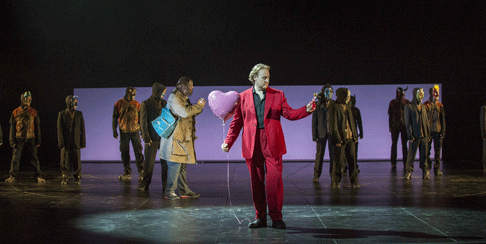 Iain Patterson as Don Giovanni and Darren Jeffery as Leporello
How, then, had Norris’s revisions turned out? Early on, I felt there
was a degree of improvement. The weird obsession with electricity —
certainly not of the musical variety — had gone, but not to be replaced by
anything else. Certain but only certain of the most bizarre impositions had
gone, or been weeded out, yet not always thoroughly enough. For instance, there
was a strange remnant of the already strange moment when, towards the end of
the Act Two sextet, people began to strip off, when Don Ottavio — an
‘uptight fiancé’, according to the company website —
carefully removed his shoes and socks. No one reacted, and a few minutes later
— I think, during Donna Anna’a ‘Non mi dir’ — he put
them back on again. Otherwise, the hideous sets and other designs remain as
they were, though one might claim a degree of contemporary
‘relevance’ in that Don Giovanni’s dated ‘leisure
wear’ now brings with it unfortunate resonances of the late Jimmy Saville.
Alas, nothing is made of the similarity. The flat designed as if by a teenage
girl, full of hearts and pink balloons, remains; as does the building that
resembles a community centre. Leporello still appears to be a tramp. There are
no discernible attempts to reflect Da Ponte’s, let alone Mozart’s,
careful societal distinctions and there is no sign whatsoever that anyone has
understood that Don Giovanni is a religious drama or it is nothing. Norris has
clearly opted for ‘nothing’.
There is, believe it or not, a villain perhaps more pernicious still. Jeremy
Sams’s dreadful, attention-seeking English translation does its best to
live up to the ‘riveting romp’ description. A few, very loud, members
of the audience did their best to disrupt what little ‘action’ there
was by laughing uproariously after every single line: the very instance of a
rhyme is intrinsically hilarious to some, it would seem. A catalogue of
Sams’s sins — sin has gone by the board in the drama itself —
would take far longer than Leporello’s aria. But I no more understand why
the countries in that aria should be transformed into months — ‘ma in
Ispagna’ becomes ‘March and April’ — than I do why Zerlina
was singing about owning a pharmacy in ‘Vedrai carino,’ or whatever
it became in this ‘version’. It is barely a translation, but nor is
it any sense a reimagination along the brilliant lines of the recent gay
Don Giovanni at Heaven; it merely caters towards those with no
more elevated thoughts than Zerlina going down on her knees, about which we are
informed time and time again, lest anyone should have missed such
‘humour’. The lack of respect accorded to Da Ponte borders upon the
sickening.
Edward Gardner led a watered-down Harnoncourt-style performance. At first it
might even have seemed exciting, but it soon became wearing, mistaking the
aggressively loud for the dramatically potent. Where was the repose, let alone
the well-nigh unbearable beauty, in Mozart’s score? A peculiar
‘version’ was employed, in that Elvira retained both her arias,
whereas Ottavio only had his in the first act. On stage, Prague remains
preferable every time, despite the painful musical losses its adoption entails;
sadly, few conductors seem to bother.
Iain Paterson remains bizarrely miscast in the title role, entirely bereft
of charisma. Darren Jeffery’s Leporello was bluff and dull in tone. (How
one longed for Erwin Schrott — in either role, or both!) Katherine
Broderick was too often shrill and squally as Donna Anna, and her stage
presence was less then convincing, shuffling on and off, without so much as a
hint of seria imperiousness. Her ‘uptight fiancé’ was sung
well enough, by Ben Johnson, though to my ears, his instrument is too much of
an ‘English tenor’ to sound at home in Mozart. Sarah Redgwick’s
Elvira was probably the best of the bunch, perhaps alongside Matthew
Best’s Commendatore, but anyone would have struggled in this production,
with these words. Elvira more or less managed to seem a credible character,
thanks to Redgwick’s impressive acting skills, quite an achievement in the
circumstances. Sarah Tynan made little impression either way as Zerlina, though
she had far more of a voice than the dry-, even feeble-toned Masetto of John
Molloy: surely another instance of miscasting.
ENO had a viscerally exciting production, genuinely daring, almost worthy of
Giovanni’s kinetic energy. It seems quite incomprehensible why anyone
should have elected to ditch the coke-fuelled orgiastic extravagance of Calixto
Bieito — now there is a properly Catholic sensibility — for Rufus
Norris. whose lukewarm response at the curtain calls was more genuinely amusing
than anything we had seen or heard on stage. Maybe the contraceptive imagery
was judicious after all.
Mark Berry
Cast and Production:
Don Giovanni: Iain Paterson; Leporello: Darren Jeffery; Donna Anna:
Katherine Broderick; Don Ottavio: Ben Johnson; Donna Elvira: Sarah Redwick;
Commendatore: Matthew Best; Zerlina: Sarah Tynan; Masetto: John Molloy.
Director: Rufus Norris; Set designs: Ian MacNeil; Costumes: Nicky Gillibrand;
Lighting: Paul Anderson; Movement: Jonathan Lunn; Projections: Finn Ross.
Orchestra and Chorus of the English National Opera (chorus master: Martin
Fitzpatrick)/Edward Gardner (conductor). The Coliseum, London, Wednesday 17
October
![Iain Patterson as Don Giovanni and Sarah Redgwick as Donna Elvira [Photo by Richard Hubert Smith courtesy of English National Opera]](http://www.operatoday.com/Don-Giovanni01.gif)