Subscribe to
Opera Today

Receive articles and news via RSS feeds or email subscription.


twitter_logo[1].gif


UCP_9780226043425.gif

Recently in Performances

Gareth John, Wigmore Hall

Baritone Gareth John is rapidly accumulating a war-chest of honours. Winner of the 2013 Kathleen Ferrier Award, he recently won the Royal Academy of Music Patrons’ Award and was presented the Silver Medal by the Worshipful Company of Musicians.

La bohème at ENO

This second revival of Jonathan Miller’s La bohème was the first time I had caught the production.

Rolando Villazón: Verdi (International Opera Stars Series 2013)

It’s Verdi’s bicentenary year and Rolando Villazón has two new CDs to plug — titled somewhat confusingly, ‘Villazón: Verdi’ and ‘Villazón’s Verdi’, the latter a ‘personal selection’ of favourite numbers performed by stars of the past and present.

Brahms Third in San Francisco

Nicola Luisotti and the San Francisco Opera Orchestra climbed out of the War Memorial pit, braved the wind whipped bay and held spellbound an audience at Cal Performances’ Zellerbach Auditorium at UC Berkeley.

Glyndebourne: Ariadne auf Naxos

Utterly mad but absolutely right — Richard Strauss’s Ariadne auf Naxos started the Glyndebourne 2013 season with an explosion. Strauss could hardly have made his intentions more clear. Ariadne auf Naxos is not “about” Greek myth so much as a satire on art and the way art is made.

Wozzeck at ENO

“Man is an abyss. It makes one dizzy to look into it.” So utters Georg Büchner’s Woyzeck, repeating what was also a recurring motif in the playwright’s own letters.

Mulhouse: Rare Britten Well Done

National Opera Company of the Rhine has marked this year’s Benjamin Britten celebration with a remarkably compelling, often gripping new production of the seldom-seen Owen Wingrave.

Frankfurt's Intriguing Idomeneo

Once upon a time, Frankfurt Opera had the baddest ass reputation in Germany as “the” cutting edge producer of must-see opera.

Rigoletto at Lyric Opera of Chicago

Productions of Giuseppe Verdi’s Rigoletto can serve as a vehicle for individual singers to make a strong impression and become afterward associated with specific roles in the opera.

Britten Sinfonia with Ian Bostridge

Just in case we were not aware that the evening’s programme was ‘themed’, the Britten Sinfonia designed a visual accompaniment to their musical exploration of night, sleep and dreams.

Aida, Manitoba Opera

Poor Aida! She never seems to have anything go her way.

Superlative singing: Don Carlo, Royal Opera House

Is it possible to upstage Jonas Kaufmann? Kaufmann was brilliant in this Verdi Don Carlo at the Royal Opera House, London, but the rest of the cast was so good that he was but first among equals. Don Carlo is a vehicle for stars, but this time the stars were everyone on stage and in the pit. Even the solo arias, glorious as they are, grow organically out of perfect ensemble. This was a performance that brought out the true beauty of Verdi's music.

Sarah Connolly: French Song at Wigmore Hall

The big names were absent: Duparc, D’Indy, Debussy, Ravel … and while Fauré, Chausson, Roussel and several members of Les Six put in an appearance, in less than familiar guises, this survey of French song of the early 20th century and interwar years deliberately took us on a journey through infrequently travelled terrain.

Rare restoration: Handel’s Esther 1720

Composed between 1718 and 1720, Handel’s Esther is sometimes described as the ‘first English Oratorio’, but is in fact a hybrid form, mixing elements of oratorio, masque, pastoral and opera.

The Damnation of Faust, London

Hector Berlioz's légende dramatique, La Damnation de Faust, exists somewhere between cantata and opera. Berlioz's flexible attitude to dramatic form made the piece unworkable on the stages of early 19th century Paris and his music is so vivid that you wonder whether the piece needs staging at all.

Elizabeth Connell Memorial Concert, St John's Smith Square

St. John’s Smith Square was the site of Elizabeth Connell’s final London concert, intended as a farewell to London on her moving to Australia. It was rendered ultimately final by her unexpected death.

Aida with all the Trimmings, Even a Blue Silk Elephant!

With the building of the Suez Canal, Egypt became more interesting to Western Europeans. Khedive Ismail Pasha wanted a hymn by Verdi for the opening of a new opera house in Cairo, but the composer said he did not write occasional pieces.

Die Zauberflöte, Royal Opera

Back for its fourth revival, David McVicar’s 2003 production of Mozart’s Die Zauberflöte has much charm, beauty and artistry.

The Marriage of Figaro Ends Season at Arizona Opera

Wolfgang Amadeus Mozart's opera The Marriage of Figaro has a libretto by Lorenzo daPonte based on the French play La folle journée, ou le Mariage de Figaro (The Crazy Day or the Marriage of Figaro) by Pierre Caron de Beaumarchais (1732-1799).

Baden’s Flute Goes Barefoot in the Park

For its world class Easter Festival, Baden-Baden mounted a Die Zauberflöte that owed more to the grey penitential doldrums of Lent than to the unbridled jubilance of re-birth.

OPERA TODAY ARCHIVES »

Performances

Joyce DiDonato as Romeo and Nicole Cabell as Giulietta [Photo by Cory Weaver courtesy of San Francisco Opera]
09 Oct 2012

I Capuleti e i Montecchi in San Francisco

Give me good verses, I’ll give you good music, said Bellini to his librettist Felice Romani. Give me a good director and I’ll give you good opera surely thought San Francisco Opera general director David Gockley.

I Capuleti e i Montecchi in San Francisco

A review by Michael Milenski

Above: Joyce DiDonato as Romeo and Nicole Cabell as Giulietta

Photos by Cory Weaver courtesy of San Francisco Opera


Not just good opera but great opera took stage at the last night in San Francisco, adding new found artistic luster to the brutal conflicts of the Capulets and the Montagues. The pretended death of Giulietta was exquisitely suffered both by Bellini’s Romeo and his rival Tebaldo, and ultimately emotional pain of monumental musical intensity and ineffable sweetness melted into the tragic release of the love-death. Near legendary mezzo Joyce DiDonato hand in hand with soprano Nicole Cabell walked triumphantly into the beyond.

It was real, this beyond. It was in fact the proscenium frame, at once the Romantic love-death itself and, Mme. DiDonato and Mlle. Cabell left standing in front of the fallen curtain, it was opera. The enraptured audience leaped to its feet and roared.

Giulietta, tragically denied true love (this is pristine Romanticism), had literally climbed the wall. Standing on a sink, the lone symbol of a physical world, balancing herself eerily on one foot, she reached up towards an unattainable suspended image of entwined lovers and floated vocal lines that soared and fell with suspended emotion in what seemed a musical eternity (uhm, this is high, very high Romanticism).

These scenes, the tragic ones, occurred in a space with a mirrored floor negating all sense of physical gravity. There was no reference to defined space save one vertical line that created a sort of metaphysical reality, a line that was always the same and never the same, clothed in an infinity of changing color, the ebb and flow of love. The stage, drawn by French designer Vincent Lemaire and lighted by Italian designer Guido Levi, provided an abstract space for love, may we say, with the Romantics, the most abstract world of them all.

In these scenes director French Vincent Broussard used an almost framed painting, though with vaguely defined, mostly abstract images that suspended the search for specific reference. However in the larger scenes with public meaning he completed the proscenium frame across the bottom of the stage making it the fully formed image of a physical painting. It became a real space with a background of infinitely ascending steps on which brilliantly colored and lighted courtiers spread themselves, and later the elaborately clothed, now disheveled women descended, remnants of the unseen defining battle. Mr. Broussard landed squarely on a descriptively minimalist language that could elevate this simple story to Bellini’s metaphysical world of music.
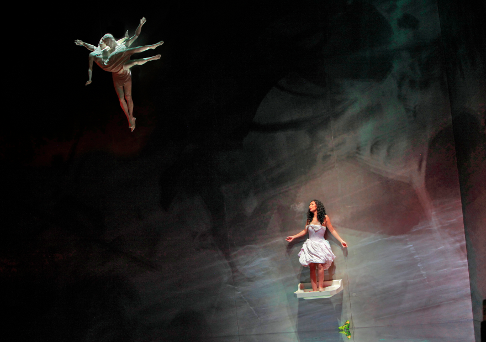
09--Capuleti.pngNicole Cabell as Giulietta

The most astonishing scene was Giulietta’s passage in her underclothes across the sharp and treacherous lower edge of this worldly frame as she sought to resolve her plight, and did so finally with the help of Lorenzo, the family physician (Felice Romani was far more practical that Shakespeare who complicated matters by appointing a priest to this task). Or was it Romeo’s address to the sleeping Giulietta, now no longer laid out on her wedding dress but frozen upright facing Joyce DiDonato who was fully possessed vocally and physically by Bellini’s music.

There was no separation between the pit and the stage, the changing stage pictures themselves almost seemed the black printed notes of Bellini’s score made into extraordinarily beautiful sounds by Italian conductor Riccardo Frizza and the San Francisco Opera Orchestra. This maestro achieved the exquisitely delicate and felt Romanticism that makes Bellini the epitome of such difficult, elusive and rare operatic art.

It was a nearly phenomenal achievement in bel canto. Like all great opera it was a collaboration of huge forces. The fine Albanian tenor Saimir Pirgu gained vocal security during the evening to viably take on the incomparable Joyce DiDonato in their confrontation. The brilliant Nicole Cabell as Giulietta in her defining long black wig found an unerring vocal balance that did not falter in confronting the extraordinary directorial demands of this role.
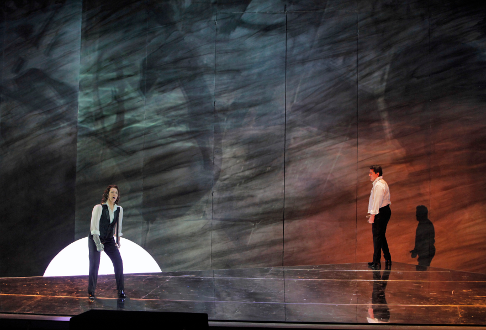
21--Capuleti.pngJoyce DiDonato as Romeo and Saimir Pirgu as Tebaldo

The high-style costumes designed by famed French couturier Christian Lacroix forcefully etched heightened supernatural character with a sophisticated sense of once-upon-a-time. The actual set became a canvas on which lighting designer Levi detailed mood after mood, choosing momentary detail that rose to the emotional surface in the shadowy supra-rational state of consciousness, never permitting a face or voice to destroy the complex metaphysical tonalities of the production.

It was an enthralling evening at the War Memorial Opera House, the ovations were enormous. And, yes, metteur en scène Vincent Broussard braved exuberant booing at his curtain call. Go figure.

Michael Milenski


Cast:

Giulietta: Nicole Cabell; Romeo: Joyce DiDonato; Tebaldo: Saimir Pirgu; Lorenzo: Ao Li; Capellio: Eric Owens. San Francisco Opera Chorus and Orchestra. Conductor: Riccardo Frizza; Stage Director: Vincent Boussard; Set Designer: Vincent Lemaire; Costume Designer: Christian Lacroix; Lighting Designer: Guido Levi. War Memorial Opera House, San Francisco. September 29, 2012

Send to a friend

Send a link to this article to a friend with an optional message.

Friend's Email Address: (required)

Your Email Address: (required)

Message (optional):