The production, the first new major
American mounting of the work in forty years, was created in collaboration with
the Palau de les Arts Reina Sofia in Valencia, the Theater an der Wien, and
London’s Covent Garden, in all of which it will eventually be performed.
Still, few opera goers anywhere in the world are likely to see the work. Of the
more than 3362 performances of Verdi operas thus far scheduled internationally
in 2012 and 2013 - there will be only fourteen (14) of I Due
Foscari.
The two Foscari of the title were 15th century historical figures: Francesco
Foscari, the octogenarian Doge of Venice, which the opera company’s General
Director, the now baritonal Plácido Domingo performed; and Francesco’s son,
Jacopo, here undertaken by Italian tenor Francesco Meli, in his debut with the
company. The other major role in the work, that of Lucrezia, Jacopo’s’
wife, was sung by the Russian soprano Marina Poplavskaya. There is also a
villain. His name is Loredano, and he doesn’t have much to say (or to sing)
in this work. More unfortunately (in dramatic terms) he doesn’t appear until
the second act.
Verdi was thirty-three and had recently completed Ernani when Rome’s
Teatro Argentina invited him to prepare a new opera for their forthcoming
season. He was given about four months to choose a subject, write a libretto,
compose the music, cast and rehearse the work, and conduct it. When his first
proposed subject, Lorenzino di Medici, (not Lorenzo — this L. Medici was no
pillar of renaissance culture) was rejected by papal censors, Verdi turned to
The Two Foscari, an historical play by Lord George Byron, which he and
his librettist Francesco Piave had previously considered.
I Due Foscari begins in medias res. Tragedy upon tragedy has
already struck the royal family before the curtain rises. Francesco Foscari,
who has been in power for thirty-four years has lost two of three sons.
Loredano believes that Francesco was responsible for the death of his father
and uncle, and is plotting against him. Francesco’s only surviving son,
Jacopo, a man given to luxury, comfort and risk-taking, has been convicted of a
variety of crimes — among them a murder he didn’t commit - and has been
sentenced to exile. Nevertheless, it is Jacopo we encounter in Venice when the
curtain rises. He has been brought back in chains from exile to be tried again
for treason, this time for writing to an enemy of the Venetian State. Jacopo
claims that he wrote the letter intending that it be intercepted just so that
he would be returned to his beloved Venice. Jacopo, we learn, would rather die
in Venice than live anyplace else. The Doge is powerless to protect his son,
since Venice has fallen under the rule of I Dieci (the council of ten) led by
Loredano, with essentially inquisitorial powers. As the opera proceeds, the
three major characters, bemoan their fate and alternately plead with God and
each other to do something to save Jacopo. To no avail. Jacopo is convicted and
once more sentenced to exile. He dies almost as soon as he boards the ship.
Subsequently word arrives that some one has confessed to the murder of which
Jacopo had been accused, but the inconsolable Doge is further humbled when
Loredano and the council demand that he abdicate his throne. He does so after
brief resistance. Then, as bells announce the election of a new Doge, the
stricken Francesco Foscari dies.
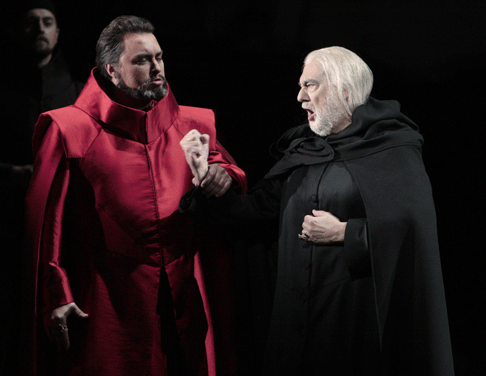 Ievgen Orlov as Loredano and Placido Domingo as Francesco Foscari
The libretto of I Due Foscari, like its English counterpart, is
melancholy and uneventful. British critics found Jacopo’s devotion to Venice
unbelievable, and Piave did nothing to alter that. There is no dramatic action
in the libretto. There is no character development. Francesco and Jacopo
essentially lament and plea. Lucrezia laments and berates. Miraculously, Verdi,
who constantly egged Piave on to provide him lyrical emotional poetry, knew how
to charge even lamentations and pleas with fervor and energy — witness the
power of Francesco, Jacopo’s and Lucrezia’a Act II trio. Music and voices
provide the thrills in this opera. Written just after Ernani, Verdi here begins
the compositional progression that will take him and all of Italian opera from
the static belcanto style and forms of his immediate predecessors — Rossini,
Bellini and Donizetti — to the lyric, rhythmic and dramatic freedoms which
culminated in his masterful Falstaff toward the end of the 19th century.
Beginning with I Due Foscari, patterns emerge: keys signatures, melodic and
rhythmic devices, which Verdi will elaborate in future works. The “oom pah
pah” opera orchestra is on its way out. Already in I Due Foscari,
the orchestra does more than merely provide back up for the vocal line. It
begins to partake in the story telling. I find it intriguing that on seeing and
hearing I Due Foscari, a present day operaphile knows more about what
Verdi would write in the future than the composer, himself, did, at the
time.
As Jacopo Foscari, Francesco Meli brought a warm voice, rich in color and
with squillo to spare, to the role. Marina Poplavskaya’s large, clearly
produced soprano filled the house, but lacked pliancy and a sense of ease in
Lucrezia’s coloratura. Plácido Domingo was, and remains an extraordinary
singer. True, his voice today lacks the heft and dark color that a young
baritone could bring to the role of Francesco, but Domingo offers unmatched
vocal control, experience, and acting ability. His death scene was particularly
affecting. The sonorous voiced Ukrainian bass, Ievgen Orlov in the role of
Loredano, represented evil so well that he was booed at his curtain call (which
tells you something about the two dimensional aspect of this opera — think
Iago!). Tenor, Ben Bliss, was his impressive sidekick, Barberigo. This is an
opera of lamentations — beautiful, melodic, even exciting lamentations.
Maestro James Conlon made it all work, with a crisp, bright, and suitably
modern interpretation, which never allowed the pace to falter.
Appropriately dark and restrained visuals for the work were provided by
director Thaddeus Strassberger, set designer Kevin Knight and costume designer
Mattie Ulrich. In contrast to Lucrezia’s and the Doge’s gleaming robes, the
red cassocked “Dieci” and black clad chorus spoke of evil men and secret
powers. Verdi’s interpolated Festa — complete with dancers, gondolieri and
a fire eater was both a musical and visual respite and delight. I have no idea
why Jacopo’s prison cell was made to sway on its way down from the rafters,
and no idea why director Strassberger had Lucrezia drown her son in a handy
trough in the Doge’s bedroom at the last moment. It distracts from the unity
of the work. Both Verdi and Byron leave us with Loredano, who theoretically set
the plot in motion, to gloat in revenge over the body of the Doge, as the
curtain comes down.
I Due Foscari is a confused and poorly constructed story at best,
but then again, it’s opera. It’s Verdi opera, and lucky Angelenos applauded
their exciting and extraordinary treat vociferously.
Estelle Gilson
Production:
Jacobo Loredano: Ievgen Orlov; Jacopo Foscari: Francesco Meli; Lucrezia
Contarini: Marina Poplavskaya; Francesco Foscari: Plácido Domingo. Orchestra
and chorus of the Los Angeles Opera. Conductor: James Conlon Director: Thaddeus
Strassberger Set Designer: Kevin Knight Costume Designer: Mattie Ullrich
Lighting Designer: Bruno Poet Chorus Director: Grant Gershon.
![Marina Poplavskaya as Lucrezia Contarini and Francesco Meli as Jacopo Foscari [Photo by Robert Millard courtesy of LA Opera]](http://www.operatoday.com/FCI8143.gif)