Subscribe to
Opera Today

Receive articles and news via RSS feeds or email subscription.


twitter_logo[1].gif


UCP_9780226043425.gif

Recently in Performances

Domingo Conducts Holdridge’s New Opera Dulce Rosa

Dulce Rosa, a brand new opera, had its world premiere Friday night, May 17, 2013 at the Broad Stage in Santa Monica, California. It was produced by Los Angeles Opera, but staged in the smaller theater.

Verdi’s Falstaff at Glyndebourne

Richard Jones’ 2009 production of Verdi’s Falstaff translates the action from the first Elizabethan age to the start of the second.

Gareth John, Wigmore Hall

Baritone Gareth John is rapidly accumulating a war-chest of honours. Winner of the 2013 Kathleen Ferrier Award, he recently won the Royal Academy of Music Patrons’ Award and was presented the Silver Medal by the Worshipful Company of Musicians.

La bohème at ENO

This second revival of Jonathan Miller’s La bohème was the first time I had caught the production.

Rolando Villazón: Verdi (International Opera Stars Series 2013)

It’s Verdi’s bicentenary year and Rolando Villazón has two new CDs to plug — titled somewhat confusingly, ‘Villazón: Verdi’ and ‘Villazón’s Verdi’, the latter a ‘personal selection’ of favourite numbers performed by stars of the past and present.

Brahms Third in San Francisco

Nicola Luisotti and the San Francisco Opera Orchestra climbed out of the War Memorial pit, braved the wind whipped bay and held spellbound an audience at Cal Performances’ Zellerbach Auditorium at UC Berkeley.

Glyndebourne: Ariadne auf Naxos

Utterly mad but absolutely right — Richard Strauss’s Ariadne auf Naxos started the Glyndebourne 2013 season with an explosion. Strauss could hardly have made his intentions more clear. Ariadne auf Naxos is not “about” Greek myth so much as a satire on art and the way art is made.

Wozzeck at ENO

“Man is an abyss. It makes one dizzy to look into it.” So utters Georg Büchner’s Woyzeck, repeating what was also a recurring motif in the playwright’s own letters.

Mulhouse: Rare Britten Well Done

National Opera Company of the Rhine has marked this year’s Benjamin Britten celebration with a remarkably compelling, often gripping new production of the seldom-seen Owen Wingrave.

Frankfurt's Intriguing Idomeneo

Once upon a time, Frankfurt Opera had the baddest ass reputation in Germany as “the” cutting edge producer of must-see opera.

Rigoletto at Lyric Opera of Chicago

Productions of Giuseppe Verdi’s Rigoletto can serve as a vehicle for individual singers to make a strong impression and become afterward associated with specific roles in the opera.

Britten Sinfonia with Ian Bostridge

Just in case we were not aware that the evening’s programme was ‘themed’, the Britten Sinfonia designed a visual accompaniment to their musical exploration of night, sleep and dreams.

Aida, Manitoba Opera

Poor Aida! She never seems to have anything go her way.

Superlative singing: Don Carlo, Royal Opera House

Is it possible to upstage Jonas Kaufmann? Kaufmann was brilliant in this Verdi Don Carlo at the Royal Opera House, London, but the rest of the cast was so good that he was but first among equals. Don Carlo is a vehicle for stars, but this time the stars were everyone on stage and in the pit. Even the solo arias, glorious as they are, grow organically out of perfect ensemble. This was a performance that brought out the true beauty of Verdi's music.

Sarah Connolly: French Song at Wigmore Hall

The big names were absent: Duparc, D’Indy, Debussy, Ravel … and while Fauré, Chausson, Roussel and several members of Les Six put in an appearance, in less than familiar guises, this survey of French song of the early 20th century and interwar years deliberately took us on a journey through infrequently travelled terrain.

Rare restoration: Handel’s Esther 1720

Composed between 1718 and 1720, Handel’s Esther is sometimes described as the ‘first English Oratorio’, but is in fact a hybrid form, mixing elements of oratorio, masque, pastoral and opera.

The Damnation of Faust, London

Hector Berlioz's légende dramatique, La Damnation de Faust, exists somewhere between cantata and opera. Berlioz's flexible attitude to dramatic form made the piece unworkable on the stages of early 19th century Paris and his music is so vivid that you wonder whether the piece needs staging at all.

Elizabeth Connell Memorial Concert, St John's Smith Square

St. John’s Smith Square was the site of Elizabeth Connell’s final London concert, intended as a farewell to London on her moving to Australia. It was rendered ultimately final by her unexpected death.

Aida with all the Trimmings, Even a Blue Silk Elephant!

With the building of the Suez Canal, Egypt became more interesting to Western Europeans. Khedive Ismail Pasha wanted a hymn by Verdi for the opening of a new opera house in Cairo, but the composer said he did not write occasional pieces.

Die Zauberflöte, Royal Opera

Back for its fourth revival, David McVicar’s 2003 production of Mozart’s Die Zauberflöte has much charm, beauty and artistry.

OPERA TODAY ARCHIVES »

Performances

Petra Lang as Ortrud and Gerd Grochowski as Friedrich von Telramund [Photo by Cory Weaver courtesy of San Francisco Opera]
27 Oct 2012

Lohengrin in San Francisco

Exquisite pianissimos, sumptuous climaxes, gigantic fortes, insistent horns, sugary winds, tremulous brass, blasting trumpets, whispering strings, pulsating oboes, more gigantic fortes, even more sumptuous climaxes.

Lohengrin in San Francisco

A review by Michael Milenski

Above: Petra Lang as Ortrud and Gerd Grochowski as Friedrich von Telramund

Photos by Cory Weaver courtesy of San Francisco Opera


Lohengrin like never before. It was an orgy of orchestral colors, an adventure in sonic discovery, the absolute summit of virtuosic orchestral delivery. Maestro Nicola Luisotti attacked and conquered Lohengrin.

There. That’s done. What’s left now that it’s all over?

No longer mythic Germanic lore, this tale seemed to be an episode from, say, Ceausescu’s already mythic Romania, where books were torn from library shelves to burn to make electricity to light the libraries. Though in the emptied library in which all this took magic took place there was not enough juice to illuminate all the grandiose (Romanian socialist moderne) light sources. Well, save in the last scene when Lohengrin finally was going to save the masses. But bowed out.

The masses were magnificent socialists, eighty mighty workers (plus a few sword and standard bearers) who whispered in shimmering sounds and roared in full, transparent tones. But with such idealistic and obviously pleasurable glory in their sonority, and willing unity in their regimentation (yes, this multitude of virtuosic choristers was happily organized in lines and blocks) that they hardly needed to be saved from such perfection — to cede such artistry to mere Western materialism would be tragic indeed.

Meanwhile Icelandic bass Kristinn Sigmundsson in socialist general regalia was instructed to walk downstage center and be the embattled king Heinrich. Mr. Sigmundsson, once an estimable artist, here was perfect as crumbling, ineffective power. Baritone Brian Mulligan, a San Francisco Opera fixture, was Heinrich’s prissy acolyte, a welcomed vocal contrast to his superior. Mr. Mulligan is a richly voiced singer who complemented the maestro’s musical textures while overwhelming the import of this mere herald.

American tenor Brandon Jovanovich was the Lohengrin, a role debut. He apparently has a new voice teacher as the perfectly reasonable tenor we heard a few years ago as Luigi in Il Tabarro has been transformed into a trumpet. While he has not yet mastered the subtlety of tone of a fine trumpeter he does have a surprising variety of volume if not color, though his first and last words in the opera were delivered in a tentative half voice that was cause for concern. Even with its moments of real beauty the sharpness of his tone worked with the costuming of this production to make him look and sound gawky. Though this maybe helped establish the assumed caricatural intent of this conception of Lohengrin.
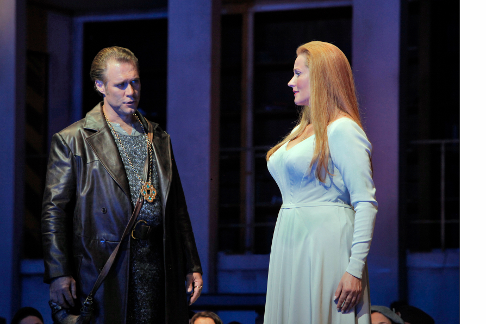
08--Lohengrin.pngBrandon Jovanovich as Lohengrin and Camilla Nylund as Elsa von Brabant

Of the five principals the Elsa of Finnish soprano Camilla Nylund realized the most successful character. Elsa herself is a lost soul, and Mlle. Nylund though looking like a well-kept Romanian apparatchik had no idea how to be one. The purity of her voice and the innocence of her presence served her well, though in the bigger moments her voice could not ride the the maestro’s mighty crests, as could, for example, the out-of-scale voice of Mr. Jovanovich.

German bass-baritone Gerd Grochowski seemed over parted as Telramund, diminishing the stature of evil in Wagner’s struggle to overcome baser levels of humanity. Mr. Grochowski’s fine baritone and interesting persona are more at home in roles that are more lyric and perhaps more complex psychologically. He lacks the inherent vocal color and physical force to personify an uncontrolled thirst for power, willing to say or do anything to get it. Reduced to a whimpering wimp in this production there was little for all those arcane powers of the Holy Grail to overcome.

Joining her homeless husband as Ortrud, the bag lady was German mezzo Petra Lang. Mme. Lang did not seem to be in good voice, her final curse thinly delivered, again underlining the opera’s need to endow evil with enough stature to be worth overcoming. As it was the famous pollution of socialist industry managed to create quite atmospheric lighting for Ortrud’s scenes brainwashing Telramund and deceiving Elsa, convincingly delivered by Mme. Lang.
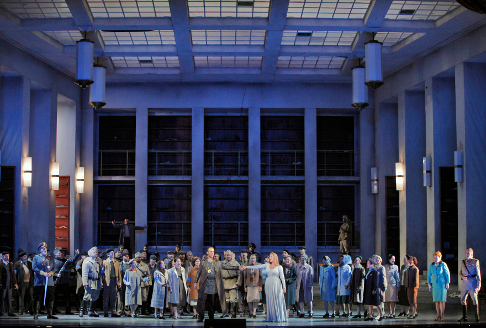
06--Lohengrin.pngA scene from Act I

The production by British director Daniel Slater and British designer Robert Innes Hopkins is from Geneva (2008) and was already in close-by Houston (2009). It apparently has the intention to remove all magic from Wagner’s tale where swans ferry supernatural knights back and forth from an imaginary mountain. The musical moments for these arrivals and departures are truly momentous, even in ordinary circumstances, but here the workers and apparatchiks stare always forward only to discover and not seem to care that the bus terminal was behind them.

The production could not support the musical values imposed by Mo. Luisotti. Magic, and a lot of it was sorely needed to give place and meaning to this mountain of sound.

Michael Milenski


Program

Lohengrin: Brandon Jovanovich; Elsa von Brabant: Camilla Nylund; Ortrud: Petra Lang; Friedrich von Telramund: Gerd Grochowski; Heinrich der Vogler: Kristinn Sigmundsson; King’s Herald: Brian Mulligan. San Francisco Opera Chorus and Orchestra. Conductor: Nicola Luisotti; Stage Director: Daniel Slater; Production Designer: Robert Innes Hopkins; Lighting Designer: Simon Mills. War Memorial Opera House, October 24, 2012.

Send to a friend

Send a link to this article to a friend with an optional message.

Friend's Email Address: (required)

Your Email Address: (required)

Message (optional):