![Jay Hunter Morris as Ahab [Photo by Cory Weaver courtesy of San Francisco Opera]](http://www.operatoday.com/Ahab.png)
12 Oct 2012
Moby Dick in San Francisco
Forget Herman Melville, forget struggling with deep human complexities. At least those that possessed nineteenth century Americans.
English Touring Opera are delighted to announce a season of lyric monodramas to tour nationally from October to December. The season features music for solo singer and piano by Argento, Britten, Tippett and Shostakovich with a bold and inventive approach to making opera during social distancing.
This tenth of ten Live from London concerts was in fact a recorded live performance from California. It was no less enjoyable for that, and it was also uplifting to learn that this wasn’t in fact the ‘last’ LfL event that we will be able to enjoy, courtesy of VOCES8 and their fellow vocal ensembles (more below …).
Ever since Wigmore Hall announced their superb series of autumn concerts, all streamed live and available free of charge, I’d been looking forward to this song recital by Ian Bostridge and Imogen Cooper.
Although Stile Antico’s programme article for their Live from London recital introduced their selection from the many treasures of the English Renaissance in the context of the theological debates and upheavals of the Tudor and Elizabethan years, their performance was more evocative of private chamber music than of public liturgy.
Evidently, face masks don’t stifle appreciative “Bravo!”s. And, reducing audience numbers doesn’t lower the volume of such acclamations. For, the audience at Wigmore Hall gave soprano Elizabeth Llewellyn and pianist Simon Lepper a greatly deserved warm reception and hearty response following this lunchtime recital of late-Romantic song.
For this week’s Live from London vocal recital we moved from the home of VOCES8, St Anne and St Agnes in the City of London, to Kings Place, where The Sixteen - who have been associate artists at the venue for some time - presented a programme of music and words bound together by the theme of ‘reflection’.
'Such is your divine Disposation that both you excellently understand, and royally entertaine the Exercise of Musicke.’
‘And there was war in heaven: Michael and his angels fought against the dragon; and the dragon fought and his angels, And prevailed not; neither was their place found any more in heaven … that old serpent … Satan, which deceiveth the whole world: he was cast out into the earth, and his angels were cast out with him.’
There was never any doubt that the fifth of the twelve Met Stars Live in Concert broadcasts was going to be a palpably intense and vivid event, as well as a musically stunning and theatrically enervating experience.
‘Love’ was the theme for this Live from London performance by Apollo5. Given the complexity and diversity of that human emotion, and Apollo5’s reputation for versatility and diverse repertoire, ranging from Renaissance choral music to jazz, from contemporary classical works to popular song, it was no surprise that their programme spanned 500 years and several musical styles.
The Academy of St Martin in the Fields have titled their autumn series of eight concerts - which are taking place at 5pm and 7.30pm on two Saturdays each month at their home venue in Trafalgar Square, and being filmed for streaming the following Thursday - ‘re:connect’.
The London Symphony Orchestra opened their Autumn 2020 season with a homage to Oliver Knussen, who died at the age of 66 in July 2018. The programme traced a national musical lineage through the twentieth century, from Britten to Knussen, on to Mark-Anthony Turnage, and entwining the LSO and Rattle too.
With the Live from London digital vocal festival entering the second half of the series, the festival’s host, VOCES8, returned to their home at St Annes and St Agnes in the City of London to present a sequence of ‘Choral Dances’ - vocal music inspired by dance, embracing diverse genres from the Renaissance madrigal to swing jazz.
Just a few unison string wriggles from the opening of Mozart’s overture to Le nozze di Figaro are enough to make any opera-lover perch on the edge of their seat, in excited anticipation of the drama in music to come, so there could be no other curtain-raiser for this Gala Concert at the Royal Opera House, the latest instalment from ‘their House’ to ‘our houses’.
"Before the ending of the day, creator of all things, we pray that, with your accustomed mercy, you may watch over us."
The doors at The Metropolitan Opera will not open to live audiences until 2021 at the earliest, and the likelihood of normal operatic life resuming in cities around the world looks but a distant dream at present. But, while we may not be invited from our homes into the opera house for some time yet, with its free daily screenings of past productions and its pay-per-view Met Stars Live in Concert series, the Met continues to bring opera into our homes.
Music-making at this year’s Grange Festival Opera may have fallen silent in June and July, but the country house and extensive grounds of The Grange provided an ideal setting for a weekend of twelve specially conceived ‘promenade’ performances encompassing music and dance.
There’s a “slide of harmony” and “all the bones leave your body at that moment and you collapse to the floor, it’s so extraordinary.”
“Music for a while, shall all your cares beguile.”
The hum of bees rising from myriad scented blooms; gentle strains of birdsong; the cheerful chatter of picnickers beside a still lake; decorous thwacks of leather on willow; song and music floating through the warm evening air.
Forget Herman Melville, forget struggling with deep human complexities. At least those that possessed nineteenth century Americans.
Think bel canto. Give a singer an impossible situation and see if he can sing his way out of it. Moby Dick in San Francisco was about singing, and well, the singers had those famous ready made situations that frame Melville’s deeper discussion, and they sang and sang. And sang.
Composer Jake Heggie has a gift for lyricism that flows and flows. And flows. In San Francisco he had very willing interpreters, most notably tenor Jay Hunter Morris, a late term replacement for heldon tenor Ben Heppner who had sung the doomed and damned Captain Ahab in this premiere production of the opera two years ago in Dallas, and this year already in Calgary and San Diego.
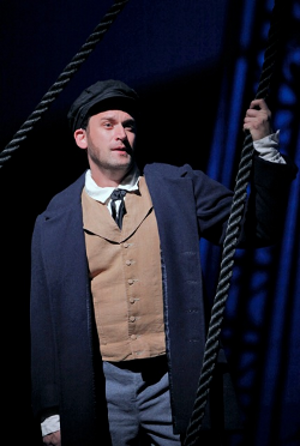 Morgan Smith as Starbuck
Maybe for a second or so one regretted the absence of Mr. Heppner, surely the epitome of casting for Melville’s emblematic monster. But Mr. Morris, a smaller scale performer with a more lyric voice, and luckily for Mr. Heggie one of great stamina, immediately commanded a character of some interest who had the impossible task of towering above mutiny, slaughter, hurricanes, human kindness and one white whale. He delivered Mr. Heggie’s very singable, if not easily hummable, lines with aplomb and musical grace.
First mate Starbuck, endowed in this made-for-opera version of Melville’s story with the daunting task of equaling Ahab in emotional stature, fared less well. Baritone Morgan Smith successfully made the case for onshore domestic contentment but could not find the needed torment and agony in Mr. Heggie and librettist Gene Sheer’s character — the only antagonist in the story, the only character asked to tackle the obsessive captain. Maybe he did not have enough words to sing or maybe Mr. Heggie’s music simply does not plumb those depths.
Librettist Sheer ends his book with the line “call me Ismael,” famously the first line of Melville’s book, a conceit that invites us to go to novel to sink ourselves into its archaic language and delve into its meanings, an immersion that Moby Dick the opera eschews. And the question then looms as to what Moby Dick the opera may have to do with anything beyond smart entertainment à l’amèricaine.
Smart it is, a libretto that cleverly abstracts the shell of the novel into a series of musical numbers. The staging by Leonard Foglia (who helped shape the opera) is presentational, generous doses of rushing forward to point to happenings exactly where the audience happens to be sitting (a sure way to ensure involvement).
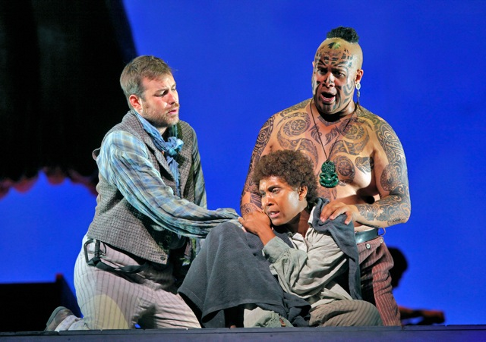 Stephen Costello as Greenhorn (Ishmael)
Designer Robert Brill made a huge wave like structure on stage that cleverly embodied the sea itself and he made smart use of sophisticated moving projections to graphically illustrate a gigantic moving schooner and its boats. Not to mention the effective fight scenes by choreographer Keturah Stickann and fight director Jonathan Rider.
The Moby Dick saga surely attracted composer Heggie because of its opportunities for programmatic music. These five or so episodes were the most successful parts of the opera. Lacking the complexities of nineteenth century morality afforded by written language the scenes that illustrated the plights of Melville’s famous characters were sometimes dramatically pallid, limited by the consistent richness of smooth sound and rhythmic movement, essential elements Mr. Heggie’s voluptuous style. It is smart, attractive music that in actuality is quite complex harmonically and rhythmically.
Greenhorn (Ishmael at the opera’s conclusion, though it is his name throughout Melville) who begins and ends the opera is the classic outcast, and in the opera he becomes innocence as well. The role was beautifully sung by tenor Stephen Costello though the role would have been more effectively served by a less Italianate voice (Italian tenors are never innocent), perhaps a purely beautiful voice could have moved us more in his extended scenes with the savage Queequeg, effectively typecast with Samoan bass Jonathan Lemalu.
There is one female voice in the cast, Pip, the black boy, sung by soprano Talise Trevigne. Pip is thrown out of the whaling boat in Moby Dick the opera (he twice jumps out in the novel) and then does the Mary Martin Peter Pan trick of flying, suspended, across the stage while singing and here going crazy too. In the opera Pip is cleverly paired in an extended duet with Stubb the Second Mate, sung by veteran baritone Robert Orth, obsessed with killing whales. Pip is his victim, a sacrifice in the rites of men, at least those portrayed in Moby Dick the opera.
Committed and convincing performances by all the named roles and by the San Francisco Opera Chorus were the hallmark of the production, by now nearly a classic. Conductor Patrick Summers gave Heggie’s score its intended luminous glow ensuring that Moby Dick the opera remain a rich theatrical confection.
Michael Milenski
Cast
Greenhorn: Stephen Costello; Captain Ahab: Jay Hunter Morris; Starbuck: Morgan Smith; Queequeg: Jonathan Lemalu; Pip: Talise Trevigne; Flask: Matthew O’Neill; Stubb: Robert Orth. San Francisco Opera Chorus and Orchestra. Composer: Jake Heggie; Librettist: Gene Sheer. Conductor: Patrick Summers; Stage Director: Leonart Foglia; Set Designer: Robert Brill; Costume Designer: Jane Greenwood; Lighting Designer: Don Holder; Projection Designer; Elaine J. McCarthy; Choreographer: Keturah Stickann. San Francisco War Memorial Opera House, October 10, 2012.