![Evelyn Herlitzius as Kundry and Klaus Florian Vogt as Parsifal [Photo © Matthias Baus]](http://www.operatoday.com/Parsifal_DO_05.jpg)
24 Oct 2012
Parsifal bears its own Cross
Parsifal, with its heavy dose of religiosity and strains of racial supremacy, remains at once the most mystical and historically burdened of Wagner’s operas.
English Touring Opera are delighted to announce a season of lyric monodramas to tour nationally from October to December. The season features music for solo singer and piano by Argento, Britten, Tippett and Shostakovich with a bold and inventive approach to making opera during social distancing.
This tenth of ten Live from London concerts was in fact a recorded live performance from California. It was no less enjoyable for that, and it was also uplifting to learn that this wasn’t in fact the ‘last’ LfL event that we will be able to enjoy, courtesy of VOCES8 and their fellow vocal ensembles (more below …).
Ever since Wigmore Hall announced their superb series of autumn concerts, all streamed live and available free of charge, I’d been looking forward to this song recital by Ian Bostridge and Imogen Cooper.
Although Stile Antico’s programme article for their Live from London recital introduced their selection from the many treasures of the English Renaissance in the context of the theological debates and upheavals of the Tudor and Elizabethan years, their performance was more evocative of private chamber music than of public liturgy.
Evidently, face masks don’t stifle appreciative “Bravo!”s. And, reducing audience numbers doesn’t lower the volume of such acclamations. For, the audience at Wigmore Hall gave soprano Elizabeth Llewellyn and pianist Simon Lepper a greatly deserved warm reception and hearty response following this lunchtime recital of late-Romantic song.
For this week’s Live from London vocal recital we moved from the home of VOCES8, St Anne and St Agnes in the City of London, to Kings Place, where The Sixteen - who have been associate artists at the venue for some time - presented a programme of music and words bound together by the theme of ‘reflection’.
'Such is your divine Disposation that both you excellently understand, and royally entertaine the Exercise of Musicke.’
‘And there was war in heaven: Michael and his angels fought against the dragon; and the dragon fought and his angels, And prevailed not; neither was their place found any more in heaven … that old serpent … Satan, which deceiveth the whole world: he was cast out into the earth, and his angels were cast out with him.’
There was never any doubt that the fifth of the twelve Met Stars Live in Concert broadcasts was going to be a palpably intense and vivid event, as well as a musically stunning and theatrically enervating experience.
‘Love’ was the theme for this Live from London performance by Apollo5. Given the complexity and diversity of that human emotion, and Apollo5’s reputation for versatility and diverse repertoire, ranging from Renaissance choral music to jazz, from contemporary classical works to popular song, it was no surprise that their programme spanned 500 years and several musical styles.
The Academy of St Martin in the Fields have titled their autumn series of eight concerts - which are taking place at 5pm and 7.30pm on two Saturdays each month at their home venue in Trafalgar Square, and being filmed for streaming the following Thursday - ‘re:connect’.
The London Symphony Orchestra opened their Autumn 2020 season with a homage to Oliver Knussen, who died at the age of 66 in July 2018. The programme traced a national musical lineage through the twentieth century, from Britten to Knussen, on to Mark-Anthony Turnage, and entwining the LSO and Rattle too.
With the Live from London digital vocal festival entering the second half of the series, the festival’s host, VOCES8, returned to their home at St Annes and St Agnes in the City of London to present a sequence of ‘Choral Dances’ - vocal music inspired by dance, embracing diverse genres from the Renaissance madrigal to swing jazz.
Just a few unison string wriggles from the opening of Mozart’s overture to Le nozze di Figaro are enough to make any opera-lover perch on the edge of their seat, in excited anticipation of the drama in music to come, so there could be no other curtain-raiser for this Gala Concert at the Royal Opera House, the latest instalment from ‘their House’ to ‘our houses’.
"Before the ending of the day, creator of all things, we pray that, with your accustomed mercy, you may watch over us."
The doors at The Metropolitan Opera will not open to live audiences until 2021 at the earliest, and the likelihood of normal operatic life resuming in cities around the world looks but a distant dream at present. But, while we may not be invited from our homes into the opera house for some time yet, with its free daily screenings of past productions and its pay-per-view Met Stars Live in Concert series, the Met continues to bring opera into our homes.
Music-making at this year’s Grange Festival Opera may have fallen silent in June and July, but the country house and extensive grounds of The Grange provided an ideal setting for a weekend of twelve specially conceived ‘promenade’ performances encompassing music and dance.
There’s a “slide of harmony” and “all the bones leave your body at that moment and you collapse to the floor, it’s so extraordinary.”
“Music for a while, shall all your cares beguile.”
The hum of bees rising from myriad scented blooms; gentle strains of birdsong; the cheerful chatter of picnickers beside a still lake; decorous thwacks of leather on willow; song and music floating through the warm evening air.
Parsifal, with its heavy dose of religiosity and strains of racial supremacy, remains at once the most mystical and historically burdened of Wagner’s operas.
As such, it is no wonder that it has yielded some of Germany’s most seminal and controversial stagings of the past decade. The late Christoph Schlingensief brought giant, rotting bunnies to Bayreuth in 2004, the original stage to which Wagner consecrated the work in 1882—leaving New Yorker critic Alex Ross “ready to hurl,” as he so candidly put it—while Stefan Herheim’s 2008 deconstructionist production for the ‘Green Hill’ becomes an allegory for German history, traveling through the world wars of the twentieth century and into the bureaucratic Federal Republic of Bonn.
Philipp Stötzl, in his new staging for the Deutsche Oper (seen at its premiere on October 21), has opted for a more conventional yet equally radical concept that foregrounds explicitly Christian imagery. The director, who worked in film before making several successful forays into opera, casts the story as a series of tableaux vivants set in a rocky mountainous region that could easily be Nazareth (sets co-designed with Conrad Moritz Reinhardt). The curtains open during the overture to a realist portrait of Jesus on the cross, surrounded by nomads and a Roman soldier. Self-flogging and fake blood abound as the procession continues, with Amfortas carrying his own cross in the final scene.
In a genius stroke that counters the lengthy nature of the opening act, Gurnemanz’s narrations about Amfortas’ seduction by Kundry and the Last Supper are depicted on the rocks in flashbacks. Parsifal, appearing in a modern black suit and tie, descends upon the scene as if walking across a film set, an effect which is accentuated by conspicuous fluorescent lighting on all sides (Ulrich Niepel). Klingsor’s magic garden is fashioned as a Mayan cave of sorts, with Native American-inspired garb for the warlock and semi-nude floral get-ups for the flower maidens (costumes by Kathi Maurer), while the final act returns to a rocky, post-apocalyptic no man’s last featuring modern-day dress and a single streetlamp under which Parsifal is anointed by a blindly fervent crowd.
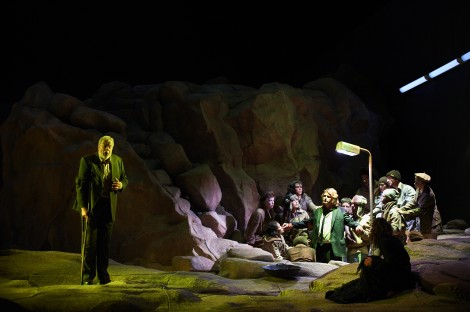 Matti Salminen as Gurnemanz and Klaus Florian Vogt as Parsifal with chorus
Stötzl’s episodes were for the most part expertly coordinated with the music, such as when Parsifal lunges his spear toward Amfortas’ wound, only to have the ruler grab it in an act of suicide (a gesture borrowed from Schlingensief). The director’s still lives, at their best, served to illustrate Wagner’s proto-cinematic qualities (theories point to the composer’s use of Leitmotifs and underscoring, techniques which were picked up by Hollywood starting in the silent film era, as well as the darkened theatre and continental seating in Bayreuth). The surging Liebesmahl (love feast) motif of the overture against the crucifixion scene captured the essence of Wagner’s spirit, a cry for redemption and a manic belief in the power of art to transform the senses.
Other scenes, such as the slow-moving mass of bodies wielding swords in the orchestral postlude of the final act, were nearly comical in their kitsch factor. The final act proved most perplexing in its chronological jump and aesthetic abstraction, failing to fully explain Parsifal’s anachronistic presence in the rest of the opera. It was also not clear whether the reverential raising of hands toward the grail in the final scene, including the shaking and collapsing of a man in zeal, was meant to be tongue-in-cheek. If Stötzl hoped to include an element of social critique, it was lost in the religious pageant.
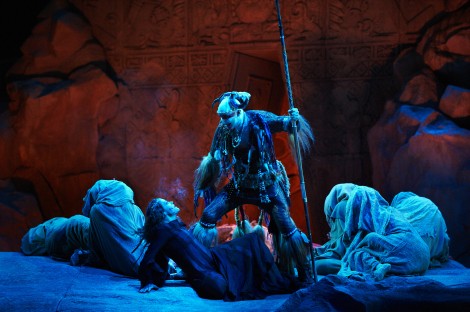 Evelyn Herlitzius, as Kundry and Thomas Jesatko as Klingsor with dancers
Nonetheless, his characters emerged in immediately human strokes. Klaus Florian Vogt, slowly overtaking Jonas Kaufmann as today’s most coveted Wagnerian tenor, conveyed Parsifal’s selfless naiveté with clarion tones and an unforced thespian presence. Although his high lying timbre may not conform to the vision of many seasoned Wagnerians, his sharp musicianship and natural appeal surely compensate. The baritone Thomas Johannes Mayer gave a wrenching delivery in the role of Amfortas, evoking his existential struggle without chewing the scenery and phrasing with great sensitivity.
The dark voice of veteran bass Matti Saliminen may have developed a slightly gravely quality, but he was unquestionably authoritative as the knight Gurnemanz, winning thunderous applause. Evelyn Herlitzius incarnated the wandering heathen Kundry with seductive tones, grounding large melodic leaps with a burnished low range. She was in particularly fine voice for her narrative to Parsifal, “Ich sah das Kind,” about seeing him as a baby in his mother’s arms. The bass Albert Pesendorfer was rich voiced and commanding as Amfortas’ father Titurel, and Thomas Jesatko a magnetic Klingsor. Comprimario roles were strongly cast, with Burkhard Ulrich and Tobias Kehrer standing out as the First and Second Knights of the Grail. The chorus of the Deutsche Oper brought a characteristic blend of elegant lyricism and homogeneity of tone.
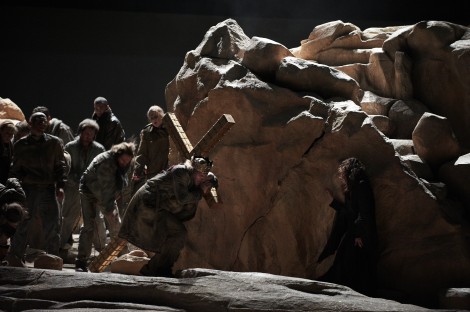 Thomas J. Mayer as Amfortas and Evelyn Herlitzius as Kundry with chorus
Donald Runnicles, now entering his fourth season as music director of the Deutsche Oper, led the orchestra in a smooth, strong-willed reading that did not always brim with tremendous pathos but did full justice to the soaring lines of Wagner’s score. The horns and trumpets were in top form through chromatic motifs, and although the strings’ gleaming tone did not always make its way into the transcendent, there was little doubt of the orchestra’s authentic connection to this tradition. With so many subversive productions circulating as we approach the eve of Wagner’s bicentenary in 2013, perhaps there is no need to fight the inevitable weight of history.
Rebecca Schmid