These performances were, if possible,
rendered all the more extraordinary by being given not by an established opera
house and company, but by the heroic Birmingham Opera Company, founded
by director, Graham Vick, as a community project, run from an office comprised
of just three full-time workers in Birmingham’s Jewellery Quarter.
Productions are site-specific: ‘We don't have an opera house and we don't
work in conventional theatres. We conjure our theatres out of spaces used for
other purposes or maybe just abandoned. A brief period of illumination and then
we move on — not tied to bricks and mortar.’ But then Stockhausen was
hardly a conventional composer, let alone a conventional opera composer. The
Argyle Works, a disused chemical factory, proved an excellent setting, not only
in terms of its large, adaptable spaces, but also on account of a fine
acoustic, doubtless testament to a great deal of expert preparation by sound
engineers.
Despite its use of a ‘super-formula’, Mittwoch is not easy —
certainly far less so than, say Donnerstag — to consider as a
unified work, especially in terms of narrative. Perhaps it would be more so as
part of a complete cycle, perhaps not. But musically, the opening Greeting and
Farewell, sound projection by the tireless Kathinka Pasveer, provide electronic
material employed, if not throughout, then in two of the four intervening
scenes, ‘Orchestra Finalists’ and ‘Michaelion’. In a sense, it is up to
the individual whether he should construct his own Mittwoch narrative,
but in a sense, that is always the case; the situation, as so often with
Stockhausen, is simply more extreme here. Mittwoch was first intended
to be the only opera in which the cycle’s three principal protagonists, for
want of a better word than characters, (Eve, Lucifer, Michael) cooperate. As it
happened, none of them actually appears in straightforward fashion, though Eve
and Lucifer are represented by ‘emanations’ (the latter in the bizarre form
of ‘Lucicamel’ (German, ‘Luzicamel’), yes, a pantomime camel), and the
name of Michael is frequently invoked with apparent awe. Yet the idea of
‘cooperation’, related to the idea of ‘love’, remains: as Richard Toop
points out, ‘almost uniquely in Stockhausen’s work, this collaboration is
political, in a parliamentary sense; in the inner ones, it is more specifically
musical’. Even when it is political, it seems a hundred light-years, or
whatever measurement Stockhausen would employ, from the political commitment of
contemporaries such as Henze and Nono, let alone the younger Lachenmann.
Stockhausen’s (quasi?-)theological cosmogony remains the thing, for better
and/or worse.
With ‘Wednesday Greeting’ (‘Mittwochs-Gruss), which originates from
the electronic music of ‘Michaelion’ rather than the other way round, we
were plunged into darkness, at least visually, whilst a four-track
(quadraphonic) performance of music ‘very seldom reminiscent of this world
and which awakens the universe of the fantasy’ (Stockhausen) unfolded.
‘Listening to music in the dark will become much more important in the future
than it is today,’ Stockhausen wrote in Electronic Art Music (2006),
going on to say, ‘The main function of art music will be to make the souls of
the listeners fly freely through the universes, with infinite new surprises.’
Whatever one thinks of that, the darkness certainly made one concentrate, and
brought into relief choreographed moments — in a scenic rather than musical
sense — that appeared all around us, just like the sounding of the music.
Aspects of creation myths, old and new, flashed before our eyes, all superbly
executed by a fine team of dancers. It is difficult not to respond favourably
to the intense seriousness of Stockhausen’s vision, if, at the same time, it
is difficult — at least for this viewer and listener — not to find an
unintentional absurdity to it too. ‘Yellow is the colour’, apparently, so
we left the first hall to progress to the ‘World Parliament’, passing an
artist apparently pleasurably writhing in yellow paint that he poured over
himself, perhaps the closest we came to conventional eroticism.
‘World Parliament’ (‘Welt-Parlament’) proved, apart from anything
else, quite beautiful in an almost conventional a cappella choral
sense. Praise could not be too high for the representatives, members of Ex
Cathedra, conducted by the President, Ben Thapa. Love is the subject for
debate, its meaning discussed in a manner that perhaps came easier to a child
of the sixties than to many of us today. But even if sentiments, sometimes in
invented tongues, sometimes in the vernacular, such as ‘Love resounds in your
voice. Listen to your tone, to the sound of your voice, to GOD, because love
must be in it,’ might be a little difficult to take for us, however
beautifully sung by tenors joining forces, let alone the President’s
‘Positive thinking — that’s it!’, the ritual, choral and visual, was
entrancing. Perched high on yellow stools, representatives with different world
flags emblazoned upon their faces — I saw them in make-up when entering the
factory — interacted, debated, apparently learned from each other. The
substitute President, an ‘Eve emanation’, her coloratura wonderfully
despatched by soprano Elizabeth Drury, takes office after a janitor called out
the President on account of his car being towed away. Stockhausen admitted that
he ‘very consciously made it that banal.’ Quite: perhaps it is a matter of
that ‘German humour’ even we Teutonophiles find baffling in the extreme.
However, it was the beauties of Stockhausen’s choral writing, apparently not
entirely removed from some of his earliest works, that offered greater
sustenance.
‘Orchestra Finalists’ (‘Orchester-Finalisten’) had us turn to the
often staggering instrumental prowess of a fine group of musicians named above,
octophonic electronic music following the progress of the instrumentalists.
Again, Pavseer’s expertise here was crucial to the scene’s success.
Suspended from the ceiling, splashing in a paddling pool, shouting, even,
according to Stockhausen, ‘moving in an individual way and projecting their
personal aura’, this extends ‘the way musicians publicly perform during
music competitions’. You can say that again. In addition to the musicians’
antics, there was much else to divert the eye: dance, processional, including
men in top hats with billowing smoke, a man with an aeroplane on his head...
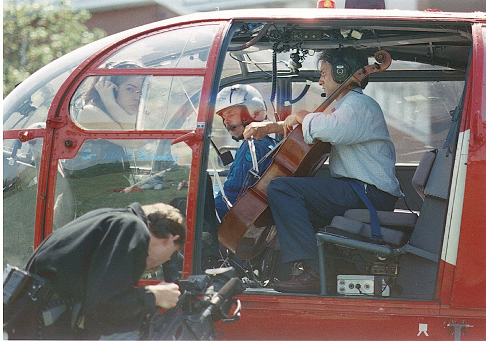
The ‘Helicopter String Quartet’, premiered by the Ardittis but here
performed by the Elysian Quartet, has become so notorious that it is difficult
to know what to say about it. It is probably best to understand it as further
evidence of Stockhausen’s extraordinary imagination, somehow both naïve and
incredibly complex. As theatre it is quite a thing — and one should remember
that Mittwoch is theatre, not ‘absolute’ music, whatever that might mean.
Reports I had read were highly critical of Radio 1 DJ Nihal as Moderator.
Perhaps anyone who was not Stockhausen himself would have come in for
considerable criticism here. Yet the role is prescribed in the work and our
Moderator offered at least one sound piece of advice, to try to listen to the
music, that is, not simply to be wowed by the effect, relayed to us
via four screens. That is difficult to do, but especially towards the end, I
found myself increasingly able to listen to the notes, to hear the passing of
notes, even lines, as well as the shouted numbers of the Lucifer formula,
between the players, as well as hearing the interaction of instruments and
helicopters. In the post-quartet discussion, the pilots acquitted themselves
very well indeed, one of them (Nigel Burton, I think) revealing a gift for dry
wit.
The final scene, ‘Michaelion’, perhaps brings us closer to something
more operatic as genuinely understood, though we remain distant indeed from
The Marriage of Figaro. Indeed, at times we seem closer to the world
of Dr Who. The name ‘Michaelion’ pays reference to Constantine’s
fourth-century temple at Chalcedon in honour of the archangel Michael, but the
‘World Parliament’ has now turned inter-galactic, with absurdity whose
humour may or may not be intentional. Cosmological solidarity is summarised by
the uniquely cooperative role played by Lucifer’s ‘emanation’, Lucicamel,
though passages such as the ‘Shoe-Shine Serenade’, the appearance of a huge
bottle of champagne, and of course Lucicamel’s defecation of seven
planet-globes, paralleling the seven days of the week, tend to linger longer in
the memory. Luca, who arises out of the camel, is appointed Operator and
responds to delegates’ concern in a short-wave form that harks back to 1960s
works such as Kurzwellen. Once again the choral singing, this time
from London Voices, was beyond reproach, similarly Pasveer’s sound projection
and the expert instrumental playing, including a ‘Bassetsu-Trio’ for basset
horn, trumpeter and trombonist, symbolising Eve, Michael, and Lucifer, but I
wondered, perhaps echoing in its way the eighteenth-century, Mozartian serenade
‘entertainment’, albeit this time for delegates. Emerging from this strange
yet compelling tableau-cum-drama, we were offered ‘a cup of yellow’ to the
strains of the electronic ‘Wednesday Farewell’
(‘Mittwochs-Abschied’).
An extraordinary experience, by any standards, for which all concerned, from
Vick to the musicians and other artists to the Arts Council deserve a huge
round of whatever passes for applause on Sirius. Now we need someone to stage
Licht in its entirety.
Mark Berry
Karlheinz Stockhausen, Mittwoch: Kathinka Pasveer (sound projection:
Wednesday Greeting, World Parliament, Michaelion, music direction); Igor
Kavulek (sound engineer)
BALANCE Audio-Media, Cologne (sound equipment); Graham Vick (director); Paul
Brown (designs); Giuseppe di Iorio (lighting); Ron Howell (choreography)
Sheelagh Barnard (technical director); Richard Willacy (executive producer).
World Parliament: Representatives: Ex Cathedra (chorus master: Jeffery
Skidmore); President: Ben Thapa; Substitute President: Elizabeth Drury.
Orchestra Finalists: Dan Bates (oboe), Jonathan Rees (cello), Vicky Wright
(clarinet), Amy Harman (bassoon), Debs White (violin), Ian Foster (tuba), Karin
de Fleyt (flute), Andrew Connington (trombone), Bridget Carey (viola), Bruce
Nockles (trumpet), Jeremy Watt (double bass), Mark Smith (French horn), David
Waring (percussion. Helicopter String Quartet: Elysian Quartet (Emma Smith,
Jennymay Logan (violins), Vincent Sipprell (viola), Laura Moody (cello);
Moderator — DJ Nihal; Ian Dearden (sound projection); Miles Fletcher, Will
Samuelson, Alistair Badman, Nigel Burton, Chris Holland, Peter Driver (pilots).
Michaelion: Delegates — London Voices (chorus director: Ben Parry); Operator
— Michael Leibendgut; Chloé l’Abbé (flute), Fie Schouten (basset horn),
Marco Blauuw (trumpet), Stephen Menotti (trombone), Antonio Pérez Abelián
(synthesiser); Lucicamel — Marie-Louise Crawley, Nathan Lafayette. Argyle
Works, Birmingham, Saturday 25 August 2012