19 Oct 2012
To Rome With Love: A Woody Allen film
What might a Woody Allen treatment involving opera read like? Tosca, third act — the firing squad lets loose shrapnel from a malfunctioning prop carbine, verily cutting into the Cavaradossi.
English Touring Opera are delighted to announce a season of lyric monodramas to tour nationally from October to December. The season features music for solo singer and piano by Argento, Britten, Tippett and Shostakovich with a bold and inventive approach to making opera during social distancing.
This tenth of ten Live from London concerts was in fact a recorded live performance from California. It was no less enjoyable for that, and it was also uplifting to learn that this wasn’t in fact the ‘last’ LfL event that we will be able to enjoy, courtesy of VOCES8 and their fellow vocal ensembles (more below …).
Ever since Wigmore Hall announced their superb series of autumn concerts, all streamed live and available free of charge, I’d been looking forward to this song recital by Ian Bostridge and Imogen Cooper.
The Sixteen continues its exploration of Henry Purcell’s Welcome Songs for Charles II. As with Robert King’s pioneering Purcell series begun over thirty years ago for Hyperion, Harry Christophers is recording two Welcome Songs per disc.
Although Stile Antico’s programme article for their Live from London recital introduced their selection from the many treasures of the English Renaissance in the context of the theological debates and upheavals of the Tudor and Elizabethan years, their performance was more evocative of private chamber music than of public liturgy.
In February this year, Albanian soprano Ermonela Jaho made a highly lauded debut recital at Wigmore Hall - a concert which both celebrated Opera Rara’s 50th anniversary and honoured the career of the Italian soprano Rosina Storchio (1872-1945), the star of verismo who created the title roles in Leoncavallo’s La bohème and Zazà, Mascagni’s Lodoletta and Puccini’s Madama Butterfly.
Evidently, face masks don’t stifle appreciative “Bravo!”s. And, reducing audience numbers doesn’t lower the volume of such acclamations. For, the audience at Wigmore Hall gave soprano Elizabeth Llewellyn and pianist Simon Lepper a greatly deserved warm reception and hearty response following this lunchtime recital of late-Romantic song.
Collapsology. Or, perhaps we should use the French word ‘Collapsologie’ because this is a transdisciplinary idea pretty much advocated by a series of French theorists - and apparently, mostly French theorists. It in essence focuses on the imminent collapse of modern society and all its layers - a series of escalating crises on a global scale: environmental, economic, geopolitical, governmental; the list is extensive.
For this week’s Live from London vocal recital we moved from the home of VOCES8, St Anne and St Agnes in the City of London, to Kings Place, where The Sixteen - who have been associate artists at the venue for some time - presented a programme of music and words bound together by the theme of ‘reflection’.
'Such is your divine Disposation that both you excellently understand, and royally entertaine the Exercise of Musicke.’
Amongst an avalanche of new Mahler recordings appearing at the moment (Das Lied von der Erde seems to be the most favoured, with three) this 1991 Mahler Second from the 2nd Kassel MahlerFest is one of the more interesting releases.
‘And there was war in heaven: Michael and his angels fought against the dragon; and the dragon fought and his angels, And prevailed not; neither was their place found any more in heaven … that old serpent … Satan, which deceiveth the whole world: he was cast out into the earth, and his angels were cast out with him.’
If there is one myth, it seems believed by some people today, that probably needs shattering it is that post-war recordings or performances of Wagner operas were always of exceptional quality. This 1949 Hamburg Tristan und Isolde is one of those recordings - though quite who is to blame for its many problems takes quite some unearthing.
There was never any doubt that the fifth of the twelve Met Stars Live in Concert broadcasts was going to be a palpably intense and vivid event, as well as a musically stunning and theatrically enervating experience.
‘Love’ was the theme for this Live from London performance by Apollo5. Given the complexity and diversity of that human emotion, and Apollo5’s reputation for versatility and diverse repertoire, ranging from Renaissance choral music to jazz, from contemporary classical works to popular song, it was no surprise that their programme spanned 500 years and several musical styles.
The Academy of St Martin in the Fields have titled their autumn series of eight concerts - which are taking place at 5pm and 7.30pm on two Saturdays each month at their home venue in Trafalgar Square, and being filmed for streaming the following Thursday - ‘re:connect’.
The London Symphony Orchestra opened their Autumn 2020 season with a homage to Oliver Knussen, who died at the age of 66 in July 2018. The programme traced a national musical lineage through the twentieth century, from Britten to Knussen, on to Mark-Anthony Turnage, and entwining the LSO and Rattle too.
With the Live from London digital vocal festival entering the second half of the series, the festival’s host, VOCES8, returned to their home at St Annes and St Agnes in the City of London to present a sequence of ‘Choral Dances’ - vocal music inspired by dance, embracing diverse genres from the Renaissance madrigal to swing jazz.
Just a few unison string wriggles from the opening of Mozart’s overture to Le nozze di Figaro are enough to make any opera-lover perch on the edge of their seat, in excited anticipation of the drama in music to come, so there could be no other curtain-raiser for this Gala Concert at the Royal Opera House, the latest instalment from ‘their House’ to ‘our houses’.
"Before the ending of the day, creator of all things, we pray that, with your accustomed mercy, you may watch over us."
What might a Woody Allen treatment involving opera read like? Tosca, third act — the firing squad lets loose shrapnel from a malfunctioning prop carbine, verily cutting into the Cavaradossi.
Cut to a hospital somewhere in Italy — an anxiety-ridden voice is heard recounting, to anyone within earshot, of how he’d dreamt about this happening, that the shirt he wore for this performance — a present from his mother-in-law — was now ruined, and that the soprano probably put her boy toy supernumerary up to taking him out. And finally, “Is the doctor Jewish, you know cause, cause…I’d prefer if he were kosher since, since I had a club sandwich today and, and, that’ll kind of balance things out.”
Some of you might recognize part of the above as non-fiction. In1995, tenor Fabio Armiliato went through the ordeal of hospitalization and recovery after this exact unfortunate improvisation became part of a production of Tosca. The rest of this, to the best of my knowledge, is fiction, dialogue invented by me as an ode to the painfully self-examining and incessantly loquacious director’s filmmaking style. There need no longer be a wondering of how Allen might handle the subject of opera in film.
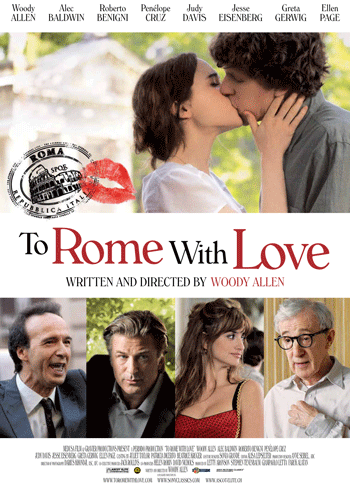
Checking out reviews of To Rome With Love (in theaters as of June 22), two stood out for their specific contrasts. One was a rave, from a publication not solely specializing in classical music, but from an opera newsy. The less complimenting piece centered on Allen’s relationship to the arts and how that influenced the construct of the film. The rave set aside particular positive attention for an opera singer by the name Armiliato. To Rome With Love, then, is a convergence of Allen and opera, as it is a convergence of Allen and Armiliato and their two characters.
Fabio is one of two Armiliatos to leave an imprint in opera today. Marco is a conductor that has had great success leading major orchestras at major theaters, through major opera assignments the world over. Fabio’s career has progressed so that he has become one of the premiere exponents of the dramatic repertory. Aside from a Tosca experience (and a Carmen one involving a sword and an Armiliato extremity) that would be difficult to make up, there is little indication why he would appear in Allen’s film. It turns out that Armiliato is a natural in Allen’s nearly probable satirical environment; I appear to have enjoyed Armiliato more than the reviewer that appraised his presence “charming.”
F. Armiliato singing at ‘red-carpet’ event promoting To Rome With LoveGenoese Armiliato plays Giancarlo, the owner of a funerary home shoppe in a strip mall. He is what you’d expect from a caricature of this persona and as the film gets underway, Armiliato gets lost in it. He is sullen and dry and flat, that is until he cleanses off embalming fluid and rigor mortis at the end of the work day and produces those big, operatically-trained sounds of Armiliato’s in the shower.
Setting the character’s temperament aside, Armiliato is warm and appears comfortable on camera. He also has a way with playing the ridiculous smoothly, and with having humor and irony fade into one another. If Allen has a gift for writing in absurdities that are nevertheless easy for actors to identify with, opera singer Armiliato seemed to easily find that place in the “filmy” climate. In opera, Armiliato’s reception steers sharply in the direction of physique (“tall, dark and handsome”), presence (“animal-like magnetism”) and greater still towards his voice — style and taste. Of his dramatics on stage, the general consensus is, well, quiet. This is a good thing in opera. It worked to an advantage in To Rome With Love.
There is nothing left to be desired from this soundtrack (per Armiliato) stacked up against the best recorded material of Del Monaco. The miking and its exposure tells us more about what Armiliato does vocally. It is a hearty, if a bit thick, and well-supported sound that rises fully through the range. It is singing that sets itself apart in knowing the music and for a strong sense of the style (mostly versimo). On the opera stage, Armiliato’s tone sounds like it falls short of the pitch in the very lower parts of the range but the middle and high range singing, squillante e potente, is from a voice opera-special and movie-star handsome.
This absolutely startles (even if your expecting it) and begins Allen’s character’s mind to churn when he visits his daughter (played by Alison Pill) and her boyfriend (played Flavio Parenti) — son of mortician. Allen’s character (Jerry) is a bit change of pace for him. He still has lots to say, and says it with the tense and torn interlocution that we’ve come to expect. But the direction of the message is “out of character.”
As a more careful than wise elder-statesman (a funny turn in it’s own right), he is less believable pinning the label of communist revolutionary on his daughter’s beau. As a cutting-edge opera-director, the kind that seeks to reinvent, update and upset all things traditional in opera, he is at least theoretically more in his element. The story doesn’t play like it’s about him anyway, or even like the ideas are bounced off him as happens in Allen’s early works.
The convergence of opera and Allen in film is poetic for the director, a convergence of fortune and the fantastic: an extraordinary talent (Ginacarlo’s) that only surfaces in the shower and a director (Jerry), in an outside-imposed professional asylum, that has no qualms about fitting this into the plot twist of Pagliacci in a major opera house. But before anyone is aware of the limitations of this talent, Jerry seeks the advice of others. The first to object is Michelangelo (Giancarlo’s son), with loud warnings of his father becoming a product, a cog and bourgeois puppet. His son sees him as fine as he is.
Giancarlo strongly agrees at first. And before you know it, the film turns to an audition, with presumably opera-elites in jury. Here we get to probably the funniest moment with regards to singing in the film. “Nessun Dorma” is already going badly, hacked up, strained high notes, no signs of the enormously gifted voice heard coming from the shower of the Giancarlo home. Then, the final note arrives. In mid-scream, Armiliato contorts his face to match, sticking-out his tongue in, possibly, a last ditch effort to loosen his voice. Or, possibly, Armiliato is sticking it out at us, the audience.
Allen’s To Rome With Love goes only so much farther into opera than many a film, and other parts of the ensemble set pieces that are the director’s forte also play to the world of opera, to love, infatuation, and the fickle nature and folly of fame.
Judy Davis (Phyllis) is again an Allen wife, less frustrated by the predicaments he has for her this time around. Roberto Benigni (Leopoldo) is a nobody who has celebrity suddenly thrust on him for no apparent reason. A young man (played by Alessandro Tiberi) loses his girlfriend (played by Alessandra Mastronardi) but gains Penelope Cruz (Anna), a lady-of-the-night that knocks on the wrong hotel door (“sono tutta tua,” she says to him, things have been paid for). This leads to some of the best comedic moments of the film. Jesse Eisenberg, Greta Gerwig, and Ellen Page (young Jack, Sally, and Monica) help Alec Baldwin (older Jack) relive an after-college year in Italy, with Baldwin meeting that younger Jack struggling to make sense of the world.
To open and close the film, this world is directed by a polizia (Pierluigi Marchionne). From the pedestal of a traffic circle in “every street” Rome, this character muses to the audience of the events and world that pass around, this world where Allen, opera, and Armiliato, meet.
Robert Carreras