Subscribe to
Opera Today

Receive articles and news via RSS feeds or email subscription.


twitter_logo[1].gif


UCP_9780226043425.gif

Recently in Performances

Domingo Conducts Holdridge’s New Opera Dulce Rosa

Dulce Rosa, a brand new opera, had its world premiere Friday night, May 17, 2013 at the Broad Stage in Santa Monica, California. It was produced by Los Angeles Opera, but staged in the smaller theater.

Verdi’s Falstaff at Glyndebourne

Richard Jones’ 2009 production of Verdi’s Falstaff translates the action from the first Elizabethan age to the start of the second.

Gareth John, Wigmore Hall

Baritone Gareth John is rapidly accumulating a war-chest of honours. Winner of the 2013 Kathleen Ferrier Award, he recently won the Royal Academy of Music Patrons’ Award and was presented the Silver Medal by the Worshipful Company of Musicians.

La bohème at ENO

This second revival of Jonathan Miller’s La bohème was the first time I had caught the production.

Rolando Villazón: Verdi (International Opera Stars Series 2013)

It’s Verdi’s bicentenary year and Rolando Villazón has two new CDs to plug — titled somewhat confusingly, ‘Villazón: Verdi’ and ‘Villazón’s Verdi’, the latter a ‘personal selection’ of favourite numbers performed by stars of the past and present.

Brahms Third in San Francisco

Nicola Luisotti and the San Francisco Opera Orchestra climbed out of the War Memorial pit, braved the wind whipped bay and held spellbound an audience at Cal Performances’ Zellerbach Auditorium at UC Berkeley.

Glyndebourne: Ariadne auf Naxos

Utterly mad but absolutely right — Richard Strauss’s Ariadne auf Naxos started the Glyndebourne 2013 season with an explosion. Strauss could hardly have made his intentions more clear. Ariadne auf Naxos is not “about” Greek myth so much as a satire on art and the way art is made.

Wozzeck at ENO

“Man is an abyss. It makes one dizzy to look into it.” So utters Georg Büchner’s Woyzeck, repeating what was also a recurring motif in the playwright’s own letters.

Mulhouse: Rare Britten Well Done

National Opera Company of the Rhine has marked this year’s Benjamin Britten celebration with a remarkably compelling, often gripping new production of the seldom-seen Owen Wingrave.

Frankfurt's Intriguing Idomeneo

Once upon a time, Frankfurt Opera had the baddest ass reputation in Germany as “the” cutting edge producer of must-see opera.

Rigoletto at Lyric Opera of Chicago

Productions of Giuseppe Verdi’s Rigoletto can serve as a vehicle for individual singers to make a strong impression and become afterward associated with specific roles in the opera.

Britten Sinfonia with Ian Bostridge

Just in case we were not aware that the evening’s programme was ‘themed’, the Britten Sinfonia designed a visual accompaniment to their musical exploration of night, sleep and dreams.

Aida, Manitoba Opera

Poor Aida! She never seems to have anything go her way.

Superlative singing: Don Carlo, Royal Opera House

Is it possible to upstage Jonas Kaufmann? Kaufmann was brilliant in this Verdi Don Carlo at the Royal Opera House, London, but the rest of the cast was so good that he was but first among equals. Don Carlo is a vehicle for stars, but this time the stars were everyone on stage and in the pit. Even the solo arias, glorious as they are, grow organically out of perfect ensemble. This was a performance that brought out the true beauty of Verdi's music.

Sarah Connolly: French Song at Wigmore Hall

The big names were absent: Duparc, D’Indy, Debussy, Ravel … and while Fauré, Chausson, Roussel and several members of Les Six put in an appearance, in less than familiar guises, this survey of French song of the early 20th century and interwar years deliberately took us on a journey through infrequently travelled terrain.

Rare restoration: Handel’s Esther 1720

Composed between 1718 and 1720, Handel’s Esther is sometimes described as the ‘first English Oratorio’, but is in fact a hybrid form, mixing elements of oratorio, masque, pastoral and opera.

The Damnation of Faust, London

Hector Berlioz's légende dramatique, La Damnation de Faust, exists somewhere between cantata and opera. Berlioz's flexible attitude to dramatic form made the piece unworkable on the stages of early 19th century Paris and his music is so vivid that you wonder whether the piece needs staging at all.

Elizabeth Connell Memorial Concert, St John's Smith Square

St. John’s Smith Square was the site of Elizabeth Connell’s final London concert, intended as a farewell to London on her moving to Australia. It was rendered ultimately final by her unexpected death.

Aida with all the Trimmings, Even a Blue Silk Elephant!

With the building of the Suez Canal, Egypt became more interesting to Western Europeans. Khedive Ismail Pasha wanted a hymn by Verdi for the opening of a new opera house in Cairo, but the composer said he did not write occasional pieces.

Die Zauberflöte, Royal Opera

Back for its fourth revival, David McVicar’s 2003 production of Mozart’s Die Zauberflöte has much charm, beauty and artistry.

OPERA TODAY ARCHIVES »

Performances

Felix Mendelssohn
16 Nov 2012

A Celebration of Mendelssohn Song

The Wigmore Hall Celebration of Mendelssohn Song series culminated in a recital of works by Felix and Fanny Mendelssohn and by Robert and Clara Schumann. The programme was very well chosen because Felix, Fanny, Robert and Clara knew each other..

Felix Mendelssohn, Fanny Mendelssohn Hensel, Robert Schumann, Clara Schumann

Susan Gritton, Sarah Connolly, Eugene Asti

Wigmore Hall, London 10th November 2012

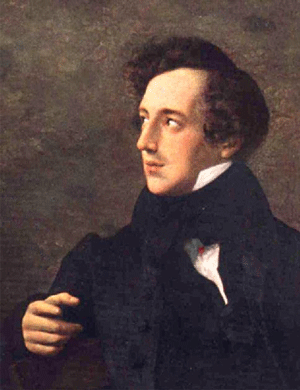
Above: Felix Mendelssohn


Susan Gritton, Sarah Connolly and Eugene Asti began the recital with duets, affirming the theme of companionship and symbiosis. Three contrasting settings of Heinrich Heine, including the famous Wasserfahrt op 50/4 which Felix Mendelssohn wrote shortly before the Schumanns married, inspiring Robert Schumann's Liederjahre. Heine's text suggests connections with Winterreise. The poet leaves his homeland. He passes his sweetheart's home but she shows no sign of interest, so he sails off into the unknown, blinded by tears. There's irony in the way the voices intertwine, though there's no hope for the relationship. The piano part describes waves: the ocean is impersonal, constantly changing, obliterating the past.

Fanny Mendelssohn Hensel wrote almost 400 works, a significant output for a woman in her social circle. Her Five Lieder op 10 reflect her intellectual rigour. Fanny endured a long engagement because Wilhelm Hensel worked in Italy, so her setting of Hensel's poem, Nach Süden (op 10/1), had deep personal meaning. The theme of separation may have resonated with her brother after her death, for he included it as the first song in this posthumous publication. Nonetheless it's very well written: Felix would not have included anything less in a tribute to his much missed sister. It bears comparison with Fanny's settings of Lenau, Geibel and Eichendorff. These were all contemporaries: Fanny was setting "new" poetry, choosing poets who were to inspire generations of composers to come.

In Vorwurf, (op 10/2), she confronts the bleakness of Lenau's verse without compromise. The suggestion of ponderous footsteps in the piano part suggests gloom, but the stern reproach in the second strophe indicates strong-minded resolution.: no escape into "romantic" passivity. The vine imagery in the Geibel setting Im Herbst (op 10/4) inspires luscious curling symmetries Most beautiful, perhaps, is the Eichendorff setting Bergeslust, (op10/5), the last piece she wrote before she died. The introduction is written with great freedom evoking the open vistas of a mountain top. Clouds drift down, and birds descend, but "Gedanken gehn und Lieder fort bis ins Himmelreich". Voice and piano join in unison.

Susan Gritton's recording of Fanny Mendelssohn Songs for Hyperion is a a classic, but on this occasion she may have been unwell, for she was not on her usual form. Nonetheless, she has worked so closely with Eugene Asti that he could compensate. He played with sensitivity, protecting Gritton so she wasn't exposed. Later in the evening, she regained her composure. In Lieder, as in life, partnership like this benefits performance. Very much in keeping with the theme of companionship that ran through this programme. It's not for nothing that Asti is one of the great champions of Mendelssohn song in recital.

Eugene Asti and Sarah Connolly have also worked closely together in Mendelssohn. Connolly sang Mendelssohn's Six Songs op 71 with great poise. Intelligent phrasing, clear diction, a nice burnished tone. I specially liked the Lenau setting Schilflied (1842) where the poet describes the stillness of a pond in the monlight, where deer and birds move among the reeds. ".....träumerisch im tiefen Rohr", sang Connolly, breathing into the vowels with great feeling. The Eichendorff setting Nachtlied (1847) is exquiste, at once elegaic and elegant. Night has descended, with intimations of death. But the poet isn't alone "Frisch auf dem, liebe Nachtigall ! du Wasserfall mit hellen Schall!" The song of the nightingale lights up the gloom with a cascade of bright, refershing song. Gentle diminuendo in the postlude, like embers glowing in the darkness.

If anything, Robert Schumann was even more sensitive to poetry than the Mendelssohns. Schumann's Spanisches Liederspiel (op 74, 1849) set Geibel's verses describing an exotic, imaginary Spain. The three songs chosen from the set depict flowers and sensual perfumes. In Botschaft, "Tausend Blumen, tauumflossen", piano and vocal lines entwine like garlands, intoxicating the listener, drawing him into a world of possibly illicit passion. In their own ways, Mendelssohn and Schumann contributed towards the Romantic challenge to the aesthetic of North German Protestant propriety. It's no coincidence that Hugo Wolf worshipped Schumann, wrote his own Spansiches Liederbuch (also to Geibel and Heyse) and operas based on Spanish themes.

Clara Schumann was a contemporary of Chopin and Liszt. Like them, she had an international celebrity career. She was an independent breadwinner in a way that Fanny Mendelssohn could not be, constrained as she was by her higher social status. By any standards, Clara Schumann was a pioneer, but Robert wanted her to be a composer, too. Songs like Lorelei and Volkslied (both Heine) charm because they're so descriptive. But her instrument was the piano, not voice. The bitter tragedy of Heine's Sie liebren sich beide (op 13/2 1842) didn't bite, though Asti's accompaniment was accomplished.

Susan Gritton sang Robert Schumann's Six Poems of Nikolaus Lenau (op 90) picking up nicely. Lyrical as these songs are, there are tricky moments, like the tongue twister "vom stillen Strahl des Schmerzens bist du gebeugt und blasser" in Meine Rose. Sarah Connolly returned for the op 90 Requiem "Ruh' von schmerzensreichen Mühen".

Anne Ozorio
Send to a friend

Send a link to this article to a friend with an optional message.

Friend's Email Address: (required)

Your Email Address: (required)

Message (optional):