![Brandon Jovanovich as Pinkerton and Oksana Dyka as Cio-Cio-San [Photo by Robert Millard courtesy of Los Angeles Opera]](http://www.operatoday.com/MdB2158.gif)
28 Nov 2012
Madame Butterfly, LA Opera
A beautiful, blingless Butterfly. How else to describe the pleasures of four glorious voices singing Puccini’s heart breaking, passionate melodies without igniting romantic sparks?
English Touring Opera are delighted to announce a season of lyric monodramas to tour nationally from October to December. The season features music for solo singer and piano by Argento, Britten, Tippett and Shostakovich with a bold and inventive approach to making opera during social distancing.
This tenth of ten Live from London concerts was in fact a recorded live performance from California. It was no less enjoyable for that, and it was also uplifting to learn that this wasn’t in fact the ‘last’ LfL event that we will be able to enjoy, courtesy of VOCES8 and their fellow vocal ensembles (more below …).
Ever since Wigmore Hall announced their superb series of autumn concerts, all streamed live and available free of charge, I’d been looking forward to this song recital by Ian Bostridge and Imogen Cooper.
Although Stile Antico’s programme article for their Live from London recital introduced their selection from the many treasures of the English Renaissance in the context of the theological debates and upheavals of the Tudor and Elizabethan years, their performance was more evocative of private chamber music than of public liturgy.
Evidently, face masks don’t stifle appreciative “Bravo!”s. And, reducing audience numbers doesn’t lower the volume of such acclamations. For, the audience at Wigmore Hall gave soprano Elizabeth Llewellyn and pianist Simon Lepper a greatly deserved warm reception and hearty response following this lunchtime recital of late-Romantic song.
For this week’s Live from London vocal recital we moved from the home of VOCES8, St Anne and St Agnes in the City of London, to Kings Place, where The Sixteen - who have been associate artists at the venue for some time - presented a programme of music and words bound together by the theme of ‘reflection’.
'Such is your divine Disposation that both you excellently understand, and royally entertaine the Exercise of Musicke.’
‘And there was war in heaven: Michael and his angels fought against the dragon; and the dragon fought and his angels, And prevailed not; neither was their place found any more in heaven … that old serpent … Satan, which deceiveth the whole world: he was cast out into the earth, and his angels were cast out with him.’
There was never any doubt that the fifth of the twelve Met Stars Live in Concert broadcasts was going to be a palpably intense and vivid event, as well as a musically stunning and theatrically enervating experience.
‘Love’ was the theme for this Live from London performance by Apollo5. Given the complexity and diversity of that human emotion, and Apollo5’s reputation for versatility and diverse repertoire, ranging from Renaissance choral music to jazz, from contemporary classical works to popular song, it was no surprise that their programme spanned 500 years and several musical styles.
The Academy of St Martin in the Fields have titled their autumn series of eight concerts - which are taking place at 5pm and 7.30pm on two Saturdays each month at their home venue in Trafalgar Square, and being filmed for streaming the following Thursday - ‘re:connect’.
The London Symphony Orchestra opened their Autumn 2020 season with a homage to Oliver Knussen, who died at the age of 66 in July 2018. The programme traced a national musical lineage through the twentieth century, from Britten to Knussen, on to Mark-Anthony Turnage, and entwining the LSO and Rattle too.
With the Live from London digital vocal festival entering the second half of the series, the festival’s host, VOCES8, returned to their home at St Annes and St Agnes in the City of London to present a sequence of ‘Choral Dances’ - vocal music inspired by dance, embracing diverse genres from the Renaissance madrigal to swing jazz.
Just a few unison string wriggles from the opening of Mozart’s overture to Le nozze di Figaro are enough to make any opera-lover perch on the edge of their seat, in excited anticipation of the drama in music to come, so there could be no other curtain-raiser for this Gala Concert at the Royal Opera House, the latest instalment from ‘their House’ to ‘our houses’.
"Before the ending of the day, creator of all things, we pray that, with your accustomed mercy, you may watch over us."
The doors at The Metropolitan Opera will not open to live audiences until 2021 at the earliest, and the likelihood of normal operatic life resuming in cities around the world looks but a distant dream at present. But, while we may not be invited from our homes into the opera house for some time yet, with its free daily screenings of past productions and its pay-per-view Met Stars Live in Concert series, the Met continues to bring opera into our homes.
Music-making at this year’s Grange Festival Opera may have fallen silent in June and July, but the country house and extensive grounds of The Grange provided an ideal setting for a weekend of twelve specially conceived ‘promenade’ performances encompassing music and dance.
There’s a “slide of harmony” and “all the bones leave your body at that moment and you collapse to the floor, it’s so extraordinary.”
“Music for a while, shall all your cares beguile.”
The hum of bees rising from myriad scented blooms; gentle strains of birdsong; the cheerful chatter of picnickers beside a still lake; decorous thwacks of leather on willow; song and music floating through the warm evening air.
A beautiful, blingless Butterfly. How else to describe the pleasures of four glorious voices singing Puccini’s heart breaking, passionate melodies without igniting romantic sparks?
And strangely, though the opening night of the Los Angeles Opera’s production of Puccini’s popular work, was just such a performance, I enjoyed almost every minute of it. Then I got home and wondered why.
The libretto of Madame Butterfly by Luigi Silica and Giuseppe Giacosa (the opera premiered in 1904) did not begin life as a sexy story. Its origin is said to lie in the true story of a Japanese woman, named Tsuru Yamamura, who in the previous century had a son by an Englishman, and who attempted suicide when he abandoned her.
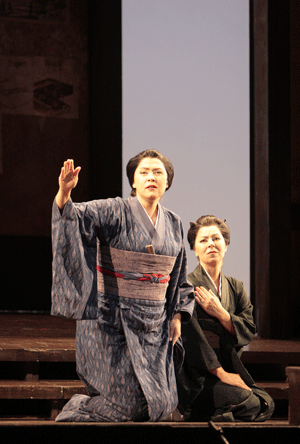 Oksana Dyka as Cio-Cio-San and Milena Kitic as Suzuki
Interest in Japan, newly opened to the West, was international in those years. In 1887 French author, Pierre Loti, a retired Naval officer’s published a fictional memoir of a Geisha dedicated to “Madame la Duchesse de Richelieu.” Loti’s Geisha, Madame Chrysanthème, marries a Caucasian and is depicted, after his departure, counting the money she received from him, as she awaits a new husband. In 1898 American writer, John Luther Long, created a highly romanticized and tragic tale of a Geisha he called Cio-Cio San. “Chou” is the American transliteration of the word meaning Butterfly in Japanese. The young girl, urged on by her American Naval officer husband, gives up her family and religion to take on her role as an American wife. When her husband returns years later with a true American wife, Butterfly kills herself with her father’s sword. David Belasco’s play, based on Long’s piece and famously cited as the inspiration for Puccini’s opera, consists of only one act — at it’s premiere its companion piece was a farce. It does not contain a love scene, but opens just at the moment Pinkerton is about to return. Belasco enhanced the theatrical heartbreak of Long’s story by staging Cio-Cio San’s vigil for Pinkerton with not a word spoken on stage as lighting shifted from day to night and back to day. And he added Pinkerton’s dramatic appearance after Cio-Cio San’s death.
The story of the abandoned Geisha appeared in world literature at a time when verismo was fading from the Italian operatic scene (Puccini’s next heroine was gun-toting Minnie) but realism was still a factor in American writing. It was a time when playwrights and novelists writing about foreigners and regional Americans were turning out dialogue in ill transliterated dialects. We, in 2012, need to be grateful not only to Puccini for setting Butterfly’s story to his exotic score, but to his librettists, Giuseppe Giacosa and Luigi Illica for the poetic words they wrote for her. One cannot in this day and age read the pidgin English that both Long and Belasco put into Butterfly’s mouth without cringing.
Although this production of Madame Butterfly is new to Los Angeles, it originated in San Francisco. The sets consist primarily of sliding shoji screens moved about by what I assume were inconspicuously attired stage hands. As one would expect there are few furnishings — certainly no chairs, the whole, imparting a quiet, uncluttered look. Unfortunately, however, just before the love duet, the center screens part to show an American double bed with thick iron bars for its footboard and headboard. I don’t know what it was supposed to add to the scene. All it added for me was jarring ugliness.
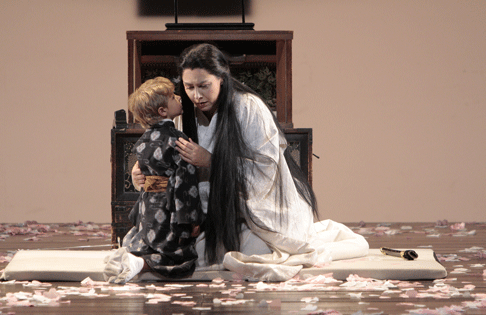 Oksana Dyka as Cio-Cio-San, with Patrick Lucaric as her child
Soprano Oksana Dyka, who made her company debut last year year as Tatyana in Eugene Onegin, held back her large voice in the early moments of the first act as the shy Butterfly, but let it soar thereafter in Puccini’s long melodic lines. However, the subtleties of the young girl’s fears and desires eluded her in the love scene. And whether it was poor direction, or some momentary slip, her suicide was poorly staged. Brandon Jovanovich, just returned from singing Lohengrin in San Francisco, was as usual a lithe, handsome Pinkerton, and sang with bright clear sound. Bass baritone Eric Owens, luxury casting as the American consul, Sharpless, who warns Pinkerton of the heartbreak he was likely to cause with this temporary liaison, appeared at times to be emotionally distant from Butterfly. I wondered whether it was a deliberate approach to playing Sharpless, or perhaps the effect of singing so many exciting Alberichs. Milena Kitic, an unusually clear voiced mezzo, was Suzuki, Cio-Cio San’s maidservant. I have never seen as angry a Bonze — that is, Cio-Cio San’s uncle, who accuses her of abandoning her people and her religion in marrying Pinkerton — as was Stefan Szkafarowsky. One had the feeling this singer had been waiting in the wings all evening for his chance to explode on the audience. Rodell Rosel pranced about and sang well as Goro, who brokered both the marriage and the house for Pinkerton. Museop Kim, a singer I enjoyed in the company’s La Bohème last year, as Yamadori, and D’Ana Lombard as Kate, Pinkerton’s American wife, did well in their brief parts.
Madame Butterfly, for which Puccini spent months studying with Japanese musicians, and which incorporates Japanese harmonies and folk melodies, is nevertheless one of his most accessible scores. From first note to last, it is essentially love music — music that tells over and over about love and longing. In this performance the Los Angeles Opera orchestra under its resident conductor Grant Gershon, supplied passion, intriguing orchestral support and the sparkle that sometimes seemed lacking on stage.
Yes, there were distractions and flaws: that gross “American” bed in a serene Japanese setting, not much sexual tension as Pinkerton pleads with his new wife to join him in it, and an ill thought out ending in which Butterfly hears Pinkerton call her name before stabbing herself and nevertheless, proceeds to do it. Why? For the silly childish thought,“Some day you’ll find me dead and you’ll be sorry”?
Yet I had enjoyed the performance. And now I know why — because whatever flaws there may have been in this production, whatever it may have lacked in sparkle, it was a performance filled with lyricism in which orchestra and voices made us aware of Puccini’s poignant affection for each of his characters — and because Puccini’s opera is not about sparks or sex. It’s about the original, sad story of Tsuru Yamamura, a story as old as our world, in which nations and people still do not view each other as equals. Madame Butterfly is an opera about the exploitation by a man of a dependent woman’s freely and fully given love and its subsequent heartbreak. And this, the Los Angeles Opera conveyed fully.
Estelle Gilson
Cast and Production
Cio-Cio San: Oksana Dyka; B.F. Pinkerton:Brandon Jovanich; Suzuki:Milena Kitic; Sharpless: Eric Owen; Goro:Rodell Rosel; The Bonze: Stefan Szkafrowsky; Prince Yamadori:Museop Kim; Kate Pinkerton: D’Ana Lombard. Conductor: Grant Gershon. Director: Ron Daniels. Scenery and Costume Designer: Michael Yeargan. Lighting Designer:Stephen Strawbridge.