Subscribe to
Opera Today

Receive articles and news via RSS feeds or email subscription.


twitter_logo[1].gif


UCP_9780226043425.gif

Recently in Performances

Gareth John, Wigmore Hall

Baritone Gareth John is rapidly accumulating a war-chest of honours. Winner of the 2013 Kathleen Ferrier Award, he recently won the Royal Academy of Music Patrons’ Award and was presented the Silver Medal by the Worshipful Company of Musicians.

La bohème at ENO

This second revival of Jonathan Miller’s La bohème was the first time I had caught the production.

Rolando Villazón: Verdi (International Opera Stars Series 2013)

It’s Verdi’s bicentenary year and Rolando Villazón has two new CDs to plug — titled somewhat confusingly, ‘Villazón: Verdi’ and ‘Villazón’s Verdi’, the latter a ‘personal selection’ of favourite numbers performed by stars of the past and present.

Brahms Third in San Francisco

Nicola Luisotti and the San Francisco Opera Orchestra climbed out of the War Memorial pit, braved the wind whipped bay and held spellbound an audience at Cal Performances’ Zellerbach Auditorium at UC Berkeley.

Glyndebourne: Ariadne auf Naxos

Utterly mad but absolutely right — Richard Strauss’s Ariadne auf Naxos started the Glyndebourne 2013 season with an explosion. Strauss could hardly have made his intentions more clear. Ariadne auf Naxos is not “about” Greek myth so much as a satire on art and the way art is made.

Wozzeck at ENO

“Man is an abyss. It makes one dizzy to look into it.” So utters Georg Büchner’s Woyzeck, repeating what was also a recurring motif in the playwright’s own letters.

Mulhouse: Rare Britten Well Done

National Opera Company of the Rhine has marked this year’s Benjamin Britten celebration with a remarkably compelling, often gripping new production of the seldom-seen Owen Wingrave.

Frankfurt's Intriguing Idomeneo

Once upon a time, Frankfurt Opera had the baddest ass reputation in Germany as “the” cutting edge producer of must-see opera.

Rigoletto at Lyric Opera of Chicago

Productions of Giuseppe Verdi’s Rigoletto can serve as a vehicle for individual singers to make a strong impression and become afterward associated with specific roles in the opera.

Britten Sinfonia with Ian Bostridge

Just in case we were not aware that the evening’s programme was ‘themed’, the Britten Sinfonia designed a visual accompaniment to their musical exploration of night, sleep and dreams.

Aida, Manitoba Opera

Poor Aida! She never seems to have anything go her way.

Superlative singing: Don Carlo, Royal Opera House

Is it possible to upstage Jonas Kaufmann? Kaufmann was brilliant in this Verdi Don Carlo at the Royal Opera House, London, but the rest of the cast was so good that he was but first among equals. Don Carlo is a vehicle for stars, but this time the stars were everyone on stage and in the pit. Even the solo arias, glorious as they are, grow organically out of perfect ensemble. This was a performance that brought out the true beauty of Verdi's music.

Sarah Connolly: French Song at Wigmore Hall

The big names were absent: Duparc, D’Indy, Debussy, Ravel … and while Fauré, Chausson, Roussel and several members of Les Six put in an appearance, in less than familiar guises, this survey of French song of the early 20th century and interwar years deliberately took us on a journey through infrequently travelled terrain.

Rare restoration: Handel’s Esther 1720

Composed between 1718 and 1720, Handel’s Esther is sometimes described as the ‘first English Oratorio’, but is in fact a hybrid form, mixing elements of oratorio, masque, pastoral and opera.

The Damnation of Faust, London

Hector Berlioz's légende dramatique, La Damnation de Faust, exists somewhere between cantata and opera. Berlioz's flexible attitude to dramatic form made the piece unworkable on the stages of early 19th century Paris and his music is so vivid that you wonder whether the piece needs staging at all.

Elizabeth Connell Memorial Concert, St John's Smith Square

St. John’s Smith Square was the site of Elizabeth Connell’s final London concert, intended as a farewell to London on her moving to Australia. It was rendered ultimately final by her unexpected death.

Aida with all the Trimmings, Even a Blue Silk Elephant!

With the building of the Suez Canal, Egypt became more interesting to Western Europeans. Khedive Ismail Pasha wanted a hymn by Verdi for the opening of a new opera house in Cairo, but the composer said he did not write occasional pieces.

Die Zauberflöte, Royal Opera

Back for its fourth revival, David McVicar’s 2003 production of Mozart’s Die Zauberflöte has much charm, beauty and artistry.

The Marriage of Figaro Ends Season at Arizona Opera

Wolfgang Amadeus Mozart's opera The Marriage of Figaro has a libretto by Lorenzo daPonte based on the French play La folle journée, ou le Mariage de Figaro (The Crazy Day or the Marriage of Figaro) by Pierre Caron de Beaumarchais (1732-1799).

Baden’s Flute Goes Barefoot in the Park

For its world class Easter Festival, Baden-Baden mounted a Die Zauberflöte that owed more to the grey penitential doldrums of Lent than to the unbridled jubilance of re-birth.

OPERA TODAY ARCHIVES »

Performances

Brian Jagde as Cavaradossi and Patricia Racette as Tosca [Photo by Cory Weaver courtesy of San Francisco Opera]
18 Nov 2012

More Tosca in San Francisco

Who is Patricia Racette? Sexually ripe Nedda, maternal Cio-Cio-San, neurotic Sister Angelica? But now the jealous Tosca? And without question Mme. Racette has again proven herself the Puccini heroine par excellence of this moment.

More Tosca in San Francisco

A review by Michael Milenski

Above: Brian Jagde as Cavaradossi and Patricia Racette as Tosca

Photos by Cory Weaver courtesy of San Francisco Opera


Patricia Racette is a powerful lyric soprano who like all great singers possesses a unique voice, its signature sound is the interplay of excited overtones. This excitement, these vocal nerve endings possess all of these Puccini victims, and transmit their vulnerability, their super human strength, their beauty, above all a melodramatic feminine humanity that has endured one full century now, and will still be real as long as there may be humankind.

Mme. Racette is a committed and skilled actress, but more so she is an honest artist. Her voice is in its prime, as it has been and will be for some time. To her voice she adds intelligent and straight forward musicianship that ties us securely to her character, thus we are held captive by her very presence even in the numerous pantomimes when Tosca does not sing, but silently observes the murdered Scarpia, and approaches the dead Cavaradossi. It is her rock solid artistry in service to real human drama that seduces us.
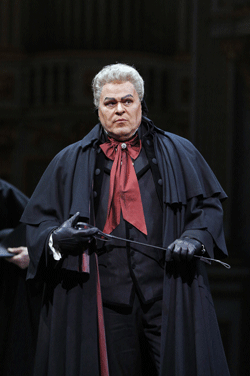
06--Tosca.gifMark Delavan as Scarpia

If in the first act la Racette does not find the persona of a jealous diva, one we suspect we would find in the more usual spinto voiced Tosca. Racette does persuade us that she is a woman in love, and a woman vulnerable to powerful men, fiery revolutionaries and corrupt functionaries. At the opera’s end, finally trapped by these forces she frees herself in her dramatic leap. And what a leap it was — in spread eagle form, the euphoria of liberation. Patricia Racette is a bona fide diva.

These days in the War Memorial when Nicola Luisotti is on the podium individual performances are tied to the pit, an aria is really a duet, and such was the case last night in a stunning delivery of Vissi d’arte, the maestro in his euphoria of pillaging every possible tremor of feeling from a very willing orchestra, the soprano but a part of his larger whole. Scarpia and his henchmen plotting to ensnare Angelotti, Cavaradossi and Tosca captured with a musical force nearly equal to Verdi’s Otello, culminating in a Te Deum that had much more to do with Luisotti and Puccini and the joy of sheer power than with Scarpia.

The maestro plumbs a depth of sound and searches color in the orchestral voice, and only then pushes forward the flow of musical action. This creates a stop and go rhythm of often extreme tempos, fast or slow. Last night in the second act in particular these fluctuating tempos musically riveted us to the interplay of Tosca and her tormentor, and in the third act bound us to her nervous fear.

Tosca’s tormentor, the Scarpia of bass baritone Mark Delavan, was not driven by the pure, unadulterated lust that usually drives this politically privileged baron. Instead Delavan toyed with his power, the seduction of Tosca was played as a game with himself, as proof of his privilege, not as release of his unbridled libido. Delavan found a humanity in Puccini’s villain that was supremely ugly, more offensive than exercising sexual prowess. Utilizing the inherent beauty of his now mature voice he thoroughly embodied the bloated, entitled political aristocracy. This was Mark Delavan as an estimable artist. We would have expressed our appreciation had he stayed around for the bows at the end of the opera.
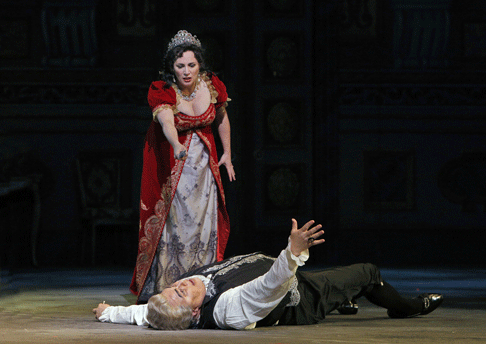
16--Tosca.gifMark Delavan as Scarpia and Patricia Racette as Tosca

Against all this, a quirk of impresario privilege, San Francisco Opera general director David Gockley cast an Adler Fellow as the artist and revolutionary tenor Cavaradossi. Young tenor Brian Jagde held his own to some degree, while definitely out of his league. He possesses a young, vibrant voice and secure high notes. He lacks the squillo that would make his voice Italianate, nor is he yet schooled in the style. There was the occasional catch that sometimes might have been the tenorial sob and other times might have been a momentary catch in an overburdened voice. While Mr. Jagde was abundantly rewarded by the crowd for his performance the fact remains that the War Memorial is not an appropriate stage for a young singer to break in a role.

Supporting roles were superbly cast. Christian Van Horn made a detailed and very present Attavanti who set the stage for a revolutionary tone to Puccini’s opera. Tenor Joel Sorensen etched a sniveling Spoletta, brutalized by Scarpia and Adler Fellow Ao Li was right-on as Sciarrone. Not to overlook the low key, masterful, not too intrusive Sacristan of Dale Travis.

The production was the 1997 remake of the 1923 production, and it is time to send it to the dump — its nostalgia has been lost and it is boring. The staging of this umpteenth revival was however masterfully managed by Jose Maria Condemi. Hopefully Mr. Condemi will write a book to reveal the now secret (maybe best left untold stories) of staging these San Francisco Opera Tosca follies.

Michael Milenski


Cast and Production

Floria Tosca: Patricia Racette; Mario Cavaradossi: Brian Jagde; Baron Scarpia: Mark Delavan; Angelotti: Christian Van Horn; Spoletta: Joel Sorensen; Sacristan: Dale Travis; Sciarrone: Ao Li; Jailer: Ryan Kuster; Shepherd Boy: Ryan Nelson-Flack. San Francisco Opera Orchestra and Chorus. Conductor: Nicola Luisotti; Stage Director: Jose Maria Condemi; Production Designer: Thierry Bosquet; Lighting Designer: Christopher Maravich. San Francisco War Memorial Opera House. November 16, 2012.

Send to a friend

Send a link to this article to a friend with an optional message.

Friend's Email Address: (required)

Your Email Address: (required)

Message (optional):