06 Dec 2012
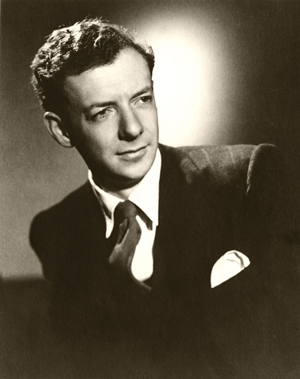
Britten: The Canticles
‘Canticle’ is the term Britten used to denote an extended setting of a text of spiritual substance.
English Touring Opera are delighted to announce a season of lyric monodramas to tour nationally from October to December. The season features music for solo singer and piano by Argento, Britten, Tippett and Shostakovich with a bold and inventive approach to making opera during social distancing.
This tenth of ten Live from London concerts was in fact a recorded live performance from California. It was no less enjoyable for that, and it was also uplifting to learn that this wasn’t in fact the ‘last’ LfL event that we will be able to enjoy, courtesy of VOCES8 and their fellow vocal ensembles (more below …).
Ever since Wigmore Hall announced their superb series of autumn concerts, all streamed live and available free of charge, I’d been looking forward to this song recital by Ian Bostridge and Imogen Cooper.
Although Stile Antico’s programme article for their Live from London recital introduced their selection from the many treasures of the English Renaissance in the context of the theological debates and upheavals of the Tudor and Elizabethan years, their performance was more evocative of private chamber music than of public liturgy.
Evidently, face masks don’t stifle appreciative “Bravo!”s. And, reducing audience numbers doesn’t lower the volume of such acclamations. For, the audience at Wigmore Hall gave soprano Elizabeth Llewellyn and pianist Simon Lepper a greatly deserved warm reception and hearty response following this lunchtime recital of late-Romantic song.
For this week’s Live from London vocal recital we moved from the home of VOCES8, St Anne and St Agnes in the City of London, to Kings Place, where The Sixteen - who have been associate artists at the venue for some time - presented a programme of music and words bound together by the theme of ‘reflection’.
'Such is your divine Disposation that both you excellently understand, and royally entertaine the Exercise of Musicke.’
‘And there was war in heaven: Michael and his angels fought against the dragon; and the dragon fought and his angels, And prevailed not; neither was their place found any more in heaven … that old serpent … Satan, which deceiveth the whole world: he was cast out into the earth, and his angels were cast out with him.’
There was never any doubt that the fifth of the twelve Met Stars Live in Concert broadcasts was going to be a palpably intense and vivid event, as well as a musically stunning and theatrically enervating experience.
‘Love’ was the theme for this Live from London performance by Apollo5. Given the complexity and diversity of that human emotion, and Apollo5’s reputation for versatility and diverse repertoire, ranging from Renaissance choral music to jazz, from contemporary classical works to popular song, it was no surprise that their programme spanned 500 years and several musical styles.
The Academy of St Martin in the Fields have titled their autumn series of eight concerts - which are taking place at 5pm and 7.30pm on two Saturdays each month at their home venue in Trafalgar Square, and being filmed for streaming the following Thursday - ‘re:connect’.
The London Symphony Orchestra opened their Autumn 2020 season with a homage to Oliver Knussen, who died at the age of 66 in July 2018. The programme traced a national musical lineage through the twentieth century, from Britten to Knussen, on to Mark-Anthony Turnage, and entwining the LSO and Rattle too.
With the Live from London digital vocal festival entering the second half of the series, the festival’s host, VOCES8, returned to their home at St Annes and St Agnes in the City of London to present a sequence of ‘Choral Dances’ - vocal music inspired by dance, embracing diverse genres from the Renaissance madrigal to swing jazz.
Just a few unison string wriggles from the opening of Mozart’s overture to Le nozze di Figaro are enough to make any opera-lover perch on the edge of their seat, in excited anticipation of the drama in music to come, so there could be no other curtain-raiser for this Gala Concert at the Royal Opera House, the latest instalment from ‘their House’ to ‘our houses’.
"Before the ending of the day, creator of all things, we pray that, with your accustomed mercy, you may watch over us."
The doors at The Metropolitan Opera will not open to live audiences until 2021 at the earliest, and the likelihood of normal operatic life resuming in cities around the world looks but a distant dream at present. But, while we may not be invited from our homes into the opera house for some time yet, with its free daily screenings of past productions and its pay-per-view Met Stars Live in Concert series, the Met continues to bring opera into our homes.
Music-making at this year’s Grange Festival Opera may have fallen silent in June and July, but the country house and extensive grounds of The Grange provided an ideal setting for a weekend of twelve specially conceived ‘promenade’ performances encompassing music and dance.
There’s a “slide of harmony” and “all the bones leave your body at that moment and you collapse to the floor, it’s so extraordinary.”
“Music for a while, shall all your cares beguile.”
The hum of bees rising from myriad scented blooms; gentle strains of birdsong; the cheerful chatter of picnickers beside a still lake; decorous thwacks of leather on willow; song and music floating through the warm evening air.
‘Canticle’ is the term Britten used to denote an extended setting of a text of spiritual substance.
‘Canticle’ is the term Britten used to denote an extended setting of a text of spiritual substance. The five Canticles span his career: the first dates from 1947, two years after the celebrated premiere of Peter Grimes; the last was composed in 1974, two years before the composer’s death. Britten’s texts are complex conceptually, semantically and syntactically. But, underpinning all five works is the blend of the spiritual, public and personal which characterises so much of the composer’s work.
This concert — which forms part of a three-week series of concerts celebrating Britten’s chamber music in anticipation of the composer’s centenary year in 2013, and also belongs to the series ‘A Singularity of Voice’, the title of countertenor Iestyn Davies’ residency at the Hall — presented a rare opportunity to hear the complete cycle of five works.
‘My beloved is mine’ is a musical meditation on a single line from the Song of Solomon, translated by the seventeenth-century poet Francis Quarles. Britten dedicated the work, and his choice of text, to Dick Sheppard who had been a founding member of the Peace Pledge Union, and at whose Memorial Concert in Westminster Central Hall it was first heard.
It is concentrated and quietly ecstatic, and tenor Mark Padmore immediately captured its quality of rapturous ethereality, the sparse airiness of the opening, with voice and piano moving discursively in diverging registers, increasingly enlivened by sudden injections of elated energy. Padmore’s searching melismas and the oriental tint of the Julius Drake’s piano accompaniment cohered to create a sense of distance and ‘strangeness’. After the recitative-like clarity of the central section, Padmore’s declamatory precision, which was punctuated by fragmentary piano interjections, gave way to more lyrical reflection — “He is my altar, I his holy place” — a low, syncopated piano gesture adding resonance and substance to the text: “He’s my supporting elm and I his vine;/ Thus I my best beloved’s am/ Thus he is mine.”
Padmore was joined by countertenor Iestyn Davies in the second canticle, ‘Abraham and Isaac’, a more dramatic work which enacts a variation on Britten’s favoured theme, the destruction of innocence. Recitative and aria alternate to create a single condensed structure, and the performers produced a seamless dramatic entity, the musical and dramatic climaxes cohering with impact. Turning their backs on the audience, Padmore and Davies intoned God’s words to Abraham instructing him to slay his son, Isaac, in sacrifice to his deity: their rhythmic homophony was unwavering but retained a touching translucency, a spiritual organum whose dissonances were both delicate and piercing. Padmore articulated Abraham’s responding recitative with warmth and intensity; turning to his son to explain his task, the tenor employed a clear, ringing high register which conveyed Abraham’s faith and resolution. In contrast, the vibrato-less purity of Davies’ trusting reply, “Father, I am all ready/ To do your bidding most meekëly”, set against Drake’s portentous staccato bass, was poignantly open and naïve.
As the sacrifice approached, Drake’s tremulous accompaniment enhanced the thrilling rhythmic dynamism which accrued, climaxing in a moment of astonishing and tense stillness, as Isaac, accepting his fate, asks for his father’s blessing. The leaping octaves of Davies’ unaccompanied line betrayed the equivocal emotions of the young boy, at once both steadfast and fearful, while his plea, “Father, do with me as you will”, was affectingly eloquent. Preparing to do God’s will, Padmore created a terrifying intensity, underlined by Drake’s disturbing bass pedals, climaxing in an apocalyptic tumult. Spared by a God in whom Abraham has demonstrated absolute faith, father and son join in an ‘Envoi’ of gentle counterpoint and consonance, Drake’s closing gesture creating a sense of integration and sweetness.
Electing to perform the Canticles out of sequence, the performers now delivered a startling change of mood, following such melodious resolution with the sparse sombreness of the fifth Canticle, a setting of T.S. Eliot’s early poem, ‘The Death of Narcissus’, which mediates on spiritual and creative striving and vision. Britten dedicated his setting to the writer William Plomer, his librettist of Gloriana and the church parables. The unique syntax of the text, and its oblique meaning, must have presented Britten with many challenges; his style here, and in the ‘The Journey of the Magi’, is concentrated in response to the multifarious nuances and strong cadences of Eliot’s poetry.
Padmore was joined by harpist Lucy Wakeford in an enigmatic performance. With characteristic alertness to the capacities and potentialities of particular instruments, Britten drew on the distinctive reverberations and harmonic resonances of the harp to create a mood of ambiguity and inscrutability. Here, the focused sobriety of the opening — “I will show you his bloody cloth and limbs. And the gray shadow on his lips” — enlarged into an energetic and expansive array of colours exploiting the harp’s full arc and scope: “First he was sure that he had been a tree,/ Twisting its branches among each other/And tangling its roots among each other. Wakeford’s articulation was simultaneously precise and sweeping; Padmore brought a dark mystery and sensuousness to his low range: “Because his flesh was in love with the burning arrows/ He danced on the hot sand.” In the final lines, “Now he is green, dry and stained/ With the shadow in his mouth”, Padmore’s ghostly modal ascent diminished into insubstantiality, while the harp’s sparing octaves dissolved into the air.
The journeying motif is present in all of the three last Canticles. Another setting of Eliot, the fourth Canticle, ‘Journey of the Magi’, explores the difficulty of grasping the significance of Christ’s birth, as the three Magi make their arduous journey through the desolate desert. Following an urgent, dissonant piano rumbling, the crisp rhythms of Padmore, Davies and baritone Marcus Farnsworth conveyed the energy of departure, the vocal close harmony underpinned by the lively punctuation of Drake’s accompanying ostinato. A boisterous vigour was conjured, “With a running stream and a water-mill beating the darkness … And an old white horse galloped away in the meadow”, the precisely delivered homophony suggesting a unity of thinking among the travellers.
Such sense of purposefulness was disturbed however by a prevailing unease, which erupts in Eliot’s final stanza, when the Magi reach their destination. Eliot is resentful and aggrieved: “I had seen birth and death/, But had thought they were different.” The singers’ focused, perfectly blended unison enhanced the sense of disturbance and fear, for the men will return to their Kingdoms of “alien people clutching their gods”. At this point, Britten introduces the plainchant ‘Magi videntes stellam’ in the piano and Drake relished the clanging strangeness which suggests the troubling disquiet of those who, so changed by what they have witnessed, “should be glad of another death”.
The recital closed with ‘Still Falls the Rain’, a setting of text from ‘The Canticle of the Rose’ by Edith Sitwell. This third Canticle was written following the suicide of Britten’s close friend Noel Mewton-Wood, and was first performed at the Wigmore Hall in January 1955 by the composer, Peter Pears and Dennis Brain. Padmore, perhaps inspired equally by the work’s history and Britten’s genius, rose to extraordinary heights of musical expression and discerning perceptivity, accompanied by the astonishingly sensitive horn playing of Richard Watkins.
Mimicking the variation structure of The Turn of the Screw, the work which immediately preceded it, this Canticle never settles, by turns expansive then austere, rhetorical and then reserved. Watkins exploited every timbre available, while Padmore found an astonishing range of colours in response to the nuances of the text, as exemplified by the startling change of tone from beauty to anger in the opening unaccompanied lines. Tempo was used to convey unrest, the staccato piano accompaniment and horn counterpoint indicative of the disturbing knowledge of man’s guilt: “the small hopes breed and the human brain/ Nurtures its greed, that worm with the brow of Cain.” Nowhere was the mood more despairing and angry than Padmore’s half-spoken outburst, “O Ile leape up to my God: who pulles me doune — ?”, a quotation from Marlowe’s Dr Faustus. The veiled quality of the tenor’s subsequent reflection on man’s human heart, “dark-smirched with pain/ As Caesar’s laurel crown”, painfully deepened the anguish.
Sitwell’s poem bears the subtitle, ‘The Raids, 1940, Night and Dawn’; she presents images from the Passion to reassure man of the continuing existence of God in a world torn apart by man’s inhumanity. If there had been any questioning about the non-chronological ordering of the Canticles, they were dispelled by the heartrendingly breathtaking close, voice and horn ultimately united in a brief but blissful moment of transcendence and reconciliation, the horn’s pianissimo almost unimaginably hushed: “’Still do I love, still shed my innocent light, my Blood, for thee.’”
Britten claimed that the canticles were ‘a new invention in a sense although … modelled on Purcell’s Divine Hymns’ . Here, surely, was music divine.
Claire Seymour
Wigmore Hall, London Friday 30th November 2012
Britten: The Canticles
Iestyn Davies countertenor Mark Padmore tenor Marcus Farnsworth baritone Richard Watkins horn Lucy Wakeford harp Julius Drake piano Britten
Canticle I: My beloved is mine Canticle II: Abraham and Isaac Canticle III: Still Falls the Rain — the Raids, 1940, Night and Dawn Canticle IV: Journey of the Magi Canticle V: The Death of Saint Narcissus