![Sondra Radvanovsky as Amelia and Marcelo Álvarez as Gustavo III [Photo by Ken Howard courtesy of The Metropolitan Opera]](http://www.operatoday.com/bal_1003a.png)
14 Dec 2012
The Met’s Un Ballo in Maschera difficult to unmask
Director David Alden’s confusing production concepts in Verdi’s A Masked Ball may make you wonder whether you came to the right party
English Touring Opera are delighted to announce a season of lyric monodramas to tour nationally from October to December. The season features music for solo singer and piano by Argento, Britten, Tippett and Shostakovich with a bold and inventive approach to making opera during social distancing.
This tenth of ten Live from London concerts was in fact a recorded live performance from California. It was no less enjoyable for that, and it was also uplifting to learn that this wasn’t in fact the ‘last’ LfL event that we will be able to enjoy, courtesy of VOCES8 and their fellow vocal ensembles (more below …).
Ever since Wigmore Hall announced their superb series of autumn concerts, all streamed live and available free of charge, I’d been looking forward to this song recital by Ian Bostridge and Imogen Cooper.
Although Stile Antico’s programme article for their Live from London recital introduced their selection from the many treasures of the English Renaissance in the context of the theological debates and upheavals of the Tudor and Elizabethan years, their performance was more evocative of private chamber music than of public liturgy.
Evidently, face masks don’t stifle appreciative “Bravo!”s. And, reducing audience numbers doesn’t lower the volume of such acclamations. For, the audience at Wigmore Hall gave soprano Elizabeth Llewellyn and pianist Simon Lepper a greatly deserved warm reception and hearty response following this lunchtime recital of late-Romantic song.
For this week’s Live from London vocal recital we moved from the home of VOCES8, St Anne and St Agnes in the City of London, to Kings Place, where The Sixteen - who have been associate artists at the venue for some time - presented a programme of music and words bound together by the theme of ‘reflection’.
'Such is your divine Disposation that both you excellently understand, and royally entertaine the Exercise of Musicke.’
‘And there was war in heaven: Michael and his angels fought against the dragon; and the dragon fought and his angels, And prevailed not; neither was their place found any more in heaven … that old serpent … Satan, which deceiveth the whole world: he was cast out into the earth, and his angels were cast out with him.’
There was never any doubt that the fifth of the twelve Met Stars Live in Concert broadcasts was going to be a palpably intense and vivid event, as well as a musically stunning and theatrically enervating experience.
‘Love’ was the theme for this Live from London performance by Apollo5. Given the complexity and diversity of that human emotion, and Apollo5’s reputation for versatility and diverse repertoire, ranging from Renaissance choral music to jazz, from contemporary classical works to popular song, it was no surprise that their programme spanned 500 years and several musical styles.
The Academy of St Martin in the Fields have titled their autumn series of eight concerts - which are taking place at 5pm and 7.30pm on two Saturdays each month at their home venue in Trafalgar Square, and being filmed for streaming the following Thursday - ‘re:connect’.
The London Symphony Orchestra opened their Autumn 2020 season with a homage to Oliver Knussen, who died at the age of 66 in July 2018. The programme traced a national musical lineage through the twentieth century, from Britten to Knussen, on to Mark-Anthony Turnage, and entwining the LSO and Rattle too.
With the Live from London digital vocal festival entering the second half of the series, the festival’s host, VOCES8, returned to their home at St Annes and St Agnes in the City of London to present a sequence of ‘Choral Dances’ - vocal music inspired by dance, embracing diverse genres from the Renaissance madrigal to swing jazz.
Just a few unison string wriggles from the opening of Mozart’s overture to Le nozze di Figaro are enough to make any opera-lover perch on the edge of their seat, in excited anticipation of the drama in music to come, so there could be no other curtain-raiser for this Gala Concert at the Royal Opera House, the latest instalment from ‘their House’ to ‘our houses’.
"Before the ending of the day, creator of all things, we pray that, with your accustomed mercy, you may watch over us."
The doors at The Metropolitan Opera will not open to live audiences until 2021 at the earliest, and the likelihood of normal operatic life resuming in cities around the world looks but a distant dream at present. But, while we may not be invited from our homes into the opera house for some time yet, with its free daily screenings of past productions and its pay-per-view Met Stars Live in Concert series, the Met continues to bring opera into our homes.
Music-making at this year’s Grange Festival Opera may have fallen silent in June and July, but the country house and extensive grounds of The Grange provided an ideal setting for a weekend of twelve specially conceived ‘promenade’ performances encompassing music and dance.
There’s a “slide of harmony” and “all the bones leave your body at that moment and you collapse to the floor, it’s so extraordinary.”
“Music for a while, shall all your cares beguile.”
The hum of bees rising from myriad scented blooms; gentle strains of birdsong; the cheerful chatter of picnickers beside a still lake; decorous thwacks of leather on willow; song and music floating through the warm evening air.
Director David Alden’s confusing production concepts in Verdi’s A Masked Ball may make you wonder whether you came to the right party
Somewhere in the heated imagination of director David Alden there may be a convincing production of Verdi’s Januslike masterpiece, Un Ballo in Maschera, part Italian barn-burner and part French operetta.
In this new production, Alden’s considerable talents did not come to the fore until Act Three, Scene One. This is where Renato, counselor to King Gustavo III of Sweden, confronts his wife Amelia. She has been unfaithful to him by loving the King from afar. The King loves her in return, but the two have never managed to consummate the relationship, this being an opera. Betrayed by both his King and his wife, Renato, heretofore a loyal lieutenant, is in a murderous mood.
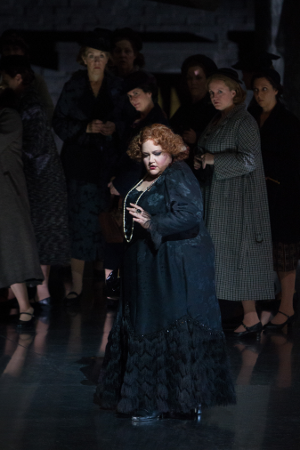 Stephanie Blythe as Madame Ulrica Arvidsson
For this grim scene Alden and set designer Paul Steinberg reduced the playing space on the enormous Met stage to a small box that is all angles with a stark black and white color scheme. The ceiling slopes down at a vertiginous angle. The walls close in on the emotionally tortured couple as Renato says he will kill her; he then swears vengeance on the King.
Baritone Dmitri Hvorostovsky as Renato and soprano Sondra Radvanovsky as Amelia are both fine actors, so Alden had much to work with in this scene. He introduced an element of sexual tension between the couple — a hint that Renato would take her in violent sex one last time before killing her. Hvorostovsky handled her roughly, lending a particular urgency to their singing. When the two conspirators (the Counts Ribbing and Horn) assisting Renato in the assassination plot suddenly appeared through a back wall of the boxy set, the effect was chilling.
Had the entire production been at this level, the Met would finally have a hit Ballo. But it was not.
Alden told the opera website Parterre Box that he sees King Gustavo as “a dreamer and a fantasist.” This is the inspiration for his conception. To demonstrate how out-of-control the King is, Alden compares him to Icarus, the mythological boy who disregards the advice of his father and flies too close to the sun. An enormous mural showing Icarus falling into the sea is a constant presence in the production.
This choice is banal. Indeed, Alden bristled when Met General Manager Peter Gelb used the word “obvious” for the Icarus image in an intermission interview. Gelb backpedaled furiously from this honest assessment as soon as he realized Alden’s displeasure. But it is obvious, and boring, and it adds nothing to our understanding of Verdi’s conception.
Alden has directed this dreamy fantasist of a king as a goofball from a Marx Brothers film. He laughs a lot (some of which is in the music). He yearns, he swoons, and he waves his arms. But he is never credible as a strong king beloved by some of his people and hated by others. The tragedy of his doomed love for Amelia never registers.
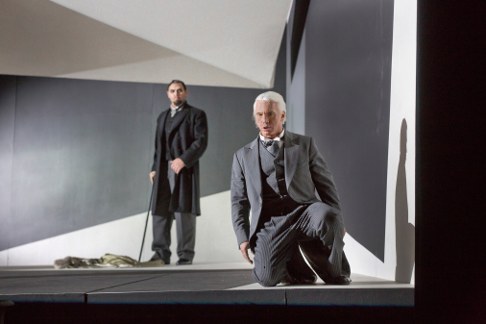 Dmitri Hvorostovsky as Count Anckarström and Marcelo Álvarez as Gustavo III
Alden has imposed no other vision than this on the opera. Is it at heart a political drama about the assassination of a tyrant, or the assassination of a good man by his enemies? If so, why are the conspirators Ribbing and Horn almost invisible in this production until Act Three? Or does Alden see Ballo as simply a tragic love triangle with a political backdrop?
Alden’s stage pictures (with the exception of Act Three, Scene One) are designed to heighten the fantasy. They are by turns risible or puzzling: dancing waiters; an Oscar (the loyal page to the King) who flaps her own Icarus mini-wings (talk about obvious) and smokes cigarettes; courtiers in brown trench coats; and the King slumming in a fisherman’s sweater topped with a royal ermine cape seemingly cadged from a Salvation Army store.
So it was left to the singers to make some sense of this hodgepodge. They did so with mixed success.
Hvorostovsky, one of the world’s leading Verdi baritones and a matinee idol with his shock of perfectly groomed white hair, brought a gravitas to the proceedings that was sorely lacking. It was hard to imagine that such a serious man could be counselor to this frivolous king. Hvorostovsky delivered both of his major arias with power, particularly “Eri Tu” in Act Three in which he hurls invective at a portrait of the king. He and Radvanovsky were believable as a couple in serious need of marriage counseling.
Radvanovsky spent the entire opera looking anguished. She is most effective when singing quietly. She floated some beautiful notes at the end of her Act Two aria as she searches for some magic herbs to rid her of her feelings for the King. When she sings at a mezzo forte or forte, and at the top of her range, she is somewhat raw. But she is an honest artist, and she did her best to make sense of the enigmatic Amelia. Her duet with the King in Act Two when they acknowledge their forbidden love was electrifying, and it received a huge ovation.
As the King, tenor Marcelo Alvarez was badly in need of better direction from Alden. He is not a natural actor. Playing an unstable character trying to fly away from his royal duties is not easy to do. Alvarez could not pull it off. The intrusive close-ups of the HD telecast didn’t help convince the audience that there was much of anything on his mind.
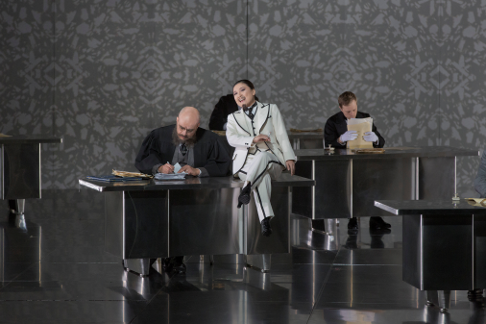 Mark Schowalter as the Judge and Kathleen Kim as Oscar
The middle and top of Alvarez’s voice remain solid and exciting, but he is losing the low notes, and he clipped some of his phrases. Powerful as it is, his voice is a bit characterless. It’s hard to keep his basic sound in mind. This was not a performance to put alongside Tucker or Peerce or Bergonzi, not to mention Pavarotti.
Kathleen Kim has given impressive performances at the Met as Olympia (in Hoffman) and Zerbinetta (in Ariadne auf Naxos). She has lost some of the agile, silvery quality to her voice, however. Perhaps her stint as Chiang Ch’ing in Nixon in China changed her instrument. Oscar, a character drawn from French operetta tradition, must be sung lightly, with humor and great agility. Alden worked against the happy sound of Kim’s arias by making this Oscar menacing. She wore a mustache and goatee, smoked, and flapped her wings. Alden also suggested that Oscar was not even faithful to the King; she was a witness to the assassination plot and clearly knew the King was a marked man. Yet she did nothing to stop it. All this undermined Kim’s performance.
The stentorian mezzo Stephanie Blythe delivered her usual blast-furnace performance as the fortune-teller Ulrica. No production concept can undermine this artist.
As Fabio Luisi conducts more Met performances, his strengths and weaknesses are starting to come into view. The Met Orchestra played with precision. His tempos were fleet. Everything was tidy, and spot-on. But, although he is Italian, this performance lacked an Italianate throb. He didn’t give his singers much room to just run with it. As a result, the performance was highly professional but cold. Listen to the CD of a live Ballo at the Met conducted by Dimitri Mitropoulos (available from Sony and the Met). It’s a bit reckless, but the Greek Mitropoulos is more Italian than Luisi, and his performance crackles with electricity. Luisi’s merely hums with efficiency.
Director Elijah Moshinsky’s 1980 Met production of Ballo seemed to be set in a sauna. Now this. Is Ballo really that hard to pull off?
David Rubin