Recently in Performances
English Touring Opera are delighted to announce a season of lyric monodramas to tour nationally from October to December. The season features music for solo singer and piano by Argento, Britten, Tippett and Shostakovich with a bold and inventive approach to making opera during social distancing.
This tenth of ten Live from London concerts was in fact a recorded live performance from California. It was no less enjoyable for that, and it was also uplifting to learn that this wasn’t in fact the ‘last’ LfL event that we will be able to enjoy, courtesy of VOCES8 and their fellow vocal ensembles (more below …).
Ever since Wigmore Hall announced their superb series of autumn concerts, all streamed live and available free of charge, I’d been looking forward to this song recital by Ian Bostridge and Imogen Cooper.
Although Stile Antico’s programme article for their Live from London recital introduced their selection from the many treasures of the English Renaissance in the context of the theological debates and upheavals of the Tudor and Elizabethan years, their performance was more evocative of private chamber music than of public liturgy.
Evidently, face masks don’t stifle appreciative “Bravo!”s. And, reducing audience numbers doesn’t lower the volume of such acclamations. For, the audience at Wigmore Hall gave soprano Elizabeth Llewellyn and pianist Simon Lepper a greatly deserved warm reception and hearty response following this lunchtime recital of late-Romantic song.
For this week’s Live from London vocal recital we moved from the home of VOCES8, St Anne and St Agnes in the City of London, to Kings Place, where The Sixteen - who have been associate artists at the venue for some time - presented a programme of music and words bound together by the theme of ‘reflection’.
'Such is your divine Disposation that both you excellently understand, and royally entertaine the Exercise of Musicke.’
‘And there was war in heaven: Michael and his angels fought against the dragon; and the dragon fought and his angels, And prevailed not; neither was their place found any more in heaven … that old serpent … Satan, which deceiveth the whole world: he was cast out into the earth, and his angels were cast out with him.’
There was never any doubt that the fifth of the twelve Met Stars Live in Concert broadcasts was going to be a palpably intense and vivid event, as well as a musically stunning and theatrically enervating experience.
‘Love’ was the theme for this Live from London performance by Apollo5. Given the complexity and diversity of that human emotion, and Apollo5’s reputation for versatility and diverse repertoire, ranging from Renaissance choral music to jazz, from contemporary classical works to popular song, it was no surprise that their programme spanned 500 years and several musical styles.
The Academy of St Martin in the Fields have titled their autumn series of eight concerts - which are taking place at 5pm and 7.30pm on two Saturdays each month at their home venue in Trafalgar Square, and being filmed for streaming the following Thursday - ‘re:connect’.
The London Symphony Orchestra opened their Autumn 2020 season with a homage to Oliver Knussen, who died at the age of 66 in July 2018. The programme traced a national musical lineage through the twentieth century, from Britten to Knussen, on to Mark-Anthony Turnage, and entwining the LSO and Rattle too.
With the Live from London digital vocal festival entering the second half of the series, the festival’s host, VOCES8, returned to their home at St Annes and St Agnes in the City of London to present a sequence of ‘Choral Dances’ - vocal music inspired by dance, embracing diverse genres from the Renaissance madrigal to swing jazz.
Just a few unison string wriggles from the opening of Mozart’s overture to Le nozze di Figaro are enough to make any opera-lover perch on the edge of their seat, in excited anticipation of the drama in music to come, so there could be no other curtain-raiser for this Gala Concert at the Royal Opera House, the latest instalment from ‘their House’ to ‘our houses’.
"Before the ending of the day, creator of all things, we pray that, with your accustomed mercy, you may watch over us."
The doors at The Metropolitan Opera will not open to live audiences until 2021 at the earliest, and the likelihood of normal operatic life resuming in cities around the world looks but a distant dream at present. But, while we may not be invited from our homes into the opera house for some time yet, with its free daily screenings of past productions and its pay-per-view Met Stars Live in Concert series, the Met continues to bring opera into our homes.
Music-making at this year’s Grange Festival Opera may have fallen silent in June and July, but the country house and extensive grounds of The Grange provided an ideal setting for a weekend of twelve specially conceived ‘promenade’ performances encompassing music and dance.
There’s a “slide of harmony” and “all the bones leave your body at that moment and you collapse to the floor, it’s so extraordinary.”
“Music for a while, shall all your cares beguile.”
The hum of bees rising from myriad scented blooms; gentle strains of birdsong; the cheerful chatter of picnickers beside a still lake; decorous thwacks of leather on willow; song and music floating through the warm evening air.
Performances
![A scene from Don Pasquale [Photo by Dan Rest courtesy of Lyric Opera of Chicago]](http://www.operatoday.com/DAN_5181.gif)
16 Jan 2013
A Noteworthy Chicago Revival of Don Pasquale
In its recent run of Gaetano Donizetti’s Don Pasquale Lyric Opera of Chicago has taken the 1973 production from Covent Garden, via Dallas Opera, and revivified it with the efforts of an excellent cast and the local directorial debut of British bass-baritone Sir Thomas Allen.
The title role and Doctor Malatesta were sung by Ildebrando D’Arcangelo and Corey Crider respectively, each making his role debut in these performances. Soprano Marlis Petersen performed the role of Norina and her beloved Ernesto was taken by tenor René Barbera. Stephen Lord conducted the Lyric Opera Orchestra with the Chorus prepared by Martin Wright.
During the orchestral prelude to the performance the lines delineating melodies associated with individual characters were nicely shaped. Don Pasquale’s opening monologue, in which he comments on his imminent meeting with Malatesta and plans for his nephew Ernesto, could have been fully appreciated if the orchestra had played its accompaniment less forte. From the start D’Arcangelo’s demeanor and conception of the role of Don Pasquale were not only dramatically but also vocally convincing. Equally suited to his part on both grounds is Corey Crider as Dr. Malatesta. When he describes the bride whom he has found for the aging gentleman, Mr. Crider inflects the word “angelo” with a rich, baritonal resonance while further executing accomplished runs in his aria “Bella siccome un angelo.” Both performers show an inborn sense of comic timing in their delivery of lines and interaction. When left alone Pasquale reveled in the prospects of his “angelic” bride, while Mr. Crider’s Malatesta watched through a curtained window in self-satisfied approval of the forthcoming masquerade. In a subsequent exchange Pasquale’s nephew Ernesto refuses to abandon his beloved Norina although he faces the prospect of disinheritance by the old gentleman. When Ernesto now learns of his uncle’s plan to marry, with the unexpected assistance provided by Dr. Malatesta, his disappointment is unleashed in the aria “Sogno soave e casto.” Barbera demonstrated a sure sense of legato in his approach, whereas individual pitches could be softened in order to express the fervor of Ernesto’s plight.
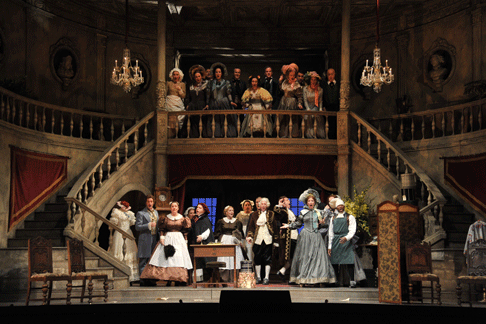
The following lengthy scene of Act One offered both Ms. Petersen and Mr. Crider the opportunities to delineate their characters through musical decoration. After Norina’s introductory “So anch’io la virtù magica,” which Ms. Petersen embellished with exquisite, light touches, Malatesta introduces his plan to fool Don Pasquale. Malatesta quiets her initial misgivings due to Ernesto’s emotional quandary and wins Norina over to the masquerade. As she agrees to play the part of Malatesta’s sister and supposedly marry Pasquale in a contrived ceremony, Norina declares “Pronta io son” at the start of their duet. Petersen and Crider here joined in a bel canto synthesis with Malatesta’s declarations of “Brava” ringing out in decorative anticipation of the comedy to be staged.
At the start of Act Two Ernesto’s well-known scene beginning “Povero Ernesto” was touchingly sung by Barbera. Since he has not yet been informed of the ruse, the nephew laments his loss of Norina and plans to leave Rome forever. Barbera invested his line with a graceful piano on “sorte,” then sang his cabaletta with a spirit of determination. At the entrance of Malatesta with the bride, now named “Sofronia,” Don Pasquale is eager to impress the naïve maiden. In this production Sofronia concealed herself demurely behind a screen, a hiding place to which Pasquale will later have access when fleeing his bride whom he can no longer control. The trio “Fresca uscita di convento” was used to enhance the comedic exchange and to tempt Don Pasquale yet further. Here Petersen’s runs were especially well executed, in this way using her voice to add to the character’s attractiveness. At the start of the marriage ceremony Ernesto’s arrival nearly spoils the ruse until he is warned off by the clever Malatesta. From this point until the start of the final scene in the opera comedy is paramount for among the principals only the duped Pasquale will continue to take his altered domestic life seriously. The quartet concluding the act showed a transformed Sofronia already making extravagant orders to improve the household, while Mr. Crider’s excellent passagework continued to guide the charade with masterful vocal control.
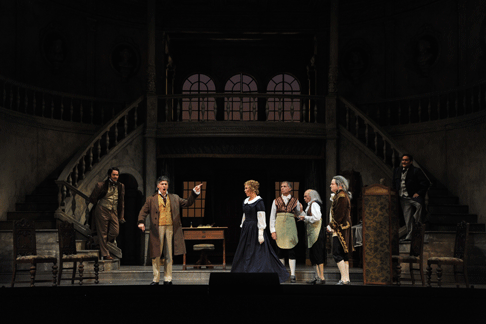
As Act Three begins the chorus of servants issues its comments on the new lifestyle in Don Pasquale’s domain. Throughout this scene D’Arcangelo showed his talents especially at acting and singing the part of an emotionally wounded signor without resorting in the least to buffo cliché. The confrontation between alleged spouses leads to Sofronia proclaiming her momentary dominance with a slap to Don Pasquale’s face. At this point the screen provided refuge to D’Arcangelo’s Pasquale as he sought escape from the wife whose acquaintance he now regrets. The final chapter in the charade is set in motion by Sofronia: upon leaving the house after the altercation with her husband, she drops a note intentionally from a presumed lover in which an assignation at night in the garden is suggested. Don Pasquale, no longer cowed and now furious, seeks out Malatesta for counsel, as the chorus, here quite effectively prepared, comments further on the house gone topsy-turvy. During the meeting between Pasquale and Malatesta, in which the gentleman is once again prepared unwittingly to be fooled, D’Arcangelo and Crider sang a model example of the challenging duet “Cheti, cheti, immantinente.”
The final scene indeed rights relationships as Petersen and Barbera sang an especially moving duet, “Tornami a dir,” in which their voices combined in a rush of emotional commitment. Don Pasquale appears and is compelled, again at the instigation of Malatesta, to give his blessing and financial support to the young couple. Yet in the finale relief and joy were palpable for all, including the now transformed Don Pasquale, at the close of this delightful production.
Salvatore Calomino
Click here for cast and production information.