Monteverdi’s ‘Sí dolce è’l tormento’ (‘So sweet is the torment’) perfectly expresses the Renaissance paradox of the exquisite pain of love. An ambitious, extensive instrumental ground accompanies a largely unadorned vocal line. Fittingly the fresh, open simplicity of Sampson’s floating high notes were complemented by a slightly more enriched lower register. But, although the sentiment of the text was supremely captured, and nuances of tone employed to convey the peaks of intensity — ‘Per foco e per gelo/ Riposo non ho’ (‘between fire and ice/ I have no rest’) — it was a pity that Sampson so neglected the consonants; for her ornamentation was delicate and judicious, complementing the theorbo’s more dramatic inflections and articulation, and she and Wadsworth built to a deep, affecting warmth for the pining lover’s final expression of hope that his passion will one day be reciprocated.
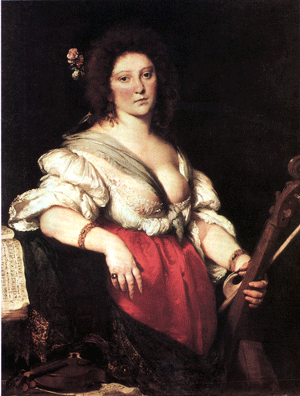
The first half of the recital was dominated by the music of Barbara Strozzi, a singer and the composer of eight volumes of, chiefly secular, vocal music published in Venice between 1644 and 1664. Sampson and Wadsworth made a convincing case for her to be considered more than a ‘historical novelty’, revealing the grace and spontaneity of Strozzi’s style, the musical motif and form responding naturally and intuitively to the text. In ‘Rissolvetevi, pensieri’ (‘Resolve, thoughts’), the poet-speaker’s troubled restlessness is conveyed by the vocal repetition of melodic and rhythmic phrases, as Strozzi frequently repeats small units of text creating a complex, lengthy aria. Sampson’s vibrato-light soprano nimbly tumbled with lucid fluidity through falling triadic shapes above Wadsworth’s searching, wandering bass line.
Although the title-pages of all but one of Strozzi’s books of madrigals announce their contents as ‘arie’, ‘ariette’ or ‘cantate’, in fact her works employ a diversity of style and form and the extended ‘L’amante segreto’ (‘The secret lover’) — its refrain built on a descending tetrachord — is more ‘operatic’ in impact. A richly inflected recitative-like idiom, as the singer urges herself to have courage and fortitude in the face of fear, contrasted powerfully with the quiet stillness of Sampson’s admission, ‘Ma io voglio morire/ Piuttosto ch’il mio mal venga a scopire’ (‘But I would rather die/ than that my sickness come to be discovered’). Wadsworth was not afraid to signal such changes of mood with surprising sharpness of attack and dynamic variation. The concluding entreaty to Cupid to throw down his mighty arrows revealed the moving rich depth of Sampson’s mezzo, which she also put to excellent use in ‘Che si può fare’ (‘What can be done’). In the latter, the performers obviously enjoyed the increasingly piquant dissonances — as the singer laments what can be done if heaven refuses to relieve her suffering and the planets rain down disasters — before such restless anxiety was ultimately resolved in a sweet tierce de picardie.
‘Che si può fare’ shares its lengthy ground with Giovanni Kapsberger’s ‘Passacaglia’ from the Libro quarto d’intavolatura di chitarrone, and Wadsworth effected a seamless transition between the preceding instrumental number and Strozzi’s song. This was one of several instrumental interludes interspersed between the vocal items, and while such repertoire is somewhat limited in expressive range, the toccatas, chaconnes and dances of Kapsberger and Alessandro Piccinini offered a pleasant contrast. Wadsworth’s decorative traceries were articulated with relaxed ease, as melodic motifs came to the fore and then were subsumed once more within the elaborate accompanying textures, suggesting hidden mysteries. Piccinini’s ‘Corrente terza’ was particularly notable for Wadsworth’s light, rhythmic finger work and the effective use of contrasting registers.
Francesca Caccini, the daughter of the virtuoso singer and composer, Guilio, was probably the most prominent and successful female musician of the period, and her ‘Lasciatemi qui solo’ followed the interval. ‘Leave me here alone’ begins the singer, and this was indeed an intimate, restrained rendering, the stillness only occasionally enlivened by gentle expressive flourishes. A brief moment of energy — ‘Felicissimi amanti/ Tornate al bel diletto’ (‘Happiest lovers,/ return to fair pleasure’) — gestured by a sudden change in the accompaniment texture, immediately gave way to languid minor-key yearning for death, Sampson’s final colourless whisper, ‘Gia sono esangu’e smorto’ (‘I am already bloodless and pale’), seemingly fulfilling the poet’s desire.
Despite the similarly despairing title of Benedetto Ferrari’s ‘Voglio di vita uscir’ (‘I wish to leave life’), a joyful lightness characterises this song and betrays the poet-speaker’s insistent avowals as a deliberate ploy to win his lover’s affection, and it offered a welcome moment of playfulness. Strozzi’s ‘L’Eraclito amoroso’ (‘Amorous Heraclitus’), a dramatic ‘scena’ was notable for the flexibility of Sampson’s recitative and the rich sheen of the more lyrical moments. Here, as throughout, there was an impressive degree of communication before the performers.
Playing straight from the heart, Sampson and Wadsworth presented a thoughtful, enchanting selection of little-known seventeenth-century music, always alert to nuances of phrase and colour, but never mannered or overly ostentatious. The performers’ evident pleasure in this music was undoubted matched by the charmed Wigmore Hall audience.
Claire Seymour
[Monteverdi ‘Sí dolce è’l tormento’; Strozzi ‘Rissolvetevi pensieri’; Piccinini Toccata X, Ciaccona in Partite Variate; Strozzi ‘L’amante segreto’; Kapsberger Passacaglia from Libro quarto d'intavolatura di chitarrone; Strozzi ‘Che si può fare’; Caccini ‘Lasciatemi morire’; Ferrari ‘Voglio di vita uscir’; Piccinini Toccata VI, Partite variate sopra quest’ aria francese detta l’Alemana, Corrente terza; Strozzi ‘L’Eraclito amoroso’.]
Carolyn Sampson, soprano; Matthew Wadsworth, theorbo; Wigmore Hall, London
Thursday 3rd January, 2013