![A scene from <em>L’Italiana in Algeri</em> [Photo by Christian Dresse courtesy of Opéra Municipal de Marseille]](http://www.operatoday.com/IMG_5787.gif)
15 Jan 2013
L’Italienne à Alger in Marseille
Once a mainstay of the repertory L’Italiana in Algeri now usually gives way to Il Turco in Italia when an opera company wants to give Il barbiere di Sivigllia and La cenerentola a rest.
English Touring Opera are delighted to announce a season of lyric monodramas to tour nationally from October to December. The season features music for solo singer and piano by Argento, Britten, Tippett and Shostakovich with a bold and inventive approach to making opera during social distancing.
This tenth of ten Live from London concerts was in fact a recorded live performance from California. It was no less enjoyable for that, and it was also uplifting to learn that this wasn’t in fact the ‘last’ LfL event that we will be able to enjoy, courtesy of VOCES8 and their fellow vocal ensembles (more below …).
Ever since Wigmore Hall announced their superb series of autumn concerts, all streamed live and available free of charge, I’d been looking forward to this song recital by Ian Bostridge and Imogen Cooper.
Although Stile Antico’s programme article for their Live from London recital introduced their selection from the many treasures of the English Renaissance in the context of the theological debates and upheavals of the Tudor and Elizabethan years, their performance was more evocative of private chamber music than of public liturgy.
Evidently, face masks don’t stifle appreciative “Bravo!”s. And, reducing audience numbers doesn’t lower the volume of such acclamations. For, the audience at Wigmore Hall gave soprano Elizabeth Llewellyn and pianist Simon Lepper a greatly deserved warm reception and hearty response following this lunchtime recital of late-Romantic song.
For this week’s Live from London vocal recital we moved from the home of VOCES8, St Anne and St Agnes in the City of London, to Kings Place, where The Sixteen - who have been associate artists at the venue for some time - presented a programme of music and words bound together by the theme of ‘reflection’.
'Such is your divine Disposation that both you excellently understand, and royally entertaine the Exercise of Musicke.’
‘And there was war in heaven: Michael and his angels fought against the dragon; and the dragon fought and his angels, And prevailed not; neither was their place found any more in heaven … that old serpent … Satan, which deceiveth the whole world: he was cast out into the earth, and his angels were cast out with him.’
There was never any doubt that the fifth of the twelve Met Stars Live in Concert broadcasts was going to be a palpably intense and vivid event, as well as a musically stunning and theatrically enervating experience.
‘Love’ was the theme for this Live from London performance by Apollo5. Given the complexity and diversity of that human emotion, and Apollo5’s reputation for versatility and diverse repertoire, ranging from Renaissance choral music to jazz, from contemporary classical works to popular song, it was no surprise that their programme spanned 500 years and several musical styles.
The Academy of St Martin in the Fields have titled their autumn series of eight concerts - which are taking place at 5pm and 7.30pm on two Saturdays each month at their home venue in Trafalgar Square, and being filmed for streaming the following Thursday - ‘re:connect’.
The London Symphony Orchestra opened their Autumn 2020 season with a homage to Oliver Knussen, who died at the age of 66 in July 2018. The programme traced a national musical lineage through the twentieth century, from Britten to Knussen, on to Mark-Anthony Turnage, and entwining the LSO and Rattle too.
With the Live from London digital vocal festival entering the second half of the series, the festival’s host, VOCES8, returned to their home at St Annes and St Agnes in the City of London to present a sequence of ‘Choral Dances’ - vocal music inspired by dance, embracing diverse genres from the Renaissance madrigal to swing jazz.
Just a few unison string wriggles from the opening of Mozart’s overture to Le nozze di Figaro are enough to make any opera-lover perch on the edge of their seat, in excited anticipation of the drama in music to come, so there could be no other curtain-raiser for this Gala Concert at the Royal Opera House, the latest instalment from ‘their House’ to ‘our houses’.
"Before the ending of the day, creator of all things, we pray that, with your accustomed mercy, you may watch over us."
The doors at The Metropolitan Opera will not open to live audiences until 2021 at the earliest, and the likelihood of normal operatic life resuming in cities around the world looks but a distant dream at present. But, while we may not be invited from our homes into the opera house for some time yet, with its free daily screenings of past productions and its pay-per-view Met Stars Live in Concert series, the Met continues to bring opera into our homes.
Music-making at this year’s Grange Festival Opera may have fallen silent in June and July, but the country house and extensive grounds of The Grange provided an ideal setting for a weekend of twelve specially conceived ‘promenade’ performances encompassing music and dance.
There’s a “slide of harmony” and “all the bones leave your body at that moment and you collapse to the floor, it’s so extraordinary.”
“Music for a while, shall all your cares beguile.”
The hum of bees rising from myriad scented blooms; gentle strains of birdsong; the cheerful chatter of picnickers beside a still lake; decorous thwacks of leather on willow; song and music floating through the warm evening air.
Once a mainstay of the repertory L’Italiana in Algeri now usually gives way to Il Turco in Italia when an opera company wants to give Il barbiere di Sivigllia and La cenerentola a rest.
So a new production of this first flower of Rossini’s comic maturity was very welcome news.
In recent years the Rossini Festival at not-too-far-away Pesaro has focused on very early and very late Rossini, from the first silly commedia dell’arte farces that manage a trio or quartet once in awhile to the mature comedies that are dramatically so complex that the comedy genre collapses into grand act finales of septets at the minimum, with internal quintets and sextets that further complicate relationships. L’Italiana manages a modest sextet to close the first act and allows the pappataci quartet to grow to a brief sextet at the opera’s end. The extended, masterful sextet finales of Il barbiere will arrive three years later.
There was the wonderful just now in Marseille. Italian conductor Giuliano Carella was in the pit. This fifty-seven year old maestro, music director of the Opéra de Toulon and frequent guest in Marseille and Monte Carlo, is one of the treasures of opera in the south of France. As well he makes the rounds of the more prestigious European stages for the bel canto repertory, not to mention the Bellini Festival in Catania.
That he is a master Rossinian as well was apparent from the first moments of Rossini’s overture — an unrushed fleetness, a lightness that would lead anywhere, like the witty interplay of the oboe and piccolo that made you feel the pure joy of making music.
Then the singing, the repeated ragings of an Algerian emir named Mustafa (fed up with a clinging concubine) where the maestro’s ample tempos allowed magnificent fioratura to rip forth. And it all came together in the end with the zany quartet in which Mustafa is made a pappataci (it’s a joke, no one, most of all Mustafa, is sure what a pappataci is), the plot complexities became musical complexities, the confusion became total and the maestro brought it all together into a joyful froth that was pure music. The great Rossini.
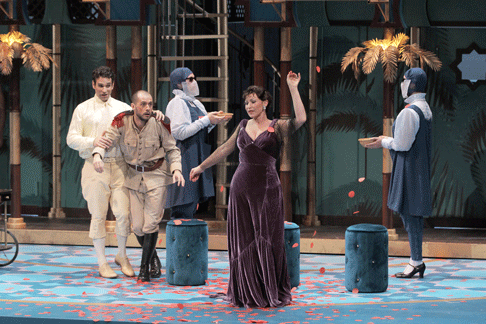 Frédéric Antoun as Lindoro, Alex Esposito as Mustafa and Marie-Ange Todorovitch as Isabella
And there was the weird. French mezzo-soprano Marie Ange Todorovitch was the Isabella. Mme. Todorovitch is one of the treasures of the Opéra de Marseille, recently in Henri Sauguet’s Chartreuse de Parme as Stendhal’s splendid Dutchess of Sanseverina inappropriately in love with her young nephew Fabrice, as the cowardly Mother Marie in Poulenc’s Dialogue of the Carmelites, and upcoming as Clytemnestra in Elektra. So it was a huge stretch to embody Rossini’s sex-bomb Isabella (role debut apparently) even though Mme. Todorovitch’s roles have included about everything else in her long career.
Mme. Todorovitch possesses a large, roundly mature mezzo-soprano voice with, therefore, minimal flexibility though she did manage a bit of fioratura at mezza voce. Her needed effort to do so deprived Rossini of the joyful unleashing of florid technique that make these passages sheer musical delirium. Unfortunately Mme. Todorovitch’s performance severely dampened the verve that had been established initially by the maestro, by the accomplished Italian Rossini bass Alex Esposito as Mustafa and by the excellent Canadian tenor Frédéric Autoun as Lindoro. Make no mistake, la Todorovitch is an estimable artist. She was flagrantly, inexplicably miscast.
The new production, shared with Avignon, was created by Italian stage director Nicola Berloffa whose major credits seem to be assisting important Italian directors at major theaters. He successfully staged Rossini's Voyage à Reims performed by entry level artists that made the rounds of French stages a few years ago. But here Mr. Berloffa made the usual mistakes perpetrated by directors who do not commune with the comic muse. Mr. Berloffa confounded Rossini fioratura with too bright colors, with busy, cute decor and with catchy staging conceits (chorus and stage hands in drag, among others) that at first glance may be amusing but pall as the evening wears on. Not trusting Rossini to provide the theatrical energy Mr. Berloffa demanded that his actors constantly move and gesture. And as a bonus the action was arbitrarily updated, at least in part, to the flapper era, perhaps so that Mr. Berloffa, who designed the costumes as well, could provide a flashy red flapper dress for Mme. Todorovitch to wear during the finale.
Besides the conducting the evening did have two other quite considerable pleasures — the Mustafa of Alex Esposito was energetically sung in consummate Rossini style. Evidently a committed collaborative artist Mr. Esposito gave his all to realize Mr. Berloffa’s hyped-up stage direction. Tenor Frédéric Antoun as Lindoro, the lost lover Isabella stumbles upon in Algeria, is a cooler performer who struck a less strident tone on the stage. He delivered the brilliant coloratura and hit all the high notes with infectious ease in warm, even tones that prove a Rossini tenor can in fact have a beautiful voice and still be exciting.
Uhm, did I miss the point? Maybe there was a well hidden concept that Isabella was supposed to be a woman in mid-life crisis who conjured for herself a fantasy fling with two fine young singers. Unfortunately she would have had to hold up her end of the deal.
Win some, lose some.
Michael Milenski
Cast
Isabella: Marie-Ange Todorovitch; Elvira: Eduarda Melo; Zulma: Carol García; Mustafa: Alex Esposito; Lindoro: Frédéric Antoun; Taddeo: Marc Barrard; Haly: Patrick Delcour. Orchestra and Chorus of the Opéra de Marseille. Conductor: Giuliano Carella; Stage Director: Nicola Berloffa; Set Design: Rifail Ajdarpasic; Costume Design: Nicola Berloffa; Lighting: Gianluca Antolini. Opéra de Marseille, January 2, 2013.