Recently in Performances
English Touring Opera are delighted to announce a season of lyric monodramas to tour nationally from October to December. The season features music for solo singer and piano by Argento, Britten, Tippett and Shostakovich with a bold and inventive approach to making opera during social distancing.
This tenth of ten Live from London concerts was in fact a recorded live performance from California. It was no less enjoyable for that, and it was also uplifting to learn that this wasn’t in fact the ‘last’ LfL event that we will be able to enjoy, courtesy of VOCES8 and their fellow vocal ensembles (more below …).
Ever since Wigmore Hall announced their superb series of autumn concerts, all streamed live and available free of charge, I’d been looking forward to this song recital by Ian Bostridge and Imogen Cooper.
Although Stile Antico’s programme article for their Live from London recital introduced their selection from the many treasures of the English Renaissance in the context of the theological debates and upheavals of the Tudor and Elizabethan years, their performance was more evocative of private chamber music than of public liturgy.
Evidently, face masks don’t stifle appreciative “Bravo!”s. And, reducing audience numbers doesn’t lower the volume of such acclamations. For, the audience at Wigmore Hall gave soprano Elizabeth Llewellyn and pianist Simon Lepper a greatly deserved warm reception and hearty response following this lunchtime recital of late-Romantic song.
For this week’s Live from London vocal recital we moved from the home of VOCES8, St Anne and St Agnes in the City of London, to Kings Place, where The Sixteen - who have been associate artists at the venue for some time - presented a programme of music and words bound together by the theme of ‘reflection’.
'Such is your divine Disposation that both you excellently understand, and royally entertaine the Exercise of Musicke.’
‘And there was war in heaven: Michael and his angels fought against the dragon; and the dragon fought and his angels, And prevailed not; neither was their place found any more in heaven … that old serpent … Satan, which deceiveth the whole world: he was cast out into the earth, and his angels were cast out with him.’
There was never any doubt that the fifth of the twelve Met Stars Live in Concert broadcasts was going to be a palpably intense and vivid event, as well as a musically stunning and theatrically enervating experience.
‘Love’ was the theme for this Live from London performance by Apollo5. Given the complexity and diversity of that human emotion, and Apollo5’s reputation for versatility and diverse repertoire, ranging from Renaissance choral music to jazz, from contemporary classical works to popular song, it was no surprise that their programme spanned 500 years and several musical styles.
The Academy of St Martin in the Fields have titled their autumn series of eight concerts - which are taking place at 5pm and 7.30pm on two Saturdays each month at their home venue in Trafalgar Square, and being filmed for streaming the following Thursday - ‘re:connect’.
The London Symphony Orchestra opened their Autumn 2020 season with a homage to Oliver Knussen, who died at the age of 66 in July 2018. The programme traced a national musical lineage through the twentieth century, from Britten to Knussen, on to Mark-Anthony Turnage, and entwining the LSO and Rattle too.
With the Live from London digital vocal festival entering the second half of the series, the festival’s host, VOCES8, returned to their home at St Annes and St Agnes in the City of London to present a sequence of ‘Choral Dances’ - vocal music inspired by dance, embracing diverse genres from the Renaissance madrigal to swing jazz.
Just a few unison string wriggles from the opening of Mozart’s overture to Le nozze di Figaro are enough to make any opera-lover perch on the edge of their seat, in excited anticipation of the drama in music to come, so there could be no other curtain-raiser for this Gala Concert at the Royal Opera House, the latest instalment from ‘their House’ to ‘our houses’.
"Before the ending of the day, creator of all things, we pray that, with your accustomed mercy, you may watch over us."
The doors at The Metropolitan Opera will not open to live audiences until 2021 at the earliest, and the likelihood of normal operatic life resuming in cities around the world looks but a distant dream at present. But, while we may not be invited from our homes into the opera house for some time yet, with its free daily screenings of past productions and its pay-per-view Met Stars Live in Concert series, the Met continues to bring opera into our homes.
Music-making at this year’s Grange Festival Opera may have fallen silent in June and July, but the country house and extensive grounds of The Grange provided an ideal setting for a weekend of twelve specially conceived ‘promenade’ performances encompassing music and dance.
There’s a “slide of harmony” and “all the bones leave your body at that moment and you collapse to the floor, it’s so extraordinary.”
“Music for a while, shall all your cares beguile.”
The hum of bees rising from myriad scented blooms; gentle strains of birdsong; the cheerful chatter of picnickers beside a still lake; decorous thwacks of leather on willow; song and music floating through the warm evening air.
Performances
![Kyungho Kim as Harlequin | A soldier and Rowan Hellier as The drummer [Photo by Barbara Braun courtesy of Staatsoper Berlin]](http://www.operatoday.com/MuTphoto_0664%20%281%29.jpg)
02 Feb 2013
Der Kaiser von Atlantis at the Staatsoper Berlin
Recent seasons have seen a surge in so-called ‘Holocaust
operas,’ from Peter Androsch’s Spiegelrund, which
premiered in Vienna last week, to Mieczysław Weinberg’s The
Passenger, unveiled with a half-century of delay in Bregenz in 2010.
The
topic of Nazi politics may be bone-chilling, but when written by survivors,
allows for some emotional distance and reflection. Meanwhile, history has
bequeathed us what may be considered a Holocaust opera in the true sense of the
word. The Staatsoper Berlin is currently performing Viktor Ullmann’s
Der Kaiser von Atlantis (The Emperor of Atlantis),which was penned at
the concentration camp Theresienstadt to a libretto by Peter Kien just before
the authors were transported to Auschwitz in 1944. The chamber opera premiered
in Amsterdam 31 years after their death.
Theresienstadt served as both a transit post and a kind of sham for the
extent of the SS forces’ brutality. Leo Baeck, Pavel Haas, and Gideon
Klein count among the conscripted intelligentsia at the ‘model
ghetto,’ where Ullmann was engaged as an official music critic. A
freelance musician schooled in Schönbergian composition, the Silesian native
found himself with more time to compose than ever before. His score creates a
dizzying, but organic blend of serialist passages, sardonic cabaret, and
Mahleresque harmonies while subversively weaving in melodies such as ‘Ein
feste Burg ist unser Gott’ in the final chorus. It is an at once
harrowing and uplifting setting of Kien’s libretto, which provides a
vivid depiction of the inner turmoil but resignation a prisoner found in the
end of life as he knew it.
The story in some ways calls to Ligeti’s Le Grand Macabre in
its montage-like structure and ambiguous treatment of death. A Loudspeaker
announces in the prologue that the living can no longer laugh and the dying can
no longer lament. Harlekin, better known as Arlecchino, the commedia
dell’arte stock character, is so bored that he begs Death to his
duty. But Death has decided to condemn mortals to eternal life. Kaiser Overall,
whose resemblance to Hitler prevented further rehearsals of the opera in the
summer of 1944, is informed by telephone of a plague whereby none of his
soldiers can die. Only when the war is over does Death, “the
gardener…the final lullaby,” deliver the world from pestilence.
The story further includes a drummer, a soldier and a girl named Bubbikopf.
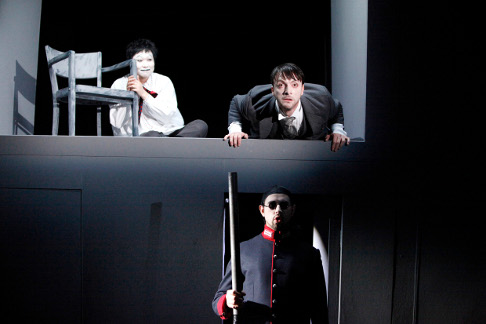 Kyungho Kim as Harlekin | Ein Soldat, Gyula Orendt as Kaiser Overall and Alin Anca as Der Lautsprecher | Der Tod
The Staatsoper staging by Mascha Pörzgen, seen January 29 at the
company’s Werkstatt, a small wing used for new music theater,
recreates the opera’s surreal qualities while maintaining a tasteful dose
of aesthetic restraint. The roles of Death and the Loudspeaker are cast with a
single bass-baritone (the tireless Alin Anca), who is wheeled in on a
motor-driven stool before revealing the garb of terrorist-like solider. His
exchanges with the sad clown-faced Harlekin are appropriately ambivalent, while
the Drummer assumes the presence of a caricature as she walks through the scene
beating wooden spoons mid-air. Kaiser Overall is a psychotic bureaucrat who
occupies the only hollow space in an all-white set (designs by Cordelia
Matthes). The proscenium moves in closer to the audience following
Harlekin’s eerie lullaby “Schlaf, Kindlein, schlaf.”
The cast, all members of the Staatsoper’s international opera studio,
gave a tight, convincing performance despite vocal unevenness. Anca carried the
show with theatrical verve and a booming bass that at times risked being too
loud for the space. As Harlekin and the soldier in the third scene, Kyungho Kim
did not rise to the same standards of sound quality and diction but was a
moving presence. The soprano Rowan Hellier gave a stand-out performance as the
Drummer, while Narine Yeghiyan, in the role of Bubbikopf, at times sounded
strained. Gyula Orendt gave an earnest performance as the Kaiser. Felix Krieger
led an elegant reading of the score with an ensemble of the Staatskapelle,
although the musicians’ position on a landing to the side of the stage
was not always ideal acoustically (drowning out Orendt in his final aria, the
very Mahlerian ‘Von allem, was geschieht’).The unearthly final
chorus could have been drawn out with more nostalgia, while the counterpoint of
a repeated, descending violin melody gave chills down the spine.
Der Kaiser von Atlantis runs through February 9.
Rebecca Schmid