![Simon Keenlyside As Eugene Onegin [Photo © ROH / Bill Cooper]](http://www.operatoday.com/BC20130131_EugeneOnegin_RO_83.png)
07 Feb 2013
Eugene Onegin at the Royal Opera House
Kasper Holten’s directorial debut in the Royal Opera House begins with silence.
English Touring Opera are delighted to announce a season of lyric monodramas to tour nationally from October to December. The season features music for solo singer and piano by Argento, Britten, Tippett and Shostakovich with a bold and inventive approach to making opera during social distancing.
This tenth of ten Live from London concerts was in fact a recorded live performance from California. It was no less enjoyable for that, and it was also uplifting to learn that this wasn’t in fact the ‘last’ LfL event that we will be able to enjoy, courtesy of VOCES8 and their fellow vocal ensembles (more below …).
Ever since Wigmore Hall announced their superb series of autumn concerts, all streamed live and available free of charge, I’d been looking forward to this song recital by Ian Bostridge and Imogen Cooper.
Although Stile Antico’s programme article for their Live from London recital introduced their selection from the many treasures of the English Renaissance in the context of the theological debates and upheavals of the Tudor and Elizabethan years, their performance was more evocative of private chamber music than of public liturgy.
Evidently, face masks don’t stifle appreciative “Bravo!”s. And, reducing audience numbers doesn’t lower the volume of such acclamations. For, the audience at Wigmore Hall gave soprano Elizabeth Llewellyn and pianist Simon Lepper a greatly deserved warm reception and hearty response following this lunchtime recital of late-Romantic song.
For this week’s Live from London vocal recital we moved from the home of VOCES8, St Anne and St Agnes in the City of London, to Kings Place, where The Sixteen - who have been associate artists at the venue for some time - presented a programme of music and words bound together by the theme of ‘reflection’.
'Such is your divine Disposation that both you excellently understand, and royally entertaine the Exercise of Musicke.’
‘And there was war in heaven: Michael and his angels fought against the dragon; and the dragon fought and his angels, And prevailed not; neither was their place found any more in heaven … that old serpent … Satan, which deceiveth the whole world: he was cast out into the earth, and his angels were cast out with him.’
There was never any doubt that the fifth of the twelve Met Stars Live in Concert broadcasts was going to be a palpably intense and vivid event, as well as a musically stunning and theatrically enervating experience.
‘Love’ was the theme for this Live from London performance by Apollo5. Given the complexity and diversity of that human emotion, and Apollo5’s reputation for versatility and diverse repertoire, ranging from Renaissance choral music to jazz, from contemporary classical works to popular song, it was no surprise that their programme spanned 500 years and several musical styles.
The Academy of St Martin in the Fields have titled their autumn series of eight concerts - which are taking place at 5pm and 7.30pm on two Saturdays each month at their home venue in Trafalgar Square, and being filmed for streaming the following Thursday - ‘re:connect’.
The London Symphony Orchestra opened their Autumn 2020 season with a homage to Oliver Knussen, who died at the age of 66 in July 2018. The programme traced a national musical lineage through the twentieth century, from Britten to Knussen, on to Mark-Anthony Turnage, and entwining the LSO and Rattle too.
With the Live from London digital vocal festival entering the second half of the series, the festival’s host, VOCES8, returned to their home at St Annes and St Agnes in the City of London to present a sequence of ‘Choral Dances’ - vocal music inspired by dance, embracing diverse genres from the Renaissance madrigal to swing jazz.
Just a few unison string wriggles from the opening of Mozart’s overture to Le nozze di Figaro are enough to make any opera-lover perch on the edge of their seat, in excited anticipation of the drama in music to come, so there could be no other curtain-raiser for this Gala Concert at the Royal Opera House, the latest instalment from ‘their House’ to ‘our houses’.
"Before the ending of the day, creator of all things, we pray that, with your accustomed mercy, you may watch over us."
The doors at The Metropolitan Opera will not open to live audiences until 2021 at the earliest, and the likelihood of normal operatic life resuming in cities around the world looks but a distant dream at present. But, while we may not be invited from our homes into the opera house for some time yet, with its free daily screenings of past productions and its pay-per-view Met Stars Live in Concert series, the Met continues to bring opera into our homes.
Music-making at this year’s Grange Festival Opera may have fallen silent in June and July, but the country house and extensive grounds of The Grange provided an ideal setting for a weekend of twelve specially conceived ‘promenade’ performances encompassing music and dance.
There’s a “slide of harmony” and “all the bones leave your body at that moment and you collapse to the floor, it’s so extraordinary.”
“Music for a while, shall all your cares beguile.”
The hum of bees rising from myriad scented blooms; gentle strains of birdsong; the cheerful chatter of picnickers beside a still lake; decorous thwacks of leather on willow; song and music floating through the warm evening air.
Kasper Holten’s directorial debut in the Royal Opera House begins with silence.
A mature Tatyana dashes about the stage desperately seeking a letter, her grandiose white gown allowing glimpses of a simple scarlet under-dress: a sartorial metaphor for the cold repression of Tatyana’s adulthood which chills but can never entirely extinguish the passionate fire of her adolescent self.
Later we learn that we have witnessed an imagined ‘in-between episode’, interjected between the opera’s final two scenes. Onegin has re-encountered Tatyana, now Princess Gremin, and is filled with remorse and regret for his rejection of her love many years before. He has sent her a letter declaring his devotion, and it is this avowal which Tatyana frantically seeks in the pre-overture mime.
In these opening moments, we are introduced to Holten’s central conceit: the simultaneity of past and present, which has the advantage of emphasising that actions from the past can be lamented but never altered, and the disadvantage that the tension and anticipation is lessened — for all is known, and fulfilment and denial exists alongside yearning. When the music of the overture begins, the fore-shadowing motifs of Tchaikovsky’s score are oddly turned to reminiscence — for we have glimpsed the outcome. What should be revealed by the musical journey through the score has already been visually presented.
The elision of past and present is sustained throughout. The older Tatyana and Onegin are partnered by dancer-doubles representing their younger selves (Vigdis Hentze Olsen and Thom Rackett respectively). The action is therefore experienced as flashback, viewed through the psyches of the protagonists who are forced to witness and re-live their former torments. But, the young doubles are not just visual externalisations of the characters’ inner selves: they actually interact with their older counterparts. Sometimes this is a neat device, actualising internal consciousness, but too often it is a distraction.
In the letter scene, naturalistic acting from the real Tatyana is accompanied by the exaggerated gestures of extreme emotional distress relayed by the younger double who, following Onegin’s words of rejection, agitatedly climbs one of the three fixed columns which dominate the stage, where she rests aloft, hunched in a cupboard, throughout the ensuing party scene. Tatyana’s confusion and subsequent devastation, depicted with such lyrical expression by Tchaikovsky, are thus rendered blindingly obvious; but as her emotions are so powerfully conveyed through score and voice, they need no such visual articulation. Indeed, the latter detracts from the potential potency of the vocal expression, which is a real shame as Krassimira Stoyanova is admirably equipped to communicate Tatyana’s mental disarray. In the event, the young woman’s anxiety is diluted — remembered and reflected on rather than immediately felt — and distanced: for the silent mime places a barrier between Tatyana and the audience to whom she unfolds her soul.
Moreover, Holten’s device often presents us with certainty and action when the libretto and score intimate hope and nebulousness. Thus, Tatyana’s dreams of an encounter with Onegin are visually realised when the young dancer wraps herself around Onegin’s double, literalising a fantasy that should remain merely imagined. In this way, there is often a disjuncture between the aural and visual narratives; the music remains unresolved, the stage-scene provides resolution.
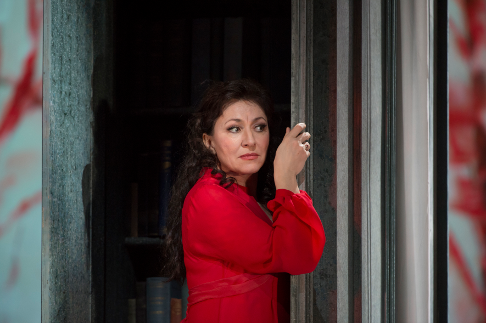 Krassimira Stoyanova as Tatyana
Similarly in the in duel scene, watched helplessly by the older Onegin who paces broodily, it is the young double who commits the murderous act before passing the gun to his older self — perhaps suggesting the continuity and inescapability of guilt. In the silence at the end of the scene, in an overly melodramatic gesture, Simon Keenlyside’s Onegin holds the pistol to his own head before the festive fanfares of the ball interrupt and dispel his suicidal intentions. Sometimes it feels as if there are too many layers: action, reflection, immediacy, retrospection. During Lensky’s aria, sung with wistful tenderness by Slovakian tenor Pavol Breslik, the older Onegin watches his former friend’s anguish and reaches out to console him, inferring the fundamental love that exists between the two men, but also implying reconciliation when the painful reality is that there is none.
Finally, during the interlude before the final scene a dance of temptation and denial reveals the passing of time, as Onegin is taunted by sylphs in grey silk, who fly past like shadows, ever eluding his grasp. We are presumably meant to apprehend that Onegin is the victim of his own sexual dalliances, recognising too late his own superficiality and what he has lost. But, the scene is crudely unsubtle and distracts from the tense anticipation which is building in the orchestral fabric.
Frequently the characters, and audience, are endowed with too much knowledge. During the party scene, twisting shadows on the backdrop reveal an encounter between Olga and Onegin. From the first this Olga is depicted as discontented and frustrated; Russian mezzo Elena Maximova produces some unusually rich and powerful chest tones, but Olga’s commitment to Lensky half-hearted in contrast with his earnest, simple devotion. Lensky is thus rendered one-dimensional: his insecurities are shown to be founded in fact. He is not insecure but betrayed; not a troubled, over-sensitive young man but a deceived dupe. Holten has a surprise in store for us at the close too, when Prince Gremlin — sung with striking poise and sincerity by Peter Rose — arrives during the final meeting of Onegin and Tatyana to witness his wife’s fraught denial of Onegin’s advances: it is therefore not clear what motivates her refusal of his love — her own conscience or her husband’s authority.
My main objection, then, is that Holten intellectualises and externalises something that is essentially emotional and instinctive. This may explain why there seemed to be little passion or genuine human feeling, especially in the opening scenes: the characters are remembering a drama rather than living it. The retrospective gaze describes rather than enacts, and we experience the drama at one remove, rather than sharing the lived emotions.
Holten presents us with a combination of realism and psycho-drama, and this duality is reflected in Mia Stensgaard’s sets, the lighting design of Wolfgang Göbbel and Katrina Lindsay’s costumes. The back- and fore-stage are divided by three imposing columns which stride the stage; neatly folding doors and drapes enclose and confine the characters, then open to reveal stunning vistas of the Russian landscape. Leo Warner’s video designs project modernist vistas behind the naturalistic nineteenth-century interiors. The hazy Turner-esque reds and ochres of the Russian spring sharpen to piercing crimsons in the duel scene: blood and passion are writ large, and contrast with the cold blues of the fore-stage which intimate the emotional repression of the protagonists.
Costumes similarly oppose vibrancy with monotony. There are simple splashes of colour for the protagonists — glossy red, then white concealing the former scarlet, for Tatyana; a shabby suit of cobalt blue for Eugene; pale peppermint green for Olga; and steely dark grey for Lensky — which are sharply juxtaposed with the distinctly characterless black of the peasant chorus.
I fear that by concentrating thus far on a single element of Holten’s conception, I may have misrepresented my actual experience in the theatre; for, although the dual time scheme dominates the production, it does not detract from the beauty of the singing and the consistently high musical standards.
Bulgarian soprano Krassimira Stoyanova has the skill, artistry and warm depths of tone to convince as Tatyana — even if she, like her Onegin, is rather advanced of years for the role. She combines smooth lyricism and technical assurance with dramatic vulnerability; but the visual shenanigans do divert our attention from her vocal revelations, and her voice does not quite have sufficient distinctiveness to overcome this.
Simon Keenlyside sings with a characteristically beautiful sense of phrasing and form, but he is not a natural fit for the role of Onegin. This Onegin is young and nonchalant rather than repressed and brooding; and Keenlyside’s engagement with the emotional depths of the role is, surprisingly, at times superficial.
Pavol Breslik is an accomplished and moving Lensky, in spite of Holten’s diminishing of the role’s dramatic complexity and Breslik’s occasionally understated projection. He deserved the warm applause he garnered on this opening night; not least for his ability to lay still, without so much as a twitch, for the last 40 minutes of the opera. Having (inexplicably) dragged a spray of silvered brushwood behind him to the scene of his impending fatality, Breslik subsequently finds himself strewn amid the detritus of the protagonists’ emotional weakness and moral failings — the broken branches, the tattered leaves from Tatyana’s torn book — Lensky’s bloodied corpse underlining the tragic consequences of Onegin’s indifferent egoism.
In the minor roles, Kathleen Wilkinson and Jihoon Kim are competent as Filipyevna and Zaretsky respectively, but rather unengaging dramatically. Diana Montague (Madame Larina) and French tenor Christophe Mortagne (Monsieur Triquet) make much of their character roles.
In the pit, the musical lines are refreshingly clear and lucid, as conductor Robin Ticciati coaxes myriad woodwind colours and warm, if not heart-searing, string sound from his players. There is some lovely horn playing in the letter scene, singer and player finding both depth of feeling and a poignant pianissimo, conveying Tatyana’s tragic mix of aching desire and fragile vulnerability. But, Ticciati’s approach to the score feels too restrained and refined: it is precise and elegant, but the music does not drive the drama forward. One longs for a bit more sentimentality. The decision to divide the performance into two parts, rather than the customary three acts, does not help in this regard, for the delicate details which Ticciati reveals do not form the sufficiently strong emotional arc which is needed to support the lengthy first part which, at 100 minutes, feels an overly long haul.
The chorus are musically tidy but somewhat lacking in Russian bravura, their movements restricted by the limited strip of fore-stage. In scene 2 the peasant workers enter the house, stand stock still to sing their chorus and then leave, the audience distracted in any case by the projection of Tatyana’s dream of Lensky which is enacted above them. The polonaise is a limp, crowded affair as Holten chooses to ignore the wonderful opportunity for a colourful set-piece provided by this master of the ballet score.
Overall then this is an interesting, sometimes intriguing, production; there is much superb singing, but the concept blunts the musical and dramatic clarity, and dilutes the edge of the emotional impact.
Claire Seymour
Cast and production information
Tatyana: Krassimira Stoyanova; Eugene Onegin: Simon Kennlyside; Lensky: Pavol Brelisk; Olga: Elena Maximova; Prince Gremin: Peter Rose; Madame Larina: Diana Montague; Christophe Mortagne: Monsieur Triquey; Filipyevna: Kathleen Wilkinson; Zaretsky: Jihoon Kim; Captain: Michel de Souza; conductor: Robin Ticciati; director: Kasper Holten; set designs: Mia Stensgaard; costume designs: Katrina Lindsay; lighting designs: Leo Warner. Royal Opera House, Covent Garden, Monday 4th February 2013