Recently in Recordings
The Sixteen continues its exploration of Henry Purcell’s Welcome Songs for Charles II. As with Robert King’s pioneering Purcell series begun over thirty years ago for Hyperion, Harry Christophers is recording two Welcome Songs per disc.
In February this year, Albanian soprano Ermonela Jaho made a highly lauded debut recital at Wigmore Hall - a concert which both celebrated Opera Rara’s 50th anniversary and honoured the career of the Italian soprano Rosina Storchio (1872-1945), the star of verismo who created the title roles in Leoncavallo’s La bohème and Zazà, Mascagni’s Lodoletta and Puccini’s Madama Butterfly.
Collapsology. Or, perhaps we should use the French word ‘Collapsologie’ because this is a transdisciplinary idea pretty much advocated by a series of French theorists - and apparently, mostly French theorists. It in essence focuses on the imminent collapse of modern society and all its layers - a series of escalating crises on a global scale: environmental, economic, geopolitical, governmental; the list is extensive.
Amongst an avalanche of new Mahler recordings appearing at the moment (Das Lied von der Erde seems to be the most favoured, with three) this 1991 Mahler Second from the 2nd Kassel MahlerFest is one of the more interesting releases.
If there is one myth, it seems believed by some people today, that probably needs shattering it is that post-war recordings or performances of Wagner operas were always of exceptional quality. This 1949 Hamburg Tristan und Isolde is one of those recordings - though quite who is to blame for its many problems takes quite some unearthing.
The voices of six women composers are celebrated by baritone Jeremy Huw Williams and soprano Yunah Lee on this characteristically ambitious and valuable release by Lontano Records Ltd (Lorelt).
As Paul Spicer, conductor of the Royal Birmingham Conservatoire Chamber Choir, observes, the worship of the Blessed Virgin Mary is as ‘old as Christianity itself’, and programmes devoted to settings of texts which venerate the Virgin Mary are commonplace.
Ethel Smyth’s last large-scale work, written in 1930 by the then 72-year-old composer who was increasingly afflicted and depressed by her worsening deafness, was The Prison – a ‘symphony’ for soprano and bass-baritone soloists, chorus and orchestra.
‘Hamilton Harty is Irish to the core, but he is not a musical nationalist.’
‘After silence, that which comes closest to expressing the inexpressible is music.’ Aldous Huxley’s words have inspired VOCES8’s new disc, After Silence, a ‘double album in four chapters’ which marks the ensemble’s 15th anniversary.
A song-cycle is a narrative, a journey, not necessarily literal or linear, but one which carries performer and listener through time and across an emotional terrain. Through complement and contrast, poetry and music crystallise diverse sentiments and somehow cohere variability into an aesthetic unity.
One of the nicest things about being lucky enough to enjoy opera, music and theatre, week in week out, in London’s fringe theatres, music conservatoires, and international concert halls and opera houses, is the opportunity to encounter striking performances by young talented musicians and then watch with pleasure as they fulfil those sparks of promise.
“It’s forbidden, and where’s the art in that?”
Dublin-born John F. Larchet (1884-1967) might well be described as the father of post-Independence Irish music, given the immense influenced that he had upon Irish musical life during the first half of the 20th century - as a composer, musician, administrator and teacher.
The English Civil War is raging. The daughter of a Puritan aristocrat has fallen in love with the son of a Royalist supporter of the House of Stuart. Will love triumph over political expediency and religious dogma?
Beethoven Symphony no 9 (the Choral Symphony) in D minor, Op. 125, and the Choral Fantasy in C minor, Op. 80 with soloist Kristian Bezuidenhout, Pablo Heras-Casado conducting the Freiburger Barockorchester, new from Harmonia Mundi.
A Louise Brooks look-a-like, in bobbed black wig and floor-sweeping leather trench-coat, cheeks purple-rouged and eyes shadowed in black, Barbara Hannigan issues taut gestures which elicit fire-cracker punch from the Mahler Chamber Orchestra.
‘Signor Piatti in a fantasia on themes from Beatrice di Tenda had also his triumph. Difficulties, declared to be insuperable, were vanquished by him with consummate skill and precision. He certainly is amazing, his tone magnificent, and his style excellent. His resources appear to be inexhaustible; and altogether for variety, it is the greatest specimen of violoncello playing that has been heard in this country.’
Baritone Roderick Williams seems to have been a pretty constant ‘companion’, on my laptop screen and through my stereo speakers, during the past few ‘lock-down’ months.
Melodramas can be a difficult genre for composers. Before Richard Strauss’s Enoch Arden the concept of the melodrama was its compact size – Weber’s Wolf’s Glen scene in Der Freischütz, Georg Benda’s Ariadne auf Naxos and Medea or even Leonore’s grave scene in Beethoven’s Fidelio.
Recordings
06 Mar 2005
PUCCINI: La Bohème
Even for a jaded reviewer like this one who has seen innumerable Bohème’s all over the world, there comes a moment in the third act when music and production simply take precedence over intellectual curiosity: the old magic works again and one is moved by the fate of these youngsters. High praise indeed for the famous Zeffirelli-production, born in 1963 at La Scala together with a juicy scandal when Di Stefano was ousted and replaced by Gianni Raimondi.
Giacomo Puccini: La Bohème
Cristina Gallardo-Domâs (Mimì), Hei-Kyung Hong (Musetta) Marcelo álvarez (Rodolfo), Roberto Servile (Marcello), Natale de Carolis (Schaunard), Giovanni Battista Parodi (Colline),
Matteo Peirone (Benoit), Angelo Romero (Alcindoro), Alberto Fraschina (Parpignol), Ernesto Panariello (Sergente dei doganieri), Tino Nava (Un doganiere), Antonio Novello (Un venditore)
Orchestra e Coro del Teatro alla Scala, Bruno Bartoletti (cond.), Franco Zeffirelli (stage dir.)
Recorded February 2003
TDK DV-OPBOH [DVD]
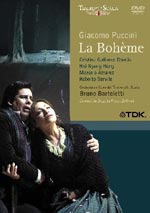
Even for a jaded reviewer like this one who has seen innumerable Bohème's all over the world, there comes a moment in the third act when music and production simply take precedence over intellectual curiosity: the old magic works again and one is moved by the fate of these youngsters. High praise indeed for the famous Zeffirelli-production, born in 1963 at La Scala together with a juicy scandal when Di Stefano was ousted and replaced by Gianni Raimondi.
This is of course the most traditional Bohème one can imagine and this has its advantages. Nowadays Bohème is mostly updated and people often read surtitles with only half an eye. But on an LCD or Plasma screen titles are a real help and have to be taken seriously. I've known several discussions on the net whereby updated productions were defended because Bohème isn't specifically dated. Nonsense of course; the singers refer to their king Luigi Filippi (Louis Philippe of France, king 1830-1848) and there is the custom house at the Paris Barrière d'Enfer in the third act. Custom houses were not around anymore by 1870. I remember a fine production at De Munt in Brussels where the Gare du Nord replaced the custom house and modern policemen were looking into plastic milk bottles (for what ? drugs maybe ?). This production has now served for three generations and has become somewhat of an institution. Indeed all of the principal singers on this DVD were not yet born when it first unfolded. In an extra feature Franco Zeffirelli himself ardently demands the use of a timeframe as planned by the composer. He tells us too that his famous Metropolitan production is just a spin-off, adapted to the somewhat more modern New York technology but basically with the same ideas. Well, it still works magnificently on screen; maybe even better than in the house. In barns such as La Scala and the Met the focus on the intimate aspects of the story sometimes doesn't come across too well but a good tv-director like Carlo Battistoni concentrates his cameras on the love story without neglecting some of the more spectacular showy moments. Maybe that's the one complaint I have. Sometimes these close-ups of an actual performance are a little too close for comfort; especially when Cristina Gallardo-Domâs opens her very wide mouth or juts forward her prominent chin. At that moment one forgets the story and is fearfully reminded of the mechanics of singing. Still that is much to be preferred over badly synchronized voices or tv-performances where the audience is requested to keep silent as not to disturb the flow of the music. The generous applause after arias is included and so it ought to be.
All singers act well and convincingly and I was once more struck that the role of Schaunard, so unimportant in a mere recording, has so more flesh on the scene when sung and acted by a good singer like Natalis de Carolis (I remember how Mark Oswald too succeeded in making the role more important than it actually is in several Met Bohème's I saw). Gallardo-Domâs and álvarez look suitably young and act accordingly; álvarez , being the first tenor whom I saw cheerfully eating real food (chicken) during the supper in the second act. Roberto Servile as Marcello or Hey-Kyung Hong (not very well made-up) look both a little bit too old in close-ups though in exuberance they lack nothing.
This DVD from La Scala, actually shot at the Teatro degli Arcimboldi during a (or a run of) performance (s) in February 2003, has one drawback: the singing. Mind you, everybody sings musically and convincingly but what is lacking is the individual touch. Take Marcelo álvarez : the voice is firm and smooth though without real morbidezza for the role. The volume is not lacking but the small individual tender utterances that make a Rodolfo great are. That first dialogue with Mimi with tender phrases like "che bella bambina" which is so unforgettable by Gigli, Di Stefano or Bergonzi goes for nothing: just sung in a run-of-the mill way without any special honeyed tone. Or take the moving "bella come un aurora" when Rodolfo tells Mimi she is still beautiful in the last act. No emphasis, just plainly sung. Gallardo-Domâs fares somewhat better though there is a little bit of a harsh edge to the upper voice; still it is a clean and nice portrait (the Donde lieta usci is indeed moving) but not a great one: the voice lacks distinction and colour and is a little bit bland. And the moment Hong makes her entrance, you've got the real Puccini-phrasing. Hong's voice has the richer sound too though the voice is maybe a shade less fresh than a few years ago. This reviewer nevertheless thinks the two female singers ought to have reversed their roles. Roberto Servile sings well but he too without the individual touch that can make Marcello a real person instead of just a cipher. One remembers too well Bastianini's "ah la miseria" or Gobbi's phrasing in that moving third act duet. La Scala's Orchestra probably can play the score without one single mistake without a conductor and maybe that wouldn't have been a severe handicap. Most of the time Bruno Bartoletti choses simple tried tempi but now and then he has a tendency of lingering and over sentimentalising the score: "O soave fanciulla" almost comes to a standstill and in "Quando m'en vo" a little more drive would be appreciated.
All in all a rewarding DVD and a fine introduction to the opera for newcomers though old hands may still prefer the same production in the Karajan-version where Freni, Raimondi and Panerai sing in a higher vocal class. There is only one extra: a long rambling talk from Zeffirelli that every minute goes in black for a few seconds when a question is clearly put forward which for one or another reason may not be heard. This becomes ridiculous when he is talking of a queen among sopranos who never sang the role on the scene. It slowly dawns upon the viewer that he is talking of Callas without mentioning her name as that was already given in the (cut) question. Still there is one nugget: it will surprise quite a lot of fans to learn that this director with so many wonderful and sometimes less wonderful productions is not able to read one note of music. In the Italian-language interview one finds the one ridiculous mistake in the English subtitles (as they couldn't be copied from the many libretti). While Zeffirelli clearly speaks of Rosa Ponselle the titles name the soprano Rosa Melba Ponselle.
Jan Neckers