Subscribe to
Opera Today

Receive articles and news via RSS feeds or email subscription.


twitter_logo[1].gif


UCP_9780226043425.gif

Recently in Recordings

Ariane et Barbe-Bleue on Blu-Ray

Paul Dukas’ Ariane et Barbe-Bleue, first heard in 1907, once seemed important. Arturo Toscanini conducted the Met premiere in 1911 with Farrar and later arranged some of its music for a 1947 recording with his NBC Symphony.

Kaufmann Wagner

The economics of the recording companies dictate much that is not ideal. Wagner’s operas were not composed as they were in order to permit the extraction of bleeding chunks, even on those occasions when strophic song forms do occur.

Mahler: Symphony No. 8

Among the recent recordings of Mahler’s Eighth Symphony, Valery Gergiev’s release on the LSO Live label is an excellent addition to the discography of this work.

Songs by Zemlinsky

While not unknown, the songs of Alexander von Zemlinsky (1871-1942) deserve to be heard more frequently.

Gustav Mahler: Lieder eines fahrenden Gesellen, Rückert-Lieder, Kindertotenlieder.

Recorded on 5 and 6 May 2008 and 17 and 18 January 2009 at the Lisztzentrum (Raiding, Austria), this recent Bridge release makes available the piano-vocal versions of three song cycles by Gustav Mahler, Lieder eines fahrenden Gesellen, Rückert-Lieder, and Kindertotenlieder performed by mezzo-soprano Hermine Haselböck, accompanied by Russell Ryan.

Kathleen Ferrier: A Film by Diane Perelsztejn

Contraltos rarely achieve the acclaim and renown of sopranos. Assigned few leading roles in opera, they are condemned to playing the villain or the grandmother, or to stealing the castrati’s trousers in en travesti roles.

1612 Italian Vespers

Following their 2011 Decca recording of Striggio’s Mass in 40 Parts (1566), I Fagiolini continue their quest to unearth lost treasures of the High Renaissance and early Baroque, with this collection of world-premiere recordings, ‘reconstructions’ and ‘reconstitutions’ of music by Giovanni and Andrea Gabrieli, Monteverdi, Palestrina, and their less well-known compatriots Viadana, Barbarino and Soriano.

Eternal Echoes: Songs and Dances for the Soul

Eternal Echoes is an album of khazones [Jewish cantorial music] for cantorial soloist, solo violin and a blended instrumental ensemble comprising a small orchestra and the Klezmer Conservatory Band.

Mahler: Symphony no. 3 / Kindertotenlieder

Michael Tilson Thomas’s recording of Mahler’s Third Symphony is an outstanding contribution to the composer’s discography.

Oliver Knussen’s Symphonies from NMC

Oliver Knussen burst into British music with an unprecedented flourish. In 1967, the London Symphony Orchestra premiered Knussen’s First Symphony, with István Kertész scheduled to conduct.

Ludwig van Beethoven: Fidelio

Based on performances given in Summer 2010 at the Lucerne Festival, this recording of Beethoven’s Fidelio is an admirable recording that captures the vitality of the work as conducted by Claudio Abbado.

Stanisław Moniuszko: Flis

Stanisław Moniuszko (1819-1872) was one of the most popular composers of his day in Poland, and of the many works he wrote for the stage, two are performed from time to time, Halka (1848) and Strazny dwór [The Haunted Manor] (1865).

Stanisław Moniuszko: Pieśni Songs

The Polish alto Jadwiga Rappé is a familiar voice in various stage and concert works, and the recent release of a selection of songs by Stanisław Moniuszko (1819-1872) is an opportunity to hear her performing artsongs.

Joan Sutherland and Richard Bonynge: Serate Musicali

Originally released on multiple discs in 1981 this reissue on two CDs is a comprehensive collection of art songs by Italian and French composers from the nineteenth and early twentieth centuries.

Richard Strauss: Salome

An exciting contribution to the discography of this popular opera, the live performance of Richard Strauss’s Salome from the Festspielhaus at Baden-Baden is a compelling DVD.

Lulu by Gran Teatro del Liceu, Barcelona

Released in late 2011, Deutsche Grammophon’s DVD of the new staging of Berg’s Lulu at the Gran Teatro del Liceu, Barcelona is an excellent contribution to the discography of this fascinating opera.

Lulu by the Metropolitan Opera

A recent release by the Metropolitan Opera, this two-disc set makes available on DVD the famous performance of Berg’s Lulu that was broadcast on 20 December 1980 as part of the PBS series “Live from the Met.”

Elmer Gantry the Opera

The novels of Sinclair Lewis once shot across the American literary skies like comets, alarming and fascinating readers of that era, but their tails didn’t extend far behind them.

Historical Performances from Covent Garden: Barbiere, La traviata and Tosca

Once the province of only the most dedicated opera fanatics, mid-20th century recordings of privately taped live performances have become more widely available.

Lucia and the glass harmonica

Flute players in opera orchestra around the world must look forward to the frequent appearances of Donizetti’s Lucia di Lammermoor, knowing that while the stage spotlight in the mad scene will be on the soprano, the orchestral spotlight will be on their instrument.

OPERA TODAY ARCHIVES »

Recordings

07 Mar 2005

STRAUSS: Die Fledermaus

Film freezes time and even serves to transport an enrapt viewer into its temporal world. Viewers of the recent DVD release of a December 1980 performance of Strauss’ operetta classic, Die Fledermaus, may not be quite as ecstatic as the local audience, but resistance is futile. Have some champagne ready for the curtain calls. Lovers of this art form will rejoice, and even the operetta-resistant (of which your reviewer is one) must succumb to the energy, star power, and sheer good will of all involved.

Johann Strauss: Die Fledermaus
Lucia Popp (Rosalinde, Edita Gruberova (Adele), Brigitte Fassbaender (Prinz Orlofsky), Bernd Weikl (Eisenstein), Walter Berry (Dr. Falke), Joseph Hopferwieser (Alfred), Erich Kunz (Frank), Helmut Lohner (Frosch), Katrin Göttling (Ida), Karl Caslavsky (Iwan)
Chor und Orchester der Wiener Staatsoper, Theodor Guschlbauer (cond.)
TDK DV-CLOPDFM [DVD]
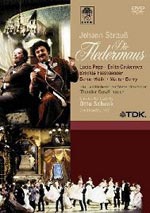
Film freezes time and even serves to transport an enrapt viewer into its temporal world. Viewers of the recent DVD release of a December 1980 performance of Strauss' operetta classic, Die Fledermaus, may not be quite as ecstatic as the local audience, but resistance is futile. Have some champagne ready for the curtain calls. Lovers of this art form will rejoice, and even the operetta-resistant (of which your reviewer is one) must succumb to the energy, star power, and sheer good will of all involved.

The camera pans the gleeful, expectant audience, and then a lanky young man with hair and glasses that proclaim, "The '70s are still with us!" sweeps into the orchestra pit. He is Theodor Guschlbauer, and he will prompt the orchestra to a consistently lively, stylishly inflected performance. This is all the more to be commended, as director Otto Schenk, with partner Peter Weiser, have revised the dialogue and more importantly, apparently kept or even increased the total amount. Guschlbauer has to reinspire his troops throughout the evening as they return to their instruments after another hiatus for chatter.

By the time of this performance, Schenk may have known the opera better than Strauss himself, and his love radiates throughout the evening. The sets have the opulent traditionalism he is known for, and the singers/actors have been directed right up to the point of cartoonish caricature, with only the briefest slips over the line.

And what a cast. Bernd Weikl, if fine voice and manic mood, splays his long legs all over. At one point, in the riotous dance than concludes act two, he even resembles John Cleese in his Ministry of Silly Walks skit. More importantly, Weikl is able to let us laugh at the self-important Eisenstein and not get too annoyed with his boorishness, so that his concluding apology can have at least some of its intended effect.

His wife, irrationally ignored, is Lucia Popp. Her act two czardas may not be the last word in Hungarian affectation, but like all her singing throughout the show, it is the purest, sweetest cream.

Moving on to the men, we have the title-referenced pranskter, Dr. Falke, in the person of Walter Berry. He sounds a bit worn in his act two singing, but otherwise contributes greatly to masking the mean-spiritedness behind some of the plot with his enthusiasm. The absurd tenor, Alfred, has surely been sung by more appealing voices than Joseph Hopferwieser's, but with his puffed-out chest and gloriously self-infatuated air, no complaint should register.

Of the major singing roles, that leaves two truly outstanding performances. Brigitte Fassbaender's Prinz Orlovsky must be the standard. Boyish and yet even more pleasingly ambiguous, she sings with such smooth tone and high spirit that one regrets that the character has so little to do in act three.

Finally, in a bit of a coup, Edita Gruberova's Adele seems to have blossomed into one of the leading roles. Something about the role inspires Gruberova to comic greatness, but even better, her agile, luscious voice, here in its prime, makes every solo a highlight. Even a scream in act two comes out as a pearly high note that many another soprano would die for.

Many will find the DVD, and of course the work itself, a laugh riot. Despite all the wonderful attributes described above, your reviewer has to admit with being impatient at times and even mildly put-out with some of the goings-on. The laborious "funny French" scene in act two seems to stretch on forever. And the Frosch, an amazingly limber Helmut Lohner, gets through all the "funny drunk" business with flair and expert timing. But it's still "funny drunk" business.

In a couple of longuers, supposedly comic, your reviewer's mind wandered to thoughts about the incipient alcoholism many of the character's seem to exhibit, and the faintly nasty social stratification, with Adele's chambermaid position being alternately a source of embarrassment and an opportunity for exploitation (as both the Prinz and Frank offer to take her on as a "protégé.")

Well, the only answer is to join the singers at curtain call in downing some champagne. The TV director, by the way, shows all the curtain calls, including the solo bows, until it's time for Weikl and Popp to emerge. Then the cameras swing to the balconies.

Unfortunate, that, but the greater part of the direction is excellent. This series of DVDs, with the insignia "Wiener Staatsoper Live," continues to provide treasures. Opera Today eagerly awaits the next.

Chris Mullins
Harbor Teacher Preparation Academy

Send to a friend

Send a link to this article to a friend with an optional message.

Friend's Email Address: (required)

Your Email Address: (required)

Message (optional):