Subscribe to
Opera Today

Receive articles and news via RSS feeds or email subscription.


twitter_logo[1].gif


UCP_9780226043425.gif

Recently in Recordings

Ariane et Barbe-Bleue on Blu-Ray

Paul Dukas’ Ariane et Barbe-Bleue, first heard in 1907, once seemed important. Arturo Toscanini conducted the Met premiere in 1911 with Farrar and later arranged some of its music for a 1947 recording with his NBC Symphony.

Kaufmann Wagner

The economics of the recording companies dictate much that is not ideal. Wagner’s operas were not composed as they were in order to permit the extraction of bleeding chunks, even on those occasions when strophic song forms do occur.

Mahler: Symphony No. 8

Among the recent recordings of Mahler’s Eighth Symphony, Valery Gergiev’s release on the LSO Live label is an excellent addition to the discography of this work.

Songs by Zemlinsky

While not unknown, the songs of Alexander von Zemlinsky (1871-1942) deserve to be heard more frequently.

Gustav Mahler: Lieder eines fahrenden Gesellen, Rückert-Lieder, Kindertotenlieder.

Recorded on 5 and 6 May 2008 and 17 and 18 January 2009 at the Lisztzentrum (Raiding, Austria), this recent Bridge release makes available the piano-vocal versions of three song cycles by Gustav Mahler, Lieder eines fahrenden Gesellen, Rückert-Lieder, and Kindertotenlieder performed by mezzo-soprano Hermine Haselböck, accompanied by Russell Ryan.

Kathleen Ferrier: A Film by Diane Perelsztejn

Contraltos rarely achieve the acclaim and renown of sopranos. Assigned few leading roles in opera, they are condemned to playing the villain or the grandmother, or to stealing the castrati’s trousers in en travesti roles.

1612 Italian Vespers

Following their 2011 Decca recording of Striggio’s Mass in 40 Parts (1566), I Fagiolini continue their quest to unearth lost treasures of the High Renaissance and early Baroque, with this collection of world-premiere recordings, ‘reconstructions’ and ‘reconstitutions’ of music by Giovanni and Andrea Gabrieli, Monteverdi, Palestrina, and their less well-known compatriots Viadana, Barbarino and Soriano.

Eternal Echoes: Songs and Dances for the Soul

Eternal Echoes is an album of khazones [Jewish cantorial music] for cantorial soloist, solo violin and a blended instrumental ensemble comprising a small orchestra and the Klezmer Conservatory Band.

Mahler: Symphony no. 3 / Kindertotenlieder

Michael Tilson Thomas’s recording of Mahler’s Third Symphony is an outstanding contribution to the composer’s discography.

Oliver Knussen’s Symphonies from NMC

Oliver Knussen burst into British music with an unprecedented flourish. In 1967, the London Symphony Orchestra premiered Knussen’s First Symphony, with István Kertész scheduled to conduct.

Ludwig van Beethoven: Fidelio

Based on performances given in Summer 2010 at the Lucerne Festival, this recording of Beethoven’s Fidelio is an admirable recording that captures the vitality of the work as conducted by Claudio Abbado.

Stanisław Moniuszko: Flis

Stanisław Moniuszko (1819-1872) was one of the most popular composers of his day in Poland, and of the many works he wrote for the stage, two are performed from time to time, Halka (1848) and Strazny dwór [The Haunted Manor] (1865).

Stanisław Moniuszko: Pieśni Songs

The Polish alto Jadwiga Rappé is a familiar voice in various stage and concert works, and the recent release of a selection of songs by Stanisław Moniuszko (1819-1872) is an opportunity to hear her performing artsongs.

Joan Sutherland and Richard Bonynge: Serate Musicali

Originally released on multiple discs in 1981 this reissue on two CDs is a comprehensive collection of art songs by Italian and French composers from the nineteenth and early twentieth centuries.

Richard Strauss: Salome

An exciting contribution to the discography of this popular opera, the live performance of Richard Strauss’s Salome from the Festspielhaus at Baden-Baden is a compelling DVD.

Lulu by Gran Teatro del Liceu, Barcelona

Released in late 2011, Deutsche Grammophon’s DVD of the new staging of Berg’s Lulu at the Gran Teatro del Liceu, Barcelona is an excellent contribution to the discography of this fascinating opera.

Lulu by the Metropolitan Opera

A recent release by the Metropolitan Opera, this two-disc set makes available on DVD the famous performance of Berg’s Lulu that was broadcast on 20 December 1980 as part of the PBS series “Live from the Met.”

Elmer Gantry the Opera

The novels of Sinclair Lewis once shot across the American literary skies like comets, alarming and fascinating readers of that era, but their tails didn’t extend far behind them.

Historical Performances from Covent Garden: Barbiere, La traviata and Tosca

Once the province of only the most dedicated opera fanatics, mid-20th century recordings of privately taped live performances have become more widely available.

Lucia and the glass harmonica

Flute players in opera orchestra around the world must look forward to the frequent appearances of Donizetti’s Lucia di Lammermoor, knowing that while the stage spotlight in the mad scene will be on the soprano, the orchestral spotlight will be on their instrument.

OPERA TODAY ARCHIVES »

Recordings

08 Mar 2005

VERDI: Les Vêpres Siciliennes

In 1847, Giuseppe Verdi revised his opera I Lombardi alla prima crociata (1843) into a work for the Parisian stage. This “new” composition, featuring extensive plot changes, new music, and the requisite ballet, is considered better than the original upon which it was based. A reverse fate awaited Verdi’s next work for Paris, the grand opéra Les Vêpres Siciliennes, which premiered at the Opéra in 1855. Although it was performed there, with minor changes, until 1863, attempts to get the work past censors in Italy failed, for tales of successful revolutions simply were not permitted on the Risorgimento stage. After a poor translation of the opera entitled Giovanna de Guzman made the circuits, Verdi revisited the score in 1856, and, removing the ballet, created I vespri sicilani. This inferior version, which employs much of Giovanna de Guzman’s text, is unfortunately the one that has remained in the repertory.

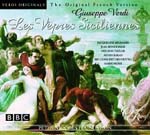
Giuseppe Verdi: Les Vepres Siciliennes
Neilson Taylor (baritone), Jean Bonhomme (tenor), Jacqueline Brumaire (soprano), Ayhan Baran (bass), Stafford Dean (bass), Neil Howlett (bass), Pamela Bowden (contralto), Bernard Dickerson (tenor), Gerald English (tenor), Michael Rippon (baritone), Nigel Rogers (tenor), BBC Chorus, BBC Concert Orchestra, Mario Rossi (cond.), Ashley Lawrence (cond. for ballet music).
Opera Rara CV 303 [3CDs]
In 1847, Giuseppe Verdi revised his opera I Lombardi alla prima crociata (1843) into a work for the Parisian stage. This "new" composition, featuring extensive plot changes, new music, and the requisite ballet, is considered better than the original upon which it was based. A reverse fate awaited Verdi's next work for Paris, the grand opéra Les Vepres Siciliennes, which premiered at the Opéra in 1855. Although it was performed there, with minor changes, until 1863, attempts to get the work past censors in Italy failed, for tales of successful revolutions simply were not permitted on the Risorgimento stage. After a poor translation of the opera entitled Giovanna de Guzman made the circuits, Verdi revisited the score in 1856, and, removing the ballet, created I vespri sicilani. This inferior version, which employs much of Giovanna de Guzman's text, is unfortunately the one that has remained in the repertory.

Les Vepres Siciliennes is the latest in the Opera Rara series Verdi Originals. Previous issues include Macbeth and Simon Boccanegra, with promises of La forza del destino and Don Carlos to come. This issue is a recording of the original French version as performed at London's Camden Theatre on 10 May 1969 and subsequently broadcast by the BBC on 15 February 1970. The CD, digitally remastered by Oliver Davis, is a superb rendering, for it lacks the usual vacant spatial sounds so often present in older live performances. As a result, Opera Rara presents a noteworthy representation of a work that expands the opera-goer's knowledge of this portion of Verdi's compositional history.

This five-act version is rarely performed. Because of its extended length and considerable vocal forces, productions are expensive undertakings. Furthermore, all but die-hard admirers come to hear Verdi the "Italian"; therefore, this work tends to fare poorly in the common repertory. For these reasons alone, this recording is significant, for it offers a fascinating picture of what came before and what would follow in the composer's canon. The quality of this performance (and the recording) is so consistently excellent that it is difficult to focus on specifics; nevertheless, the principals, tenor Jean Bonhomme (Henri), soprano Jacqueline Brumaire (Hélène), baritone Neilson Taylor (Montfort), and bass Ayhan Baran (Procida) deserve special mention for certain numbers. Bonhomme and Taylor are perhaps at their dramatic best in the their Act III Scene and Duet, the main melody of which is among those Verdi previewed in the opera's extensive Overture. Baran's interpretation of "Et toi, Palerme," Procida's entrance aria (and one of the most popular selections from the opera in its own day) demonstrates his melodic ability. Throughout the performance, Brumaire excells, but perhaps her florid mastery in "Merci, jeunes amis" in Act V is one of her strongest points in this performance.

Because of the position of this work in the Verdi canon, certain numbers are of special interest. In the Act IV quartet "Adieu, mon pays," one hears how the composer applied the skills learned from Rigoletto. Moreover, the setting of the "De profundis clamavi" is clearly reminiscent of the composer's use of the "Miserere" in Il trovatore, and the falling "sigh" figures in the string accompaniment as Hélène and Procida sing "Mon pays" is a clear allusion to the third act of La traviata. Looking forward, one can foresee the musical energy and character development that will again appear in La forza del destino, Don Carlos, Aida, and, of course, Otello. What amazes about this version, something lost in the Italian Vespri, is Verdi's able handling of all of the elements of grand opera, including the Act III Ballet of the Four seasons, well conducted, by the way, by Ashley Lawrence, who for the ballet, takes the baton from Mario Rossi. One needs to note Maestro Rossi's able handling of the score (perhaps retouched in the remastering?); the balance between the singers and the orchestra is perfect. In this complex score when so much melodic activity rests in the accompaniment, the singers are never overwhelmed. The BBC Chorus ably supports the singers, but, at times, one suspects that their forte is really choral music and not opera choruses. If one has the opportunity to see Les Vepres Siciliennes on stage, one should, of course, do so. In lieu of a live performance — or even to enhance it — Opera Rara's recording is a must.

Denise Gallo

Send to a friend

Send a link to this article to a friend with an optional message.

Friend's Email Address: (required)

Your Email Address: (required)

Message (optional):