28 Apr 2005
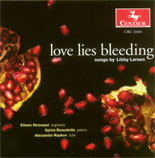
LARSEN: love lies bleeding — Songs by Libby Larsen.
This CD, entitled "Love Lies Bleeding," is a companion to the fascinating recording by the same soprano and pianist, entitled "With All My Soul" (The Orchard 6003).
The Sixteen continues its exploration of Henry Purcell’s Welcome Songs for Charles II. As with Robert King’s pioneering Purcell series begun over thirty years ago for Hyperion, Harry Christophers is recording two Welcome Songs per disc.
In February this year, Albanian soprano Ermonela Jaho made a highly lauded debut recital at Wigmore Hall - a concert which both celebrated Opera Rara’s 50th anniversary and honoured the career of the Italian soprano Rosina Storchio (1872-1945), the star of verismo who created the title roles in Leoncavallo’s La bohème and Zazà, Mascagni’s Lodoletta and Puccini’s Madama Butterfly.
Collapsology. Or, perhaps we should use the French word ‘Collapsologie’ because this is a transdisciplinary idea pretty much advocated by a series of French theorists - and apparently, mostly French theorists. It in essence focuses on the imminent collapse of modern society and all its layers - a series of escalating crises on a global scale: environmental, economic, geopolitical, governmental; the list is extensive.
Amongst an avalanche of new Mahler recordings appearing at the moment (Das Lied von der Erde seems to be the most favoured, with three) this 1991 Mahler Second from the 2nd Kassel MahlerFest is one of the more interesting releases.
If there is one myth, it seems believed by some people today, that probably needs shattering it is that post-war recordings or performances of Wagner operas were always of exceptional quality. This 1949 Hamburg Tristan und Isolde is one of those recordings - though quite who is to blame for its many problems takes quite some unearthing.
The voices of six women composers are celebrated by baritone Jeremy Huw Williams and soprano Yunah Lee on this characteristically ambitious and valuable release by Lontano Records Ltd (Lorelt).
As Paul Spicer, conductor of the Royal Birmingham Conservatoire Chamber Choir, observes, the worship of the Blessed Virgin Mary is as ‘old as Christianity itself’, and programmes devoted to settings of texts which venerate the Virgin Mary are commonplace.
Ethel Smyth’s last large-scale work, written in 1930 by the then 72-year-old composer who was increasingly afflicted and depressed by her worsening deafness, was The Prison – a ‘symphony’ for soprano and bass-baritone soloists, chorus and orchestra.
‘Hamilton Harty is Irish to the core, but he is not a musical nationalist.’
‘After silence, that which comes closest to expressing the inexpressible is music.’ Aldous Huxley’s words have inspired VOCES8’s new disc, After Silence, a ‘double album in four chapters’ which marks the ensemble’s 15th anniversary.
A song-cycle is a narrative, a journey, not necessarily literal or linear, but one which carries performer and listener through time and across an emotional terrain. Through complement and contrast, poetry and music crystallise diverse sentiments and somehow cohere variability into an aesthetic unity.
One of the nicest things about being lucky enough to enjoy opera, music and theatre, week in week out, in London’s fringe theatres, music conservatoires, and international concert halls and opera houses, is the opportunity to encounter striking performances by young talented musicians and then watch with pleasure as they fulfil those sparks of promise.
“It’s forbidden, and where’s the art in that?”
Dublin-born John F. Larchet (1884-1967) might well be described as the father of post-Independence Irish music, given the immense influenced that he had upon Irish musical life during the first half of the 20th century - as a composer, musician, administrator and teacher.
The English Civil War is raging. The daughter of a Puritan aristocrat has fallen in love with the son of a Royalist supporter of the House of Stuart. Will love triumph over political expediency and religious dogma?
Beethoven Symphony no 9 (the Choral Symphony) in D minor, Op. 125, and the Choral Fantasy in C minor, Op. 80 with soloist Kristian Bezuidenhout, Pablo Heras-Casado conducting the Freiburger Barockorchester, new from Harmonia Mundi.
A Louise Brooks look-a-like, in bobbed black wig and floor-sweeping leather trench-coat, cheeks purple-rouged and eyes shadowed in black, Barbara Hannigan issues taut gestures which elicit fire-cracker punch from the Mahler Chamber Orchestra.
‘Signor Piatti in a fantasia on themes from Beatrice di Tenda had also his triumph. Difficulties, declared to be insuperable, were vanquished by him with consummate skill and precision. He certainly is amazing, his tone magnificent, and his style excellent. His resources appear to be inexhaustible; and altogether for variety, it is the greatest specimen of violoncello playing that has been heard in this country.’
Baritone Roderick Williams seems to have been a pretty constant ‘companion’, on my laptop screen and through my stereo speakers, during the past few ‘lock-down’ months.
Melodramas can be a difficult genre for composers. Before Richard Strauss’s Enoch Arden the concept of the melodrama was its compact size – Weber’s Wolf’s Glen scene in Der Freischütz, Georg Benda’s Ariadne auf Naxos and Medea or even Leonore’s grave scene in Beethoven’s Fidelio.
This CD, entitled "Love Lies Bleeding," is a companion to the fascinating recording by the same soprano and pianist, entitled "With All My Soul" (The Orchard 6003).
(Total disclosure: I know both performers and asked them for review copies of the CDs because of my interest in music by women composers.) The earlier release presented songs by three important French women from the nineteenth and early twentieth centuries — Pauline Viardot-Garcia, Marie vicomtesse de Grandval, and Lili Boulanger — and was remarkable in at least three respects: the Viardot songs handled their German texts persuasively, the Grandval songs (world premiere recordings) proved to be consistently interesting if a bit conventional, and the Lili Boulanger cycle is one of the major statements by that important composer who died all too young at age 24.
The present CD, by contrast, is devoted almost entirely to a single woman composer and a living one at that, Libby Larsen (1950- ). The works — including one that is new to disc — prove to be just as fascinating and nearly as diverse as the contents of the previous CD, as might well be predicted by those who know some of Larsen's previous pieces, such as her 1990 opera Frankenstein: The Modern Prometheus, her song cycle for mezzo-soprano Love after 1950 (Koch International Classics 3-7506-2 H1), or her 1988 orchestral work Collage: Boogie (on the Baltimore Symphony's widely circulated Dance Mix CD: Decca 444 454-2/Argo D 108669), which show her use of what New Grove calls "liberated tonality without harsh dissonance, and pervading lyricism."
The first of the three Cowboy Songs of 1994, "Bucking Bronco," has a seductive, tango-like lilt for a poem (by Belle Star) of a Western gal who was courted and then abandoned by her rider beau. "Lift Me into Heaven Slowly" is a powerful four lines of verse (by Robert Creeley) made truly gripping by Larsen's decisions about which words to repeat and when to have the vocal line pause for rhetorical effect; Larsen also gives the piano a sweet-sad "cowboy" tinge through a loping rhythm. "Billy the Kid," makes a fascinating contrast to other, better-known works about that varmint, namely Aaron Copland's ballet (1938) and Andre Previn's recent Sally Chisum Remembers Billy the Kid (London 455 511). Whereas, in those two works, Billy comes across as something of a doomed charmer, here the bustling, ferocious music bans all melancholy, as befits an anonymous folk text that spares no regret: "One day he met a man / A whole lot badder / And now he's dead. / And we ain't none the sadder."
The Sonnets from the Portuguese are based on poems from Elizabeth Barrett Browning's famous collection of that name (1846) that, written a few years after she married fellow poet Robert Browning, recall their courtship, which had been carried out often in secret because of violent opposition from Elizabeth's father.
Larsen's cycle, originally for soprano and chamber orchestra, was written at the request of, and with the close cooperation of, the wonderful soprano Arleen Augér. (See David Mason Greene's review of her "live" recording of the orchestral version, Koch International Classics, 3-7248-2H1, in American Record Guide, March/April 1994.) The present CD is the recorded premiere of the remarkably effective piano version.
Sonnets is a major work and a deeply earnest one, about the joys and fears inherent in a close but sometimes unequal loving relationship. The poems' meter is unvaried iambic pentameter; the rhyme pattern, though different from that in Shakespeare's sonnets, is tightly repetitive and interlocking (abba abba cdc ded). Larsen lets both (verse-)meter and rhyme work at a subliminal level, focusing instead on the text's shifts in gut emotion and gestural energy.
Particularly striking, and not at all dated, is the poet's worry that she is giving herself to someone who may not be willing or able to sacrifice as much in return, a worry that is made all the more poignant by recurrent expressions of her needfulness: "If I leave all for thee, wilt thou exchange / And be all to me? . . . / I have grieved so I am hard to love. / Yet love — wilt thou? Open thy heart wide, / And fold within [it] the wet wings of thy dove." Larsen reflects the poet's vulnerability at that final phrase with a soft high note. Eloquent also is the composer's decision to highlight musically through near-Tchaikovskyan rising sequences the words of the man whom the poet is beseeching. At these moments, the cycle almost becomes a mini-opera played out in the mind of one of the characters. Augér, from the beginning, had asked Larsen for a cycle that "spoke about the finding of mature love, as opposed to the young girl's feeling for the promise of love in [Schumann's] Frauenliebe und [-]Leben." The task is brilliantly, movingly fulfilled.
The CD concludes with the world premiere recording of Larsen's Try Me, Good King: Last Words of the Wives of Henry VIII (2001). Larsen decided not to set any words of the sixth wife, Katherine Parr, who outlived the monarch. Instead, she focused on letters and gallows speeches of the remaining (or, rather, non-remaining!) five. Stressful documents they are, ranging from Anne Boleyn's "Let me have a lawful trial, and let not my enemies sit as my accusers and judges" to Katherine Howard's frank words at her execution, as transcribed by an unknown Spaniard: "Long before the King took me, I loved Thomas Culpeper. I die a Queen, but I would rather die the wife of Culpeper."
The songs contrast sharply in tone and make occasional and effective use of melismatic singing and virtuosic leaps that never feel superficially "archaic" but rather responsive to the particular woman and her specific anguish, such as the sarcastic leap up an octave and then down again at the end of Anne of Cleves's declaration: "I neither can nor will repute myself for your grace's wife. Yet it will please your highness to take me for your sister." Larsen also subtly worked musical phrases from four sixteenth-century lute songs into the Try Me cycle, again more for expressive purposes than for some kind of self-consciously "neo-" effect. These four songs — Dowland's "In Darkness Let Me Dwell" and "If My Complaints Could Passions Move," Michael Praetorius's "Lo How a Rose E'er Blooming," and Thomas Campion's "I Care Not for Those Ladies That Must be Wooed" — are performed on the CD just before the Try Me cycle, giving the listener all s/he needs to catch yet another aspect of Larsen's artistry. Strempel sings them in the gorgeous mid and lower end of her range and is artfully accompanied by Russian-born lutenist Alexander Raykov.
In the Larsen works themselves, Strempel handles the vocal lines with confident professionalism and communicative thrust, including subtle use of portamento, speechlike inflections, and so on. (Larsen coached the duo, attended the recording sessions, and even adjusted the vocal line of one song for greater depth of characterization.) One suspects that Strempel would be able to cope handily with the additional challenge of the orchestral version of the Sonnets: she performs often in oratorios and has scored a hit as Violetta with the Bolshoi Opera. The voice comes across, through speakers or earphones, as rich and brilliant, with a few particularly vivid full-voiced high notes and a few exquisite "floated" ones; this is not the thin, artsy type of "recitalist's" voice whose notes nearly vanish after a consonantal puff of air.
Richness of voice, of course, can carry its own disadvantages, especially when vividly recorded: here the vibrato can become a touch obtrusive, and pitch is sometimes a shade flat on held notes. Nonetheless, the warmth of the voice is a plus overall, and somehow does not prevent Strempel from conveying the words and their sense to the listener's ear. Her readings feel not laboratory-perfect, like so many recordings these days, but alert and alive.
Throughout the piano-accompanied songs, the soprano is brilliantly partnered by Québec-born Sylvie Beaudette, who brings immense oomph and ease to her part, which the engineers have balanced very satisfyingly with the voice. Her playing in the Cowboy Songs is enchanting, drawing one right into Larsen's mind-world from the start. (Beaudette recorded this short cycle once before, with Nanette McGuinness, on Centaur CRC 2461. Yet another Cowboy performance, by soprano Louise Toppin and John B. O'Brien, is on Albany Records TROY 385. Both of these are anthology discs of music by various women composers.) Similarly, in the Sonnets, it is to Beaudette's great credit that one rarely finds oneself trying to guess what the colors might be in the orchestral version. And, in Try Me, one is carried along by her responsiveness to the ebb and flow of feeling and drama in this portrait gallery come to life.
Ralph P. Locke
Eastman School of Music (University of Rochester)
THIS REVIEW ORIGINALLY APPEARED IN THE MARCH/APRIL 2005 ISSUE (VOL.68, NO.2) OF AMERICAN RECORD GUIDE (ARG). IT IS REPRINTED HERE WITH THE KIND PERMISSION OF ARG AND THE AUTHOR. FOR ADDITIONAL INFORMATION ON ARG, GO TO ITS WEBSITE AT www.americanrecordguide.com.