Subscribe to
Opera Today

Receive articles and news via RSS feeds or email subscription.


twitter_logo[1].gif


UCP_9780226043425.gif

Recently in Recordings

Ariane et Barbe-Bleue on Blu-Ray

Paul Dukas’ Ariane et Barbe-Bleue, first heard in 1907, once seemed important. Arturo Toscanini conducted the Met premiere in 1911 with Farrar and later arranged some of its music for a 1947 recording with his NBC Symphony.

Kaufmann Wagner

The economics of the recording companies dictate much that is not ideal. Wagner’s operas were not composed as they were in order to permit the extraction of bleeding chunks, even on those occasions when strophic song forms do occur.

Mahler: Symphony No. 8

Among the recent recordings of Mahler’s Eighth Symphony, Valery Gergiev’s release on the LSO Live label is an excellent addition to the discography of this work.

Songs by Zemlinsky

While not unknown, the songs of Alexander von Zemlinsky (1871-1942) deserve to be heard more frequently.

Gustav Mahler: Lieder eines fahrenden Gesellen, Rückert-Lieder, Kindertotenlieder.

Recorded on 5 and 6 May 2008 and 17 and 18 January 2009 at the Lisztzentrum (Raiding, Austria), this recent Bridge release makes available the piano-vocal versions of three song cycles by Gustav Mahler, Lieder eines fahrenden Gesellen, Rückert-Lieder, and Kindertotenlieder performed by mezzo-soprano Hermine Haselböck, accompanied by Russell Ryan.

Kathleen Ferrier: A Film by Diane Perelsztejn

Contraltos rarely achieve the acclaim and renown of sopranos. Assigned few leading roles in opera, they are condemned to playing the villain or the grandmother, or to stealing the castrati’s trousers in en travesti roles.

1612 Italian Vespers

Following their 2011 Decca recording of Striggio’s Mass in 40 Parts (1566), I Fagiolini continue their quest to unearth lost treasures of the High Renaissance and early Baroque, with this collection of world-premiere recordings, ‘reconstructions’ and ‘reconstitutions’ of music by Giovanni and Andrea Gabrieli, Monteverdi, Palestrina, and their less well-known compatriots Viadana, Barbarino and Soriano.

Eternal Echoes: Songs and Dances for the Soul

Eternal Echoes is an album of khazones [Jewish cantorial music] for cantorial soloist, solo violin and a blended instrumental ensemble comprising a small orchestra and the Klezmer Conservatory Band.

Mahler: Symphony no. 3 / Kindertotenlieder

Michael Tilson Thomas’s recording of Mahler’s Third Symphony is an outstanding contribution to the composer’s discography.

Oliver Knussen’s Symphonies from NMC

Oliver Knussen burst into British music with an unprecedented flourish. In 1967, the London Symphony Orchestra premiered Knussen’s First Symphony, with István Kertész scheduled to conduct.

Ludwig van Beethoven: Fidelio

Based on performances given in Summer 2010 at the Lucerne Festival, this recording of Beethoven’s Fidelio is an admirable recording that captures the vitality of the work as conducted by Claudio Abbado.

Stanisław Moniuszko: Flis

Stanisław Moniuszko (1819-1872) was one of the most popular composers of his day in Poland, and of the many works he wrote for the stage, two are performed from time to time, Halka (1848) and Strazny dwór [The Haunted Manor] (1865).

Stanisław Moniuszko: Pieśni Songs

The Polish alto Jadwiga Rappé is a familiar voice in various stage and concert works, and the recent release of a selection of songs by Stanisław Moniuszko (1819-1872) is an opportunity to hear her performing artsongs.

Joan Sutherland and Richard Bonynge: Serate Musicali

Originally released on multiple discs in 1981 this reissue on two CDs is a comprehensive collection of art songs by Italian and French composers from the nineteenth and early twentieth centuries.

Richard Strauss: Salome

An exciting contribution to the discography of this popular opera, the live performance of Richard Strauss’s Salome from the Festspielhaus at Baden-Baden is a compelling DVD.

Lulu by Gran Teatro del Liceu, Barcelona

Released in late 2011, Deutsche Grammophon’s DVD of the new staging of Berg’s Lulu at the Gran Teatro del Liceu, Barcelona is an excellent contribution to the discography of this fascinating opera.

Lulu by the Metropolitan Opera

A recent release by the Metropolitan Opera, this two-disc set makes available on DVD the famous performance of Berg’s Lulu that was broadcast on 20 December 1980 as part of the PBS series “Live from the Met.”

Elmer Gantry the Opera

The novels of Sinclair Lewis once shot across the American literary skies like comets, alarming and fascinating readers of that era, but their tails didn’t extend far behind them.

Historical Performances from Covent Garden: Barbiere, La traviata and Tosca

Once the province of only the most dedicated opera fanatics, mid-20th century recordings of privately taped live performances have become more widely available.

Lucia and the glass harmonica

Flute players in opera orchestra around the world must look forward to the frequent appearances of Donizetti’s Lucia di Lammermoor, knowing that while the stage spotlight in the mad scene will be on the soprano, the orchestral spotlight will be on their instrument.

OPERA TODAY ARCHIVES »

Recordings

23 May 2005

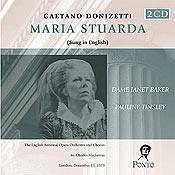
DONIZETTI: Maria Stuarda

One of the more interesting debates in arts politics in England last century centered on the language in which operas should be performed. While some staunchly favored opera in the original, others maintained that librettos should be translated into the vernacular. The latter side felt strongly that opera in English would nurture a national style of operatic presentation; a more chauvinistic argument suggested that if native composers heard opera in English, they would be more likely to attempt to set original English librettos (which, of course, would come from the pens of similarly inspired writers). Benjamin Britten and W.H. Auden’s Peter Grimes (1945) might be interpreted as representative of such a strategy. In addition, the mounting of vernacular performances also would inspire British performers (and discourage foreign singers who would be less likely to want to relearn a role in a new language). The debate eventually led to the division of operatic labor, with Covent Garden (soon to be renamed The Royal Opera) to perform works in their original languages and Sadler’s Wells (renamed the English National Opera after its move to the Coliseum, where it remains today) to produce works in translation. Thus, it was left up to audiences to decide which they preferred—or, better yet, to enjoy them both.

Gaetano Donizetti: Maria Stuarda (sung in English)
Dame Janet Baker (Mary Stuart); Pauline Tinsley (Queen Elizabeth I); Keith Erwen (Robert Dudley, Earl of Leicester); Don Garrard (George Talbot, Earl of Shrewsbury); Christian Du Plessis (Sir William Cecil); Audrey Gunn (Hannah Kennedy)
The English National Opera Orchestra and Chorus conducted by Sir Charles Mackerras
Live recording London, 13 December 1973
Ponto 1031 [2CDs]
One of the more interesting debates in arts politics in England last century centered on the language in which operas should be performed. While some staunchly favored opera in the original, others maintained that librettos should be translated into the vernacular. The latter side felt strongly that opera in English would nurture a national style of operatic presentation; a more chauvinistic argument suggested that if native composers heard opera in English, they would be more likely to attempt to set original English librettos (which, of course, would come from the pens of similarly inspired writers). Benjamin Britten and W.H. Auden's Peter Grimes (1945) might be interpreted as representative of such a strategy. In addition, the mounting of vernacular performances also would inspire British performers (and discourage foreign singers who would be less likely to want to relearn a role in a new language). The debate eventually led to the division of operatic labor, with Covent Garden (soon to be renamed The Royal Opera) to perform works in their original languages and Sadler's Wells (renamed the English National Opera after its move to the Coliseum, where it remains today) to produce works in translation. Thus, it was left up to audiences to decide which they preferred--or, better yet, to enjoy them both.

The Ponto label is presently in the process of issuing recordings of operas starring the great English mezzo Dame Janet Baker. The third in this series is her performance as Mary Stuart in Donizetti's Maria Stuarda in the 1973 English National Opera production (other Baker recordings issued by Ponto include Handel's Admetus in English and Gluck's Alceste in French). This recording merits note for a variety of reasons. First, it serves as an example of the aims of the aestheticians who deemed opera in translation a necessity in mid-twentieth century England. As translations go--and some can be dead wrong--this libretto stays well within the meaning of Giuseppe Bardari's original text. One might wish that the program booklet included the translator's name, but perhaps it was unknown even to the Ponto producers. In addition to significance, the selected vocabulary also matches well with the melodic line; hence, instead of awkward patches of sounds one often hears in performances employing translated librettos (English or otherwise), the sung text flows well with the music.

In the context of the opera's history, this recording also proves of interest. Donizetti composed the opera for Naples and specifically for one of his favorite sopranos, Giuseppina Ronzi De Begnis. The Bourbon censors, however, were always touchy about tales that suggested political coups or the death of a monarch, so the subject was rejected as written. Donizetti reworked the opera as Buondelmonte, which premiered at the San Carlo in 1834. Enter the legendary Maria Malibran, who wanted to perform the opera as it had been composed. Censors in Milan were no more enthusiastic about the tale than were their colleagues in Naples, but Malibran skirted their orders and sung the work without revision, resulting in a ban against the work. A heavily-censored score was employed for subsequent performances. Early twentieth-century performances, including the one on this recording, are based on revised versions of the score. Only in the late 1980s when Donizetti's autograph manuscript was discovered in Sweden was the opera returned to its original two-act form, now published in the critical edition of the composer's works.

This recording is a prime example of Baker's artistry. Indeed, this version of the score, which Donizetti lowered for Malibran's own mezzo voice, suits her perfectly. Baker's ability to create dramatic portrayals is apparent as well, especially in scenes with Keith Erwen (Leicester) and especially in the final numbers of Act III such as "Death hovers near me, so take my pardon" ("D'un cor che muore reca il perdono" in the original). Soprano Pauline Tinsley, another classic of this golden age of the ENO, performs ably as Elizabeth, but her voice (perhaps as captured in this live recording) is often less brilliant and less skilled than Baker's. Indeed, in "May the light of wisdom and justice" ("Ah! del ciel discenda un raggio"), she clings for dear life to the dangerously high penultimate note of the cadenza. Dramatically, however, she matches Baker in scenes in which the rival half-sisters (also rivals for Leicester's affections) meet head on. Erwen has a pleasant and lyrical tone, but his interpretation is somewhat stereotypical of a bel canto tenor. Of even greater concern is a questionable sense of pitch; he tends to sit on the flat side of a pitch, a trait particularly noticeable in his duets with Baker and Tinsley, who to their credit fail to allow him to pull them down off the correct note. Credible interpretations are turned in by bass Don Garrard as Talbot, baritone Christian Du Plessis as Cecil, and mezzo Audrey Gunn as Hannah. Although all are not British, all are native English speakers (Garrard is Canadian and Plessis, South African); hence, all fit the image of the singers whom vernacular advocates were promoting.

The CD includes a list of the tracks and liner notes (by Andrew Palmer) but no printed libretto. Although the cast members carefully enunciate, in strettas like "My arrogant rival has long sought to rob me" ("Sul crin la rivale la man mi stendea") the text simply is sung too quickly for comprehension. If issuing more of Baker's (or anyone's) performances in English is intended, this might be something Ponto could keep in mind.

Aside from the usual blemishes of a live recording - applause, coughs, singers' footsteps as they trod the stage - this Maria Stuarda documents an important stage in the mature compositions of one of the dramatic masters of the Ottocento, an equally important part of the narrative of English opera in the twentieth century, and one of England's greatest voices.

Denise Gallo

Send to a friend

Send a link to this article to a friend with an optional message.

Friend's Email Address: (required)

Your Email Address: (required)

Message (optional):