30 May 2005
SALIERI: Tarare
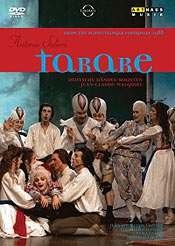
The appearance of a DVD of the Beaumarchais — Salieri Tarare is cause for celebration.
The Sixteen continues its exploration of Henry Purcell’s Welcome Songs for Charles II. As with Robert King’s pioneering Purcell series begun over thirty years ago for Hyperion, Harry Christophers is recording two Welcome Songs per disc.
In February this year, Albanian soprano Ermonela Jaho made a highly lauded debut recital at Wigmore Hall - a concert which both celebrated Opera Rara’s 50th anniversary and honoured the career of the Italian soprano Rosina Storchio (1872-1945), the star of verismo who created the title roles in Leoncavallo’s La bohème and Zazà, Mascagni’s Lodoletta and Puccini’s Madama Butterfly.
Collapsology. Or, perhaps we should use the French word ‘Collapsologie’ because this is a transdisciplinary idea pretty much advocated by a series of French theorists - and apparently, mostly French theorists. It in essence focuses on the imminent collapse of modern society and all its layers - a series of escalating crises on a global scale: environmental, economic, geopolitical, governmental; the list is extensive.
Amongst an avalanche of new Mahler recordings appearing at the moment (Das Lied von der Erde seems to be the most favoured, with three) this 1991 Mahler Second from the 2nd Kassel MahlerFest is one of the more interesting releases.
If there is one myth, it seems believed by some people today, that probably needs shattering it is that post-war recordings or performances of Wagner operas were always of exceptional quality. This 1949 Hamburg Tristan und Isolde is one of those recordings - though quite who is to blame for its many problems takes quite some unearthing.
The voices of six women composers are celebrated by baritone Jeremy Huw Williams and soprano Yunah Lee on this characteristically ambitious and valuable release by Lontano Records Ltd (Lorelt).
As Paul Spicer, conductor of the Royal Birmingham Conservatoire Chamber Choir, observes, the worship of the Blessed Virgin Mary is as ‘old as Christianity itself’, and programmes devoted to settings of texts which venerate the Virgin Mary are commonplace.
Ethel Smyth’s last large-scale work, written in 1930 by the then 72-year-old composer who was increasingly afflicted and depressed by her worsening deafness, was The Prison – a ‘symphony’ for soprano and bass-baritone soloists, chorus and orchestra.
‘Hamilton Harty is Irish to the core, but he is not a musical nationalist.’
‘After silence, that which comes closest to expressing the inexpressible is music.’ Aldous Huxley’s words have inspired VOCES8’s new disc, After Silence, a ‘double album in four chapters’ which marks the ensemble’s 15th anniversary.
A song-cycle is a narrative, a journey, not necessarily literal or linear, but one which carries performer and listener through time and across an emotional terrain. Through complement and contrast, poetry and music crystallise diverse sentiments and somehow cohere variability into an aesthetic unity.
One of the nicest things about being lucky enough to enjoy opera, music and theatre, week in week out, in London’s fringe theatres, music conservatoires, and international concert halls and opera houses, is the opportunity to encounter striking performances by young talented musicians and then watch with pleasure as they fulfil those sparks of promise.
“It’s forbidden, and where’s the art in that?”
Dublin-born John F. Larchet (1884-1967) might well be described as the father of post-Independence Irish music, given the immense influenced that he had upon Irish musical life during the first half of the 20th century - as a composer, musician, administrator and teacher.
The English Civil War is raging. The daughter of a Puritan aristocrat has fallen in love with the son of a Royalist supporter of the House of Stuart. Will love triumph over political expediency and religious dogma?
Beethoven Symphony no 9 (the Choral Symphony) in D minor, Op. 125, and the Choral Fantasy in C minor, Op. 80 with soloist Kristian Bezuidenhout, Pablo Heras-Casado conducting the Freiburger Barockorchester, new from Harmonia Mundi.
A Louise Brooks look-a-like, in bobbed black wig and floor-sweeping leather trench-coat, cheeks purple-rouged and eyes shadowed in black, Barbara Hannigan issues taut gestures which elicit fire-cracker punch from the Mahler Chamber Orchestra.
‘Signor Piatti in a fantasia on themes from Beatrice di Tenda had also his triumph. Difficulties, declared to be insuperable, were vanquished by him with consummate skill and precision. He certainly is amazing, his tone magnificent, and his style excellent. His resources appear to be inexhaustible; and altogether for variety, it is the greatest specimen of violoncello playing that has been heard in this country.’
Baritone Roderick Williams seems to have been a pretty constant ‘companion’, on my laptop screen and through my stereo speakers, during the past few ‘lock-down’ months.
Melodramas can be a difficult genre for composers. Before Richard Strauss’s Enoch Arden the concept of the melodrama was its compact size – Weber’s Wolf’s Glen scene in Der Freischütz, Georg Benda’s Ariadne auf Naxos and Medea or even Leonore’s grave scene in Beethoven’s Fidelio.
The appearance of a DVD of the Beaumarchais — Salieri Tarare is cause for celebration.
The work is an extraordinary curiosity; a child of the heady days just before the French Revolution, Tarare is the famous French writer's only opera and one of the Italian composer's rare French scores. First and most strikingly a work of social and political commentary, Tarare is also an entertaining work of theatre. Salieri's music supports these aims admirably and offers a few memorable moments of its own. As an opera form, Tarare defies easy categorization; it may be best described as a comedic satire dressed in the clothes of a sprawling 5 act lyric tragedy, complete with Prologue and a grand divertissement with dance.
This performance, from the Schwetzinger Festspiele in 1988, is a co-production of the Badishe Staatstheatre Karlsruhe and the Théatre National Opéra de Paris, and makes an impressive case for the work as a lively comedy. The production is remarkably well cast, directed with great imagination by Jean-Louis Martinoty, and energetically performed by Jean-Claude Malgoire and the Deutsche Händel Solisten. There are several cuts made, the only disconcerting one being the elimination of most, but not all of the overture between the Prologue and Act I.
The Prologue is the most unusual part of the opera. It poses certain theatrical challenges that do not seem well met in this production, however. Interestingly, the opera opens with a storm scene. The stage is here filled with emblems of the nations of the world and their emperors, each struck down in slow motion by an allegorical figure wielding death's scythe. It would have been preferable to have recreated, with the dance company, the pantomime of winds unchained described in the original stage directions, and to see them gradually calmed, the clouds dispersed, and a daytime countryside revealed, all in response to the musical score. What follows is a lengthy discourse between La Nature (Gabrielle Rossmanith) and the Le Genie de Feu (Klaus Kirchner) over the fates of each of the characters in the opera, whose shadows appear before them and whose souls they are about to awake. The discourse is convoluted, but filled with allusions to equality, class and power, science, character, and the creator.
Happily, from the first notes of Act I, we are in a world of action, where the author's philosophical point of view, though heavy handed, is made in lively metaphor. The setting is an Asiatic kingdom, where Atar, the king, (Jean-Philippe LaFont) is frustrated by the adulation his people confer upon the heroic soldier Tarare (Howard Crook). Atar conspires with the high priest of Brama, Arthénée (Nicolas Rivenq) and the priest's son Altamort (Hannu Niemelä) to abduct Tarare's wife Astasie (Zehava Gal), whom the king desires, and to get rid of Tarare. It sounds like the stuff of dramatic opera, but from the very beginning it is hilarious. This hilarity is aided considerably by the two European servants in the court — the eunuch Calpigi (Eberhard Lorenz), and his wife Spinette (Anna Caleb), who are, appropriately, dressed as Harlequins in surroundings of Asiatic exoticism (stage design by Heinz Balthes and costumes by Daniel Ogier). There may be in the libretto a little more threatening evil to Atar's character, but LaFont's comedic talents and his singing are delightful. Howard Crook seems exactly right as the earnest hero Tarare, and his 'Astasie est une Déesse' is an air both arresting and beautiful. Eberhard Lorenz helps carry the drama forward with brilliant and athletic humor as he manipulates circumstances to Tarare's advantage. The third act is primarily an extended divertissement, choreographed by Ann Jacoby. The wonderful conceit of this is that the 'exotic' elements are the Europeans, and it is very funny to see Atar and the long mustached Middle-Eastern soldiers trying to imitate a provincial French pastorale. The scene ends with a tuneful strophic Italian song sung by Calpigi that is cleverly and dramatically interrupted by the appearance of Tarare. At this point the work begins to take on the trappings of a rescue opera. The fourth act provides two musical moments worth mentioning — Astasie's passionate air, alternating with recitative, "O mort, termine mes douleurs", and a compelling duo reflecting the humorous emotional confusion of a scene of mistaken identity between Tarare and Spinette. In Act 5, Atar's plans fall to pieces. The subjugated Tarare is loyal to the monarchy to the end, however, despite the king's perfidy, but the soldier is still the object of the people's affections. Humiliated, the king then ends his own life, and the people, led by Urson, the captain of the guards, (Jean Francois Gardeil) give the crown to Tarare, which he reluctantly accepts. The final chorus hammers the moral home; "Mortals,.....your greatness comes not from your rank, but from your character."
The theatre at the Schwetzinger Festspiele is an intimate one, and it is a bit odd not to feel a greater presence of the audience and orchestra in the filming of this production. We wish to be laughing with the audience at this live performance, and to see the orchestra and conductor at work. Having eliminated the overture and thus the natural place to film the orchestra, the only time the camera focuses on the musicians is when the action happens to be brought to the edge of the stage. This is of course a small complaint in a welcome production of a fascinating opera that clearly reflects the ideas of its time. As Beaumarchais played a crucial role in financing the American Revolution, and Tarare was written on the eve of the Constitutional Convention, his social commentary will likely resonate with Americans, and we look forward to staging in this country soon.
Ryan Brown