Subscribe to
Opera Today

Receive articles and news via RSS feeds or email subscription.


twitter_logo[1].gif


UCP_9780226043425.gif

Recently in Recordings

Kaufmann Wagner

The economics of the recording companies dictate much that is not ideal. Wagner’s operas were not composed as they were in order to permit the extraction of bleeding chunks, even on those occasions when strophic song forms do occur.

Mahler: Symphony No. 8

Among the recent recordings of Mahler’s Eighth Symphony, Valery Gergiev’s release on the LSO Live label is an excellent addition to the discography of this work.

Songs by Zemlinsky

While not unknown, the songs of Alexander von Zemlinsky (1871-1942) deserve to be heard more frequently.

Gustav Mahler: Lieder eines fahrenden Gesellen, Rückert-Lieder, Kindertotenlieder.

Recorded on 5 and 6 May 2008 and 17 and 18 January 2009 at the Lisztzentrum (Raiding, Austria), this recent Bridge release makes available the piano-vocal versions of three song cycles by Gustav Mahler, Lieder eines fahrenden Gesellen, Rückert-Lieder, and Kindertotenlieder performed by mezzo-soprano Hermine Haselböck, accompanied by Russell Ryan.

Kathleen Ferrier: A Film by Diane Perelsztejn

Contraltos rarely achieve the acclaim and renown of sopranos. Assigned few leading roles in opera, they are condemned to playing the villain or the grandmother, or to stealing the castrati’s trousers in en travesti roles.

1612 Italian Vespers

Following their 2011 Decca recording of Striggio’s Mass in 40 Parts (1566), I Fagiolini continue their quest to unearth lost treasures of the High Renaissance and early Baroque, with this collection of world-premiere recordings, ‘reconstructions’ and ‘reconstitutions’ of music by Giovanni and Andrea Gabrieli, Monteverdi, Palestrina, and their less well-known compatriots Viadana, Barbarino and Soriano.

Eternal Echoes: Songs and Dances for the Soul

Eternal Echoes is an album of khazones [Jewish cantorial music] for cantorial soloist, solo violin and a blended instrumental ensemble comprising a small orchestra and the Klezmer Conservatory Band.

Mahler: Symphony no. 3 / Kindertotenlieder

Michael Tilson Thomas’s recording of Mahler’s Third Symphony is an outstanding contribution to the composer’s discography.

Oliver Knussen’s Symphonies from NMC

Oliver Knussen burst into British music with an unprecedented flourish. In 1967, the London Symphony Orchestra premiered Knussen’s First Symphony, with István Kertész scheduled to conduct.

Ludwig van Beethoven: Fidelio

Based on performances given in Summer 2010 at the Lucerne Festival, this recording of Beethoven’s Fidelio is an admirable recording that captures the vitality of the work as conducted by Claudio Abbado.

Stanisław Moniuszko: Flis

Stanisław Moniuszko (1819-1872) was one of the most popular composers of his day in Poland, and of the many works he wrote for the stage, two are performed from time to time, Halka (1848) and Strazny dwór [The Haunted Manor] (1865).

Stanisław Moniuszko: Pieśni Songs

The Polish alto Jadwiga Rappé is a familiar voice in various stage and concert works, and the recent release of a selection of songs by Stanisław Moniuszko (1819-1872) is an opportunity to hear her performing artsongs.

Joan Sutherland and Richard Bonynge: Serate Musicali

Originally released on multiple discs in 1981 this reissue on two CDs is a comprehensive collection of art songs by Italian and French composers from the nineteenth and early twentieth centuries.

Richard Strauss: Salome

An exciting contribution to the discography of this popular opera, the live performance of Richard Strauss’s Salome from the Festspielhaus at Baden-Baden is a compelling DVD.

Lulu by Gran Teatro del Liceu, Barcelona

Released in late 2011, Deutsche Grammophon’s DVD of the new staging of Berg’s Lulu at the Gran Teatro del Liceu, Barcelona is an excellent contribution to the discography of this fascinating opera.

Lulu by the Metropolitan Opera

A recent release by the Metropolitan Opera, this two-disc set makes available on DVD the famous performance of Berg’s Lulu that was broadcast on 20 December 1980 as part of the PBS series “Live from the Met.”

Elmer Gantry the Opera

The novels of Sinclair Lewis once shot across the American literary skies like comets, alarming and fascinating readers of that era, but their tails didn’t extend far behind them.

Historical Performances from Covent Garden: Barbiere, La traviata and Tosca

Once the province of only the most dedicated opera fanatics, mid-20th century recordings of privately taped live performances have become more widely available.

Lucia and the glass harmonica

Flute players in opera orchestra around the world must look forward to the frequent appearances of Donizetti’s Lucia di Lammermoor, knowing that while the stage spotlight in the mad scene will be on the soprano, the orchestral spotlight will be on their instrument.

Levine conducts at the Metropolitan Opera: 1978 to 2006

Since his debut at the Metropolitan Opera in 1971, conductor James Levine has come to represent the house’s commitment to artistic excellence — reliable, professional, and immaculately presented.

OPERA TODAY ARCHIVES »

Recordings

29 May 2005

TCHAIKOVSKY: Eugene Onegin

Recently released by TDK, this version of a Tchaikovsky classic was recorded at the Bolshoi Theater in October 2000. Directed by Boris Pokrovsky and conducted by Mark Ermler, the production features Maria Gavrilova as Tatiana, Nikolai Baskov as Lensky, Vladimir Redkin as Onegin, Yelena Novak as Olga, and Aik Martirosyan as Gremin. It is very much a live recording, complete with curtain calls and screaming fans who cheer their favorites after practically every number (to the performers’ credit, there are no encores!).

Peter Tchaikovsky: Eugene Onegin
Maria Gavrilova (Tatyana), Vladimir Redkin (Eugene Onegin), Nikolay Baskov (Lensky), Aik Martirosyan (Prince Gremin), Yelena Novak (Olga), Urina Udalova (Larina), Alexander Arkhipov (Triquet)
Orchestra and Chrus of the Bolshoi Theatre, Mark Ermler (cond.)
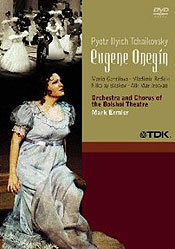
Recently released by TDK, this version of a Tchaikovsky classic was recorded at the Bolshoi Theater in October 2000. Directed by Boris Pokrovsky and conducted by Mark Ermler, the production features Maria Gavrilova as Tatiana, Nikolai Baskov as Lensky, Vladimir Redkin as Onegin, Yelena Novak as Olga, and Aik Martirosyan as Gremin. It is very much a live recording, complete with curtain calls and screaming fans who cheer their favorites after practically every number (to the performers' credit, there are no encores!).

Billed as a remake of the 1944 Bolshoi production (conducted by Alexander Melik-Pashaev, it is currently available on CD from Naxos), this is perhaps the most traditional of the four Onegin DVDs that will be available this year. Sets and costumes of the duel scene in particular may remind some viewers of the old black-and-white photographs that feature Kozlovsky as the tenor lead. Boris Pokrovsky's work is typical of this director: his Onegin is a realistic costumed drama with lively crowd scenes and plenty of stage business. There are some nice touches: for instance, in the opening scene, Madame Larina, all aflutter at the arrival of unexpected guests, pretends to read a book while holding it upside down, which Olga promptly corrects. Very few directing ideas are what one would consider revisionist. The only significant one occurs at the end of the duel scene, when Lensky appears to make a gesture of reconciliation, walking toward his opponent with his arms outstretched; Onegin, without noticing, fires the fatal shot.

Overall, Onegin's coldness and indifference are perhaps over-emphasized throughout Acts 1 and 2 (after his "sermon" to Tatiana in Tableau 3 he looks positively smug), which makes his sudden transformation into a passionate lover in the final scenes rather unconvincing. The fault may not lie with the director here, however: Redkin's stage presence is stiff and reserved, while the voice is adequate but hardly memorable. Gavrilova's Tatiana is more likable. Her voice is pleasant, with clear, pure tone in the high register; projection is sometimes an issue in the middle and low ones. On stage, the singer seems more comfortable as the dignified and refined St Petersburg socialite of Act 3 than as the shy country girl of the opening tableaux. In the latter, her repetitive gestures and perpetually ecstatic facial expression tend to get tiresome, although there are some nice moments with the Nurse just before the Letter Scene.

Novak's Olga and Baskin's Lensky sing well and look their parts. Novak is young, blond, coquettish, and carefree; her strong, deep contralto is as surprising a contradiction to her image now as it must have been at the opera's 1879 premiere. Baskin is striking, mannered, and just a touch melodramatic, which Lensky's music frankly invites. One only wishes that in the ball scene the singer would refrain from smiling so sweetly at his audience as he complains about his girlfriend's betraying him with his best friend. Martirosyan as Prince Gremin shines in his single aria in Tableau 6. Other minor characters support the ensemble well, although the acting varies from stereotypical but acceptable (Udalova's Larina) to truly atrocious (Borisova's Nurse).

In a recent and most unfortunate Bolshoi tradition, the orchestral sound is heavy and loud, with the musicians occasionally finding it hard to stay in tune and in time. Equally predictably, the choristers seem constantly on the lookout both for each other and the beat. The ballet is as fine as ever; in the 4th-tableau ball sequence, Pokrovsky does a nice job mixing the corps with the singing characters, which provides lively action, albeit mostly by way of comic relief.

As for the technical aspects of the release, the DVD features include an easy-to-navigate menu with a select-a-scene option, a choice of different sound formats, and subtitles in multiple languages. Overall, this is a decent enough traditional introduction to Tchaikovsky's opera for those unfamiliar with it (say, for a class of college students); for a connoisseur, I would suggest checking out the new version with Dyadkova and Leiferkus, which will be out on Kultur label later this month.

Olga Haldey
University of Missouri at Columbia

Send to a friend

Send a link to this article to a friend with an optional message.

Friend's Email Address: (required)

Your Email Address: (required)

Message (optional):