Subscribe to
Opera Today

Receive articles and news via RSS feeds or email subscription.


twitter_logo[1].gif


UCP_9780226043425.gif

Recently in Recordings

Ariane et Barbe-Bleue on Blu-Ray

Paul Dukas’ Ariane et Barbe-Bleue, first heard in 1907, once seemed important. Arturo Toscanini conducted the Met premiere in 1911 with Farrar and later arranged some of its music for a 1947 recording with his NBC Symphony.

Kaufmann Wagner

The economics of the recording companies dictate much that is not ideal. Wagner’s operas were not composed as they were in order to permit the extraction of bleeding chunks, even on those occasions when strophic song forms do occur.

Mahler: Symphony No. 8

Among the recent recordings of Mahler’s Eighth Symphony, Valery Gergiev’s release on the LSO Live label is an excellent addition to the discography of this work.

Songs by Zemlinsky

While not unknown, the songs of Alexander von Zemlinsky (1871-1942) deserve to be heard more frequently.

Gustav Mahler: Lieder eines fahrenden Gesellen, Rückert-Lieder, Kindertotenlieder.

Recorded on 5 and 6 May 2008 and 17 and 18 January 2009 at the Lisztzentrum (Raiding, Austria), this recent Bridge release makes available the piano-vocal versions of three song cycles by Gustav Mahler, Lieder eines fahrenden Gesellen, Rückert-Lieder, and Kindertotenlieder performed by mezzo-soprano Hermine Haselböck, accompanied by Russell Ryan.

Kathleen Ferrier: A Film by Diane Perelsztejn

Contraltos rarely achieve the acclaim and renown of sopranos. Assigned few leading roles in opera, they are condemned to playing the villain or the grandmother, or to stealing the castrati’s trousers in en travesti roles.

1612 Italian Vespers

Following their 2011 Decca recording of Striggio’s Mass in 40 Parts (1566), I Fagiolini continue their quest to unearth lost treasures of the High Renaissance and early Baroque, with this collection of world-premiere recordings, ‘reconstructions’ and ‘reconstitutions’ of music by Giovanni and Andrea Gabrieli, Monteverdi, Palestrina, and their less well-known compatriots Viadana, Barbarino and Soriano.

Eternal Echoes: Songs and Dances for the Soul

Eternal Echoes is an album of khazones [Jewish cantorial music] for cantorial soloist, solo violin and a blended instrumental ensemble comprising a small orchestra and the Klezmer Conservatory Band.

Mahler: Symphony no. 3 / Kindertotenlieder

Michael Tilson Thomas’s recording of Mahler’s Third Symphony is an outstanding contribution to the composer’s discography.

Oliver Knussen’s Symphonies from NMC

Oliver Knussen burst into British music with an unprecedented flourish. In 1967, the London Symphony Orchestra premiered Knussen’s First Symphony, with István Kertész scheduled to conduct.

Ludwig van Beethoven: Fidelio

Based on performances given in Summer 2010 at the Lucerne Festival, this recording of Beethoven’s Fidelio is an admirable recording that captures the vitality of the work as conducted by Claudio Abbado.

Stanisław Moniuszko: Flis

Stanisław Moniuszko (1819-1872) was one of the most popular composers of his day in Poland, and of the many works he wrote for the stage, two are performed from time to time, Halka (1848) and Strazny dwór [The Haunted Manor] (1865).

Stanisław Moniuszko: Pieśni Songs

The Polish alto Jadwiga Rappé is a familiar voice in various stage and concert works, and the recent release of a selection of songs by Stanisław Moniuszko (1819-1872) is an opportunity to hear her performing artsongs.

Joan Sutherland and Richard Bonynge: Serate Musicali

Originally released on multiple discs in 1981 this reissue on two CDs is a comprehensive collection of art songs by Italian and French composers from the nineteenth and early twentieth centuries.

Richard Strauss: Salome

An exciting contribution to the discography of this popular opera, the live performance of Richard Strauss’s Salome from the Festspielhaus at Baden-Baden is a compelling DVD.

Lulu by Gran Teatro del Liceu, Barcelona

Released in late 2011, Deutsche Grammophon’s DVD of the new staging of Berg’s Lulu at the Gran Teatro del Liceu, Barcelona is an excellent contribution to the discography of this fascinating opera.

Lulu by the Metropolitan Opera

A recent release by the Metropolitan Opera, this two-disc set makes available on DVD the famous performance of Berg’s Lulu that was broadcast on 20 December 1980 as part of the PBS series “Live from the Met.”

Elmer Gantry the Opera

The novels of Sinclair Lewis once shot across the American literary skies like comets, alarming and fascinating readers of that era, but their tails didn’t extend far behind them.

Historical Performances from Covent Garden: Barbiere, La traviata and Tosca

Once the province of only the most dedicated opera fanatics, mid-20th century recordings of privately taped live performances have become more widely available.

Lucia and the glass harmonica

Flute players in opera orchestra around the world must look forward to the frequent appearances of Donizetti’s Lucia di Lammermoor, knowing that while the stage spotlight in the mad scene will be on the soprano, the orchestral spotlight will be on their instrument.

OPERA TODAY ARCHIVES »

Recordings

03 May 2005

VERDI: Attila

This DVD release, taken from an RAI telecast, documents a 1991 La Scala performance of Verdi’s 1846 opera, based on the life of Attila the Hun. I’ve always felt that early Verdi is one of Riccardo Muti’s greatest strengths. When Muti was Music Director of the Philadelphia Orchestra, I was privileged to see their concert performances of Nabucco and Macbeth. Both featured breathtaking execution, intensity, and momentum.

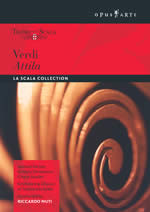
Giuseppe Verdi: Attila

Samuel Ramey, bass (Attila), Giorgio Zancanaro, baritone (Ezio), Cheryl Studer, soprano, (Odabella), Kaludi Kaludov, tenor (Foresto), Chorus and Orchestra of the Teatro alla Scala, Milan, Riccardo Muti, Conductor.
Opus Arte OA LS3010 D [DVD]
This DVD release, taken from an RAI telecast, documents a 1991 La Scala performance of Verdi's 1846 opera, based on the life of Attila the Hun. I've always felt that early Verdi is one of Riccardo Muti's greatest strengths. When Muti was Music Director of the Philadelphia Orchestra, I was privileged to see their concert performances of Nabucco and Macbeth. Both featured breathtaking execution, intensity, and momentum.

Those same qualities may be found in this La Scala Attila. What a pleasure it is to hear an early Verdi score treated with the same respect as his later masterpieces. Verdi's incisive rhythms and dynamic contrasts — so necessary for maintaining the tension of these early, vibrant works — are given their full due. Muti also elicits a beautiful, singing tone from the La Scala Orchestra, and conducts with a flexibility that belies the "metronome" criticism often leveled at his work. Listen, for example, to the way Muti and tenor Kaludi Kaludov sculpt the grand, ascending phrases of Foresto's Prologue aria. That kind of gratifying collaborative work is evident throughout this performance.

Leading the cast is the superb American bass, Samuel Ramey, in the prime of his career. Atilla is a role that fit Ramey's powerful and gleaming, high bass like a glove. Here, he revels in the part, both vocally and histrionically. Whenever Ramey is on stage, he commands the center of attention, as well he should. A fine document of a great singer in one of his signature roles.

The rest of the singers are a bit more uneven, but each still offers many positive attributes. Cheryl Studer copes well with the fiendish dramatic coloratura of Odabella's music in the Prologue, although the soprano is much happier in the upper reaches of her voice than in the lower, which tends to lose support and focus. The remainder of the opera features more conventional soprano writing, and here, Studer acquits herself admirably. She also brings considerable stage presence to the part.

Giorgio Zancanaro was one of the few singers of his generation who possessed the style, incisive diction, vibrant tone, and free upper register so essential for the great Verdi baritone roles. I wish Zancanaro didn't so frequently resort to aspirates instead of maintaining a true legato, but overall, I can't imagine anyone from the past few decades performing the role of Ezio better. Both the Prologue duet with Attila and Ezio's Act II scene are among the highlights of this performance.

I previously mentioned tenor Kaludi Kaludov's fine singing in the Prologue. Throughout this performance, the tenor gives a well-sung and sensitive account of Foresto. I don't think the consistently bright timbre of his voice is ideal for the role (Carlo Bergonzi once said that a Verdi tenor's voice should have "the color of blood"). But Kuladov uses his resources well, and certainly never a liability.

The video and sound quality of this DVD release are both first-rate. The DVD menu offers the option of English subtitles. The booklet contains a synopsis and Italian libretto.

Recommended particularly for the work of Muti and Ramey. Admirers of the other performers, and of this opera, may purchase this DVD with confidence as well.

Kenneth Meltzer

Send to a friend

Send a link to this article to a friend with an optional message.

Friend's Email Address: (required)

Your Email Address: (required)

Message (optional):