Subscribe to
Opera Today

Receive articles and news via RSS feeds or email subscription.


twitter_logo[1].gif


9780521746472.png

Recently in Recordings

Adding Movie Magic to The Magic Flute

What better way for Masonic brothers, Wolfgang Amadeus Mozart and Emmanuel Shikaneder to disseminate Masonic virtues, than through the most popular musical entertainment of their age, a happy ending folktale that features a dragon, enchanting flutes and bells, mixed-up parentage, and a beautiful young princess in distress?

L’Incoronazione di Poppea from Virgin Classics

Since its first performance at the Teatro Santi Giovanni e Paolo during Venice’s 1643 Carnevale, Monteverdi’s L’Incoronazione di Poppea has been one of the most important milestones in the genesis of modern opera despite its 250 years of unmerited obscurity. 

Saverio Mercadante: I due Figaro

Though 2013 is the bicentennial of the births of Giuseppe Verdi and Richard Wagner, the releases of Cecilia Bartoli’s recording of Bellini’s Norma on DECCA, a new studio recording of Donizetti’s Caterina Cornaro from Opera Rara, and this première recording of Saverio Mercadante’s forgotten I due Figaro, suggest that this is the start of a summer of bel canto.

Christian Thielemann’s Der Ring des Nibelungen

Recording Richard Wagner’s Der Ring des Nibelungen is for a record label equivalent to a climber reaching the summit of Mount Everest: it is the zenith from which a label surveys its position among its rivals and appreciates an achievement that can define its reputation for a generation. 

Cecilia Bartoli as Norma

Few people who love opera in general and bel canto in particular have never heard the comment made by Lilli Lehmann, veteran of the inaugural Ring at Bayreuth in 1876, that singing all three of Wagner’s Brünnhildes—in Die Walküre, Siegfried, and Götterdämmerung, respectively, all of which she sang to great acclaim—pales in comparison with singing the title rôle in Bellini’s Norma

Ariane et Barbe-Bleue on Blu-Ray

Paul Dukas’ Ariane et Barbe-Bleue, first heard in 1907, once seemed important. Arturo Toscanini conducted the Met premiere in 1911 with Farrar and later arranged some of its music for a 1947 recording with his NBC Symphony.

Kaufmann Wagner

The economics of the recording companies dictate much that is not ideal. Wagner’s operas were not composed as they were in order to permit the extraction of bleeding chunks, even on those occasions when strophic song forms do occur.

Mahler: Symphony No. 8

Among the recent recordings of Mahler’s Eighth Symphony, Valery Gergiev’s release on the LSO Live label is an excellent addition to the discography of this work.

Songs by Zemlinsky

While not unknown, the songs of Alexander von Zemlinsky (1871-1942) deserve to be heard more frequently.

Gustav Mahler: Lieder eines fahrenden Gesellen, Rückert-Lieder, Kindertotenlieder.

Recorded on 5 and 6 May 2008 and 17 and 18 January 2009 at the Lisztzentrum (Raiding, Austria), this recent Bridge release makes available the piano-vocal versions of three song cycles by Gustav Mahler, Lieder eines fahrenden Gesellen, Rückert-Lieder, and Kindertotenlieder performed by mezzo-soprano Hermine Haselböck, accompanied by Russell Ryan.

Kathleen Ferrier: A Film by Diane Perelsztejn

Contraltos rarely achieve the acclaim and renown of sopranos. Assigned few leading roles in opera, they are condemned to playing the villain or the grandmother, or to stealing the castrati’s trousers in en travesti roles.

1612 Italian Vespers

Following their 2011 Decca recording of Striggio’s Mass in 40 Parts (1566), I Fagiolini continue their quest to unearth lost treasures of the High Renaissance and early Baroque, with this collection of world-premiere recordings, ‘reconstructions’ and ‘reconstitutions’ of music by Giovanni and Andrea Gabrieli, Monteverdi, Palestrina, and their less well-known compatriots Viadana, Barbarino and Soriano.

Eternal Echoes: Songs and Dances for the Soul

Eternal Echoes is an album of khazones [Jewish cantorial music] for cantorial soloist, solo violin and a blended instrumental ensemble comprising a small orchestra and the Klezmer Conservatory Band.

Mahler: Symphony no. 3 / Kindertotenlieder

Michael Tilson Thomas’s recording of Mahler’s Third Symphony is an outstanding contribution to the composer’s discography.

Oliver Knussen’s Symphonies from NMC

Oliver Knussen burst into British music with an unprecedented flourish. In 1967, the London Symphony Orchestra premiered Knussen’s First Symphony, with István Kertész scheduled to conduct.

Ludwig van Beethoven: Fidelio

Based on performances given in Summer 2010 at the Lucerne Festival, this recording of Beethoven’s Fidelio is an admirable recording that captures the vitality of the work as conducted by Claudio Abbado.

Stanisław Moniuszko: Flis

Stanisław Moniuszko (1819-1872) was one of the most popular composers of his day in Poland, and of the many works he wrote for the stage, two are performed from time to time, Halka (1848) and Strazny dwór [The Haunted Manor] (1865).

Stanisław Moniuszko: Pieśni Songs

The Polish alto Jadwiga Rappé is a familiar voice in various stage and concert works, and the recent release of a selection of songs by Stanisław Moniuszko (1819-1872) is an opportunity to hear her performing artsongs.

Joan Sutherland and Richard Bonynge: Serate Musicali

Originally released on multiple discs in 1981 this reissue on two CDs is a comprehensive collection of art songs by Italian and French composers from the nineteenth and early twentieth centuries.

Richard Strauss: Salome

An exciting contribution to the discography of this popular opera, the live performance of Richard Strauss’s Salome from the Festspielhaus at Baden-Baden is a compelling DVD.

OPERA TODAY ARCHIVES »

Recordings

09 May 2005

WEILL: Die sieben Todsünden

A new recording of Kurt Weill’s (1900 – 1950) ballet chanté, Die 7 Todsünden (1933) featuring Anja Silja and the SWR Rundfunkorchestra Kaiserslautern and conducted by Grzegorz Nowak, has recently been made available in the U.S. on the Hässler-Classic label. Also included on the CD is Weill’s Quodlibet, opus 9 (1923) — an orchestral arrangement taken from his 1922 children’s pantomime, Zaubernacht.

Kurt Weill: Die sieben Todsünden; Quodlibet op. 9 from the Pantomime "Zaubernacht" op. 4
Anja Silja, Julius Pfeifer, Alexander Yudenkov, Bernhard Hartmann, Torsten Müller,
SWR RO Kaiserslautern, Nowak
Hänssler Classic 93109 [CD]
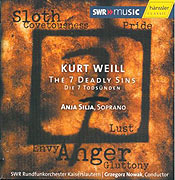
A new recording of Kurt Weill's (1900 - 1950) ballet chanté, Die 7 Todsünden (1933) featuring Anja Silja and the SWR Rundfunkorchestra Kaiserslautern and conducted by Grzegorz Nowak, has recently been made available in the U.S. on the Hänssler Classic label. Also included on the CD is Weill's Quodlibet, opus 9 (1923) — an orchestral arrangement taken from his 1922 children's pantomime, Zaubernacht.

Die 7 Todsünden is the product of Weill's forced collaboration with Bertolt Brecht, from whom he had been estranged for nearly three years by the time the ballet was commissioned. Die 7 Todsünden is unusual in that it features prominently a vocalist and a dancer as two parts of the protagonist's personality, as well as a male quartet and small dance roles. The ballet relates the adventures of the protagonist, a young woman named Anna, who must leave her home in provincial Louisiana to seek employment in the major cities of the U.S. in order to finance the building of a house for her family.

In the prologue we learn that Anna has a split personality, the practical side of which is portrayed by the singer (Anna I), while the more fanciful side of Anna — the part of her that dabbles in the seven deadly sins — is portrayed by a dancer (Anna II), who also has a few spoken line in the production. Anna's family at home in Louisiana is represented by the male quartet, which in this recording is staffed by tenors Julius Pfeifer and Alexander Yudenkov, baritone Berhard Hartmann, and bass Torsten Müller.

Throughout the nine movements of the work — one for each deadly sin plus a prologue and an epilogue — we follow Anna's struggles with sin and witness her family express their concern over her ability to avoid sinfulness. Ironically, neither Anna nor her family seem to worry about the seven deadly sins for religious or moral reasons; rather, the theme of the family's arguments is that only by adhering to "the law" will Anna be able to earn a substantial amount of money. The libretto blatantly mocks bourgeois family values, and Weill's musical settings of the text emphasize the hypocrisy of Anna's family. For example, in the movement titled "Gluttony," the male quartet sings a capella homophonic harmonies, imitating the sound of Lutheran chorales. Rather than conveying a message of avoiding gluttony in order to achieve moral soundness or entry in to Heaven, the family warns Anna not to be gluttonous, lest she gain weight and therefore lose her contract as a solo dancer in Philadelphia. Two men with revolvers, ostensibly at the behest of her employers, "help" Anna to maintain her weight at 110 pounds despite her fondness for muffins, cutlets, asparagus, chicken, and little yellow honey-buns.

Die 7 Todsünden was written for and premiered by Weill's off-and-on-again wife Lotte Lenya in Paris at the Théâtre des Champs-Elysées. In a1955 recording of Die 7 Todsünden Lenya sings each of her movements down a fourth from their original pitch level — a musical decision made apparently without ever having discussed it with Weill. Lenya's recording, part of an attempt to capture all Weill's songs on record, set a precedent for later performances of Die 7 Todsünden so that in its published format, the score contains an appendix of Anna's songs "for low voice," this despite the composer's lack of involvement in any such version.

Although she made this recording after a singing career of nearly five decades Silja gives a convincing performance as the young Anna I and Anna II, and she does so in the register at which Weill originally composed Anna's songs. While a few notes at the top of her register seem to give Silja some trouble, her overall portrayal of the Annas is delightful. In interviews Silja has indicated that acting is as important to her as vocal technique, a philosophy that is apparent even on CD: this recording is full of energy and drama from the optimistic beginning all the way to the sardonic "Ja, Anna" at the end. Silja is ably supported by the male quartet whose performance highlight the pretentious nature of Anna's family; this is especially true in "Covetousness," a movement in which the family expresses their that Anna will not appear greedy to the extent that she ceases to exact money from her admirers. The quartet's articulation is clear so no word is lost, and the hypocrisy of their concerns is immediately comprehensible.

In addition to the moving performances by the singers and the orchestra, the SWR recording can be recommended for its excellent sound quality. The warmth of Silja's voice and the colors of the orchestra can be heard clearly throughout. The CD booklet contains notes in German that are (dubiously) translated into English, as well as the complete lyrics in both German and English and short bios for each of the performers.

Weill's Die 7 Todsünden is just one of many modern works that deserves wider hearing. Quality recordings such as this Hänssler Classic CD will make access to these pieces easier and more enjoyable.

Megan Jenkins
CUNY The Graduate Center

Send to a friend

Send a link to this article to a friend with an optional message.

Friend's Email Address: (required)

Your Email Address: (required)

Message (optional):