Subscribe to
Opera Today

Receive articles and news via RSS feeds or email subscription.


twitter_logo[1].gif


UCP_9780226043425.gif

Recently in Recordings

Ariane et Barbe-Bleue on Blu-Ray

Paul Dukas’ Ariane et Barbe-Bleue, first heard in 1907, once seemed important. Arturo Toscanini conducted the Met premiere in 1911 with Farrar and later arranged some of its music for a 1947 recording with his NBC Symphony.

Kaufmann Wagner

The economics of the recording companies dictate much that is not ideal. Wagner’s operas were not composed as they were in order to permit the extraction of bleeding chunks, even on those occasions when strophic song forms do occur.

Mahler: Symphony No. 8

Among the recent recordings of Mahler’s Eighth Symphony, Valery Gergiev’s release on the LSO Live label is an excellent addition to the discography of this work.

Songs by Zemlinsky

While not unknown, the songs of Alexander von Zemlinsky (1871-1942) deserve to be heard more frequently.

Gustav Mahler: Lieder eines fahrenden Gesellen, Rückert-Lieder, Kindertotenlieder.

Recorded on 5 and 6 May 2008 and 17 and 18 January 2009 at the Lisztzentrum (Raiding, Austria), this recent Bridge release makes available the piano-vocal versions of three song cycles by Gustav Mahler, Lieder eines fahrenden Gesellen, Rückert-Lieder, and Kindertotenlieder performed by mezzo-soprano Hermine Haselböck, accompanied by Russell Ryan.

Kathleen Ferrier: A Film by Diane Perelsztejn

Contraltos rarely achieve the acclaim and renown of sopranos. Assigned few leading roles in opera, they are condemned to playing the villain or the grandmother, or to stealing the castrati’s trousers in en travesti roles.

1612 Italian Vespers

Following their 2011 Decca recording of Striggio’s Mass in 40 Parts (1566), I Fagiolini continue their quest to unearth lost treasures of the High Renaissance and early Baroque, with this collection of world-premiere recordings, ‘reconstructions’ and ‘reconstitutions’ of music by Giovanni and Andrea Gabrieli, Monteverdi, Palestrina, and their less well-known compatriots Viadana, Barbarino and Soriano.

Eternal Echoes: Songs and Dances for the Soul

Eternal Echoes is an album of khazones [Jewish cantorial music] for cantorial soloist, solo violin and a blended instrumental ensemble comprising a small orchestra and the Klezmer Conservatory Band.

Mahler: Symphony no. 3 / Kindertotenlieder

Michael Tilson Thomas’s recording of Mahler’s Third Symphony is an outstanding contribution to the composer’s discography.

Oliver Knussen’s Symphonies from NMC

Oliver Knussen burst into British music with an unprecedented flourish. In 1967, the London Symphony Orchestra premiered Knussen’s First Symphony, with István Kertész scheduled to conduct.

Ludwig van Beethoven: Fidelio

Based on performances given in Summer 2010 at the Lucerne Festival, this recording of Beethoven’s Fidelio is an admirable recording that captures the vitality of the work as conducted by Claudio Abbado.

Stanisław Moniuszko: Flis

Stanisław Moniuszko (1819-1872) was one of the most popular composers of his day in Poland, and of the many works he wrote for the stage, two are performed from time to time, Halka (1848) and Strazny dwór [The Haunted Manor] (1865).

Stanisław Moniuszko: Pieśni Songs

The Polish alto Jadwiga Rappé is a familiar voice in various stage and concert works, and the recent release of a selection of songs by Stanisław Moniuszko (1819-1872) is an opportunity to hear her performing artsongs.

Joan Sutherland and Richard Bonynge: Serate Musicali

Originally released on multiple discs in 1981 this reissue on two CDs is a comprehensive collection of art songs by Italian and French composers from the nineteenth and early twentieth centuries.

Richard Strauss: Salome

An exciting contribution to the discography of this popular opera, the live performance of Richard Strauss’s Salome from the Festspielhaus at Baden-Baden is a compelling DVD.

Lulu by Gran Teatro del Liceu, Barcelona

Released in late 2011, Deutsche Grammophon’s DVD of the new staging of Berg’s Lulu at the Gran Teatro del Liceu, Barcelona is an excellent contribution to the discography of this fascinating opera.

Lulu by the Metropolitan Opera

A recent release by the Metropolitan Opera, this two-disc set makes available on DVD the famous performance of Berg’s Lulu that was broadcast on 20 December 1980 as part of the PBS series “Live from the Met.”

Elmer Gantry the Opera

The novels of Sinclair Lewis once shot across the American literary skies like comets, alarming and fascinating readers of that era, but their tails didn’t extend far behind them.

Historical Performances from Covent Garden: Barbiere, La traviata and Tosca

Once the province of only the most dedicated opera fanatics, mid-20th century recordings of privately taped live performances have become more widely available.

Lucia and the glass harmonica

Flute players in opera orchestra around the world must look forward to the frequent appearances of Donizetti’s Lucia di Lammermoor, knowing that while the stage spotlight in the mad scene will be on the soprano, the orchestral spotlight will be on their instrument.

OPERA TODAY ARCHIVES »

Recordings

23 Jun 2005

CARISSIMI: Oratorios

Two recent CDs of Carissimi oratorios provide the listener the opportunity to compare very different “takes” on the composer’s remarkable works, which exemplify the sophisticated and exclusive style cultivated by the cardinalate nobility in mid-seventeenth-century Rome. Carissimi’s oratorios survive in manuscript only, and with relatively sparse indications concerning instrumentation; it has long been a challenge for contemporary performers to balance the need for dramatic clarity with the desirability of sonic variety, and the two groups featured on these CDs take different approaches to that challenge, each with fruitful results.

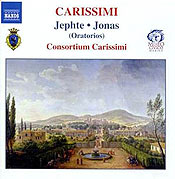
Giacomo Carissimi:


Jepthe, Jonas, Oratorios
Consortium Carissimi, dir. Vittorio Zanon
Naxos 8.557390 [CD]
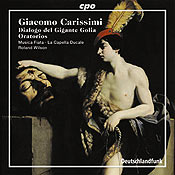
Dialogo del gigante Golia, Oratorios
Monika Mauch, Constanze Backes, Wilfrid Jochens, Harry van der Kamp; La Capella Ducale, Musica Fiata Köln, dir. Roland Wilson
cpo 999 983-2 [CD]
Two recent CDs of Carissimi oratorios provide the listener the opportunity to compare very different "takes" on the composer's remarkable works, which exemplify the sophisticated and exclusive style cultivated by the cardinalate nobility in mid-seventeenth-century Rome. Carissimi's oratorios survive in manuscript only, and with relatively sparse indications concerning instrumentation; it has long been a challenge for contemporary performers to balance the need for dramatic clarity with the desirability of sonic variety, and the two groups featured on these CDs take different approaches to that challenge, each with fruitful results.

The ensemble "Consortium Carissimi" was founded in Rome in the late 1990s to bring more attention to the works of the prolific composer (whose fame in a wide variety of genres was extraordinary in the 1600s, but who is now known primarily for his Latin oratorios). This is the first recording by the ensemble to tackle sacred dramatic works in the genre, and while it is understandable that they chose to measure their Jepthe (the most famous of Carissimi's oratorios, a jewel of compact drama) against the many other recorded versions of the work, their goal of greater exposure for Carissimi's music might have benefited from the choice of less well-worn works (the other oratorio in the recording, Jonas, has also been recorded repeatedly since at least the 1970s). The ensemble's approach is minimalistic, with a clear focus on the dramatic delivery of text; this is done very effectively, and the clarity and subtlety of enunciation is wonderful, especially on the part of Marco Scavazza, the baritone who plays the title role in Jepthe. The lament of the daughter of the king who must die without children is certainly the most poignant moment in the work, and soprano Nadia Caristi has an extraordinary delivery; likewise in Jonas, the monologues are extremely powerful.

The duets and ensemble sections that punctuate the works are less interestingly conveyed. Melody-instrument reinforcement is relatively sparse (two violins), and even with a reasonably well-stocked continuo group (two plucked-string and two bass-line string in addition to the harpsichord/organ player) the accompaniment creates a relatively uniform effect. There are few moments of dramatic sonic contrast: it seems that the ensemble is relying on the power of the solo voices, sometimes dangerously leaning toward a monotonous effect.

The male voices of the ensemble are the strongest aspect of this recording, both individually and in their sonic blend. This makes the trio for tenor, baritone, and bass that complements the two oratorios — "Dai piu riposti abissi", an Italian cantata — the most remarkable and worthwhile piece on the CD. It alone is worth the purchase price, and the clarity of the delivery in the two oratorios is a welcome change over some earlier recordings of the works that provided more sound and fury than dramatic effect. One hopes that the Consortium Carissimi will continue to expand our awareness of Carissimi's lesser-known works, their strength being perhaps the smaller-scale compositions rather than the oratorios.

More musically satisfying overall to this reviewer is the other disc under consideration, a recording of four recently-rediscovered Carissimi oratorios. Perhaps the unfamiliarity of the works (thought to be lost, but recovered in a Czech archive) adds to the pleasure of discovery; while Jepthe is a wonderful work, it is more exciting to have the opportunity to experience another facet of Carissimi's creativity. Certainly La Capella Ducale and Musica Fiata Köln, long-standing effective interpreters of seventeenth-century concerted music, are on top of their game. The two sopranos, seasoned Constanze Backes and the young Monika Mauch, create extraordinary characterizations of old-testament heroines (and heros), and veteran bass Harry van der Kamp at his sonorous best, especially in his turn as the cocky giant Goliath. The presence of brass resources (cornetti and trombones, long a strong suit for Musica Fiata) in the soundscape gives Roland Wilson a wider palette than that available to Consortium Carissimi, and that palette is deployed to great effect, creating a wonderfully varied interplay between melody and continuo resources (despite actually having a more compact continuo group than the Italian ensemble). Delivery is perhaps a little less crisp than in the other disc under consideration, but the dramatic power of the musical gestures is unquestionable, and Wilson and his ensembles once again demonstrate their command of the sacred musical idiom of the Italian seventeenth century.

While the Consortium Carissimi CD is interesting as a comparison-point to many other recordings of Jepthe and Jonas, and most worthwhile for its more unusual Italian cantata, the Musica Fiata CD is a must-have for its expressive variety (not to mention the delight of discovering Mauch's powerful voice); the fact that it provides what appear to be the first recordings of four wonderful Carissimi works is icing on the cake. One quibble with the format: while Naxos (as they often do) have created many (almost too many?) separate tracks, allowing the listener to quickly locate a particular excerpt, cpo frustratingly provides a single track for each work — which, in the case of Regina Hester and Diluvium Universale, makes for 25-minute tracks — making it difficult for the listener to find favorite passages. But this is a small logistical matter, and a negligible road-bump in the enjoyment of this fabulous CD.

Andrew Dell'Antonio
The University of Texas at Austin

Send to a friend

Send a link to this article to a friend with an optional message.

Friend's Email Address: (required)

Your Email Address: (required)

Message (optional):