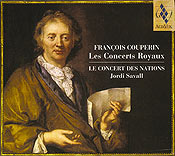
François Couperin: Les Concerts Royaux
Marc Hantäi (flute); Alfredo Bernardini (oboe); Manfredo Kraemer (violin); Joseph Borràs (bassoon); Bruno Cocset (bass-violin); Xavier Dìaz-Latorre (theorboro and guitar); Guido Morini (harpsichord); Jordi Savall (bass-viol and director).
AliaVox AV9840 [CD]
If you've recently browsed the shelves in a bookstore or Blockbuster, you would have to be oblivious not to notice titles such as The DaVinci Code, the Romanov Prophecy, or films like National Treasure and Kingdom of Heaven. Responses to these titles suggest an increased interest in historical topics and journeys that provoke us to unravel clues that, in the end, will reveal an ultimate truth. Works that exude knowledge and mystery have always been popular in music, because it is by the dissemination of clues and their eventual interpretation that lead to the re-creation of a musical moment in history. One might even call it one of the earliest forms of a "treasure hunt." In this high quality CD, the Concert des Nations directed by Jordi Savall, has successfully disseminated the few details left by Couperin and re-created what are perhaps the most important works of the French royal court: the Concert Royaux. Having already recorded Couperin's Pièces de Voile, Les Nations, and Les Apothéoses, the Concert Royaux would comprise the second category of chamber works written by Couperin for the Court of King Louis XIV. To gain a better understanding of the general purpose of these concerts, you might think of them as relative to Handel's Music for the Royal Fireworks, but only in their sense of purpose. Their stylistic elements couldn't be more diverse.
Why this CD reminded me of the recent worldwide fascination with historical clues and ultimate truths is because its music also went through a similar process of being unraveled and interpreted to reach a final result. In fact, due to the grand musicianship, historically accurate performance, and quality of sound on this CD, I will go so far as to call it is a treasure trove. You see, biographers of Couperin have very little to work from and so it is enticing to consider how this group of performers sufficiently re-created a work of this magnitude. Moreover, they did so even withstanding the unfortunate fact that Couperin rarely discussed which instruments he was writing for in the first place. At least for the Concerts Royaux he wrote that it might be played on the harpsichord, or on the violin, oboe, flute, viol, and bassoon, although this information is very vague. Here, the Concert des Nations uses the instrumentation Couperin suggests but in different organizations for each of the twenty-five separate dance movements and on period instruments; a point which brings me to the first treasure find on the CD: on the inside flap is a list of the period instruments being used, historical information for each instrument, and its current owner and origin; a welcome bonus for avid CD collectors. In addition, on page 10 of the CD booklet, there is a facsimile of Couperin's original letter indicating his instrument choices for the Concert Royaux. Although these additions to the collection are historically intriguing, it is the music itself that is the greatest treasure.
Divided into four separate concerts, each track on the CD presents one of the popular dance forms that predominated the Baroque. Each concert opens with a prelude followed by an: Allemande, Sarabande, Gavotte, Gigue, Minuet and Trio and/or substituted by an Air, Echos, Fugue, Courante, Chaconne, Muzette, Rigaudon, or Forlana, where the flavor and tempo of each dance contributes to the overall mood of the entire concert. Unique to Couperin, in the Concert Royaux, is his distinct fascination with Italianness, and there are several of the dance numbers in which a certain spiciness can be detected, but these are always contrasted by French lyric style and some Germanic fugal tendencies. French influence is most likely attributed to Lully who was most well known for his tragedies en musique (early opera), and the imposing orchestral style of his ouvertures or the dance music of his ballets, but the Italian qualities are most likely attributed to Corelli. Interestingly, Couperin was known to have rejected opera and other large orchestral works. In his CD notes, director Jordi Savall, discusses Couperin as a "poet musician" who worked his best with smaller and more intimate forms. Here, it is the juxtaposition of the Italian elements with the French that give the Concerts Royaux their distinct international flavor. This is especially noted in the fourth concert of the series, where Couperin uses a Courante Françoise that uses a light texture complemented by even melodic fragments, then followed by a Courante à l'italiene that is permeated with endless driving rhythm and cruder harmonies; both styles eloquently captured by the Concert des Nations.
As an ensemble, the Concert des Nations is solid and responsive to the unique emotion that each concert is to exude. For example, the first concert is surrounded by an air of melancholy that prevails through all six dances. Beginning in the free-form prelude, marked gravement (extremely melancholy) the stylized playing is doubly enhanced by the authentic acoustic space created by the Abbey of Saint-Michel on Thiérache. The overtones are rich, especially as the oboe begins with its yearning tone that is later doubled by the violin. But in the first concert it is the Sarabande that is the most affective work, where a minor theme weaves tellingly around falling chords. Perhaps most descriptive is the theorboro that offers an almost comedic lightness to the seriousness of the violin's melody.
"Melancholy" is contrasted in the second concert by a focus on fugal elements and a more pronounced German style. One will hear a pronounced polyphonic style (more than one melody occurring simultaneously) and within many of the dances the treble instruments seem to introduce a subject that never completely develops into fugue but taunts us to listen to it as such. It seems that the point of the Concert Royaux becomes apparent in the Air Tendre where Couperin achieves a synthesis of international styles. It is one of the most beautiful courtly pieces in the C.R. that functions on a dialogue between treble and bass instruments but always maintains its lyricism. This is followed by a virtuosic display of musicianship by the members of the Concerts des Nations in the Air Contre fugue, where the highly ornamented melody again suggests the beginning of a fugue but there is no imitation. This means that Couperin was playing with our expectations and those of the Royal Court, who would have thought that that dances were fugal when, in fact, they were not. How might we interpret this? Perhaps Couperin was playing the "poet musician" here and proposing that a true synthesis of styles is only attainable by presenting a dialogue between styles, but one that never fully develops into an argument. The influence of Bach can be detected in the playing of the Concert des Nations, especially in the detached bass, a punto (punctuated) performed by Jordi Savall on the Bass Viol. While playing with German stylistic elements, Couperin decidedly completes the second concert with the Echos: a favorite effect of the Baroque period. Each melody is repeated in echo, although in this recording the affect that the Concert des Nations was trying to achieve is diminished. This is partly due to the enhanced acoustic of the Abbey where the sonorities of the higher instruments continue to pierce the texture of the music, rather than to echo the statements first directed by the bass.
Overall, the most outstanding concert on the CD is the third, where the Sarabande — Grave could be considered the pieces de résistance. In stately rhythms instigated by frequent and deliberate pauses (rests) there is a new-found dramatic impetus to this work. The members of the Concert des Nations pay close attention to these rests so as to create a heightened sense of drama; but more importantly, each instrument here is of equal value and brought to the fore at specific moments to increase the emotional impact and majesty that surrounds the work. It develops into a polyphonic web of ascending and descending patterns in simultaneous statements.
All in all, the recording quality is excellent, although one must approach listening to this CD with the knowledge that the sound will be different from a normal chamber ensemble recording. The tessitura (range) of the instruments is often quite high, producing a sometimes monotonous quality, however the CD is well organized in that you may choose to listen to one concert at a time, one dance at a time, or all four at once. Personally, I think it best to listen to these works as they would have been performed: one at a time. This allows the listener to reflect on the general mood and quality being presented within each concert. Each detail then becomes part of a larger picture and the historical value of each dance becomes apparent. Ideally, the Concert Royaux are Couperin's solution to the issue of competing styles, a problem composers would face for the next two-hundred years. While he adopts the forms of the Italian sonata or the German fugue, he never deserted the basic ideals of French art. If you are one of those people who enjoy historical treasure finds, then the Concert des Nations is a group that you would enjoy immensely. Each performer is strong in his approach and it is the musicianship of the individual parts that contributes to this most exciting and historically enlightening whole.
Mary-Lou Patricia Vetere, Mus.B. M.A., PhD (ABD)
SUNY at Buffalo