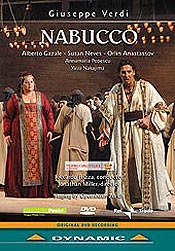
Giuseppe Verdi: Nabucco
Alberto Gazale (Nabucco), Susan Neves (Abigaille), Orlin Anastassov (Zaccaria), Yasuharu Nakajima (Ismaele), Annamaria Popescu (Fenena), Alberto Rota (High Priest of Baal), Sabrina Modena (Anna), Alessandro Cosentino (Abdallo).
Chorus and Orchestra of Teatro Carlo Felice of Genoa, Riccardo Frizza (cond.)
Dynamic 33465 [DVD]
With Nabucco (1842) Giuseppe Verdi began a long and feverishly productive creative period in his life. More importantly, in this work, largely influenced by French grand opéra, the masses are as important as the soloists. This is one of the reasons why this opera, representing the enslavement of the Hebrews by the Babylonians under the rule of Nebuchadnezzar, was later received as a metaphor of the Austrian political domination of Italy, which the patriots of the Risorgimento were fighting against. Neither the alleged political metaphor (which has been recently questioned by Roger Parker), nor the grandeur of the drama as a series of large tableaux seem to be at the center of the conception of this recent production (Genoa, 2004), staged in a relatively small theater that does not allow choral masses to act dynamically (the soloists overpower the contained choral masses).
The major strength of this production is in the musical rather than in the visual domain, although this remains a DVD worth seeing. It is important to mention that this production is based on the critical edition of the score edited by Roger Parker (published by Ricordi and University of Chicago Press). The Orchestra of the Teatro Carlo Felice of Genoa, conducted by Riccardo Frizza, offers an energetic and engaged interpretation of Verdi's intense music, as is already immediately clear in the overture, during which the camera documents the tension and attention of the instrumentalists. The orchestra rarely drags in this considerably fast version of Nabucco and the energy of the performers (both instrumentalists and singers) is consistently rewarded by the numerous enthusiast reactions of the audience.
The largest numbers of ovations are reserved for and well deserved by American soprano Susan Neves (Abigail). Her full figure, powerful voice, and impressive technique grant her a mighty stage presence, which suits this role well (an unusually tough female heroine in Verdi's operatic dramaturgy). In the scena section of the double aria in Part II, Ms. Neves shows her total control over the entire extended register of her role; her ease in the sudden drop of two octaves in "fatal sdegno" is amazing, as is her ability to express contrasting emotions (one of the major challenges of this role). In the scena Abigail bitterly resents being a slave and expresses her hatred for her adoptive father Nabucco and his daughter Fenena ("O iniqui tutti" - "wretched all! upon everyone you will see my fury fall! Yes, let Fenena fall... my false father... the whole kingdom, even upon myself my fatal anger will call for ruin"). After these fierce lines, there is a paradoxical cantabile, "Anch'io dischiuso un giorno" ("I too once opened my heart to joy"), in which Abigail remembers her tender feelings of love. This sudden shift in emotional content leaves the whole responsibility for dramatic convincingness to the performer; Ms. Neves handles this difficult juxtaposition extremely well both musically (by emphasizing a sort of continuity in maintaining un underlying tension) and through gestures and facial expressions. The cabaletta is more credible due to the unfolding of events in the tempo di mezzo (The high priest informs Abigail that the people of Assyria claim her as their Queen). This fills Abigail's heart with pride and courage, launching her in a forceful and rhythmically driving cabaletta ("Salgo gia' del trono aurato"). Ms. Neves manages to surf the high dramatic waves required in this entire scene (from rage and resentment to tenderness, to pride and triumph) very convincingly. One remains impressed by her agility throughout the register, the dramatic effectiveness achieved even in the most difficult coloratura passages, her total control in extreme dynamics, and her consistent ability to maintain good balance with the orchestra. One may notice that at least in this production her acting is better in solo pieces than in ensembles or duets, in which her interaction with other characters is at times unconvincing. A clear example is when she tries to steal the crown from Fenena in Part II, scene 2: she reaches for the crown but hesitates, knowing that Nabucco is supposed to take it. In moments like this one gets the impression that the singer is more concerned with remembering stage directions than with offering a convincing dramatic interpretation. In the duet with Nabucco in part III, Susan Neville offers another musically flawless interpretation, but also confirms that her expressive power relies in her voice and facial expressions, rather than in a dynamic acting style based on gestures and movements.
Alberto Gazale (Nabucco) also shows a considerable stage presence, especially in Part I. Here the expression of rage ("Tremin gl'insani") is more convincing than his later interpretation of the mad scene. After proclaiming himself God in Part II, a thunderbolt bursts above Nabucco's head and drives him crazy. The libretto prescribes that before he sings again "madness manifests itself in his every feature" ("la follia appare in tutti is suoi lineamenti"), calling for a powerful acting style. Gazale shakes on the ground, covering his face. He seems to be more in pain than crazy; and his idea of madness thereafter seems to be one of sadness and dismay. He does well in the lament "Oh i qual'onta aggravasi" during the duet with Abigail in Part III and better in Part IV after, upon converting to Judaism, he regains his reason. Admittedly, any interpreter of this role suffers in the comparison with the unsurpassed interpretation of Renato Bruson, whose representation of madness reached a level of sophistication and emotional power of Shakespearean dimensions.
Yasuharu Nakajima (Ismaele or Ishmael) shows remarkable strength and clarity of diction, although he seems affected by fatigue in the second finale. This fine Japanese tenor seems also slightly penalized by the mismatch with Fenena, Ishmael's lover, interpreted by Annamaria Popescu, one of the weakest singers in this production, while minor roles like the High Priest and Anna are interpreted by very promising singers (Alberto Rota and Sabrina Modena). Orlin Anastassov (Zaccaria), exhibits a dynamic acting style when confronting Nabuccco in Part I, while for the rest of the opera he maintains a hieratic posture and style of singing. In the famous prayer in Part II this approach reveals its effectiveness; although the music is a lulling and gentle andante the text shows a contrasting emotion ("over the shattered idols the law of God shall arise"). This is one of the few puzzling examples in Verdi's operas in which the music does not seem appropriate for the text. But the reason why this happens is that Zechariah does not have a realistically delineated psychology; he is a vestige of Metastasian heroic opera, and Anastassov shows that he understands this by avoiding an inappropriate Romantic (more dramatically realistic) interpretation of this part.
As mentioned before, the choral masses are given an unusually important and difficult role in Nabucco. As often happens, not all the chorus singers remember that they are on stage and not in church or in a concert hall. The stage of the Carlo Felice is not wide enough to allow mass movement and all the interest is left to the power of static gestures. This is particularly true in the chorus that precedes the terrifying entrance of Nebuchadnezzar ("Lo vedeste?" - "Did you see him? Like thunder he bursts into the crowd, brandishing his bloody sword, etc."). We do not see the bloodthirsty Assyrian King, who in the 7th century B.C. destroyed the temple of Solomon in Jerusalem and took Hebrew hostages to Babylon as slaves. The mass of Hebrews at this point is in the temple and sees the barbarian approaching like thunder; the sense of terror is conveyed musically (the orchestra and chorus of Genoa provide a fiery performance) and through expression and posture. In the numerous pertichini with the soloists and with the ensembles of soloists this chorus reveals its best quality. The stretto of the first finale is one of the greatest moments in this production for dramatic dynamism and intensity. In Part II, the recurring theme presto and sottovoce with the staccato 8th notes ("Il maledetto non ha fratelli") is conveyed with agility and appropriate lightness and clarity of diction. In "S'appressan gl'istanti d'un'ira fatale" ("The moment of wrath is approaching") the soloists manage to express most convincingly the sense of approaching rage and terror; the chorus, however, in this case opens up in a broad cantabile that does not, however, seem to be dramatically appropriate. In the celebrated "Va pensiero" (Part III/2) the chorus shows a great control of the extreme dynamics and expressive crescendos required for this piece, although the tempo seems too slow (this is a largo, but it shouldn't drag).
In general, the filming technique in this DVD appears closer to that of a TV documentary than to that of a film-opera. The close-ups are not too abrasive (as is often the case in opera on video) and the points of view are diversified enough to offer some degree of variety in perspective. Unfortunately the excerpts shot from off-stage and above the stage are really bad in quality due to the fact that the cameraman could not alter the original stage lights and could not invade the stage either (this is a live production). In these moments the light in the video becomes too bright and icy, the image loses contrast and sharpness, and - worse - the viewer feels that the actors are not establishing a direct contact with the video audience, since the point of view of the camera does not coincide with that of the real audience in the theater, with whom the singers are interacting.
The beginning of Part III reveals one of the major downfalls of this video production. Not only are there serious problems with the quality of the image, but there is a major conceptual mistake: the camera travels fast through the orchestra banks, shooting the musicians in the orchestra pit; yet this is one of the pieces labeled by Verdi as "banda interna": the orchestra is supposed to play stage-music (meaning music heard as such by the characters on stage). Here we need to forget that the music is produced by the musicians in the orchestra pit and we need to imagine that this piece is played by an Assyrian marching band (as absurd as this may be from a historical point of view). Another infelicitous idea in regard to stage directions occurs in Part IV, scene 2. Here Fenena and the Hebrews are condemned to die and we hear a funeral march from off-stage (another 'banda interna'). Suddenly an idol that looks like an Egyptian mummy comes down from the ceiling, hanged by the neck: a grotesque scene that seems to belong to a cheap horror movie. To make things worse the camera angle is again from off-stage, producing the aforementioned problem of contrast and light. To make it even worse, Fenena's voice is almost gone at this point and the idol-mummy burns (this part is originally subtitled "l'idolo infranto" or the broken idol, not the burned idol). The libretto prescribes that the idol falls and is broken into pieces ("idolo cade infanto da sé"), while in this production the idols catches on fire but hangs there completely intact. Even the triumphal "Immenso Jeovha" (Almighty Jehovah) occurs under the hanging mummy, which stays there all throughout the final curtain calls. People bow and smile, the audience claps and rejoices, but the mummy idol still hangs grotesquely.
Regarding the scenery, the oppressive volumetric architecture (an unadorned almost cubic space) effectively conveys at the beginning a sense of claustrophobia (the Hebrews are trapped in the temple of Solomon), although it makes the stage even smaller so that the choral masses are constantly impeded. The triumphal entrance of Nebuchadnezzar is a lengthy musical passage in which the same phrase is repeated in a sort of Rossini crescendo used to accompany the slow parade of the Assyrian army approaching the temple from a distance. Because of the lack of space, however, here the chorus of Assyrians can only keep the Levites at a distance by brandishing daggers.
The costumes of the Assyrians and the hairstyles have a great effect (especially the High Priest with a mohawk falling in long braids). The costumes of the Jewish women are less effective. Especially in the chorus of Part III the Hebrews should appear in chains as forced laborers, as prescribed in the libretto. In this production, however, the women wear bright colored satin costumes, a few ladies show off unlikely elegant makeup, including blue eye shadow and red lipstick. The men are not as well dressed, but still decent, dignified, the costumes carefully ironed and nobody is in chains or shows signs of fatigue.
Besides these admittedly minor problems and oddities in staging and costumes, this is a very enjoyable production, putting together an international cast of mostly young talents, able to offer a lively and energetic production of one of Verdi's most enthusiastic creations.
Pierpaolo Polzonetti
Assistant Professor of Music History
School of Music
University of North Carolina at Greensboro