Subscribe to
Opera Today

Receive articles and news via RSS feeds or email subscription.


twitter_logo[1].gif


UCP_9780226043425.gif

Recently in Recordings

Kaufmann Wagner

The economics of the recording companies dictate much that is not ideal. Wagner’s operas were not composed as they were in order to permit the extraction of bleeding chunks, even on those occasions when strophic song forms do occur.

Mahler: Symphony No. 8

Among the recent recordings of Mahler’s Eighth Symphony, Valery Gergiev’s release on the LSO Live label is an excellent addition to the discography of this work.

Songs by Zemlinsky

While not unknown, the songs of Alexander von Zemlinsky (1871-1942) deserve to be heard more frequently.

Gustav Mahler: Lieder eines fahrenden Gesellen, Rückert-Lieder, Kindertotenlieder.

Recorded on 5 and 6 May 2008 and 17 and 18 January 2009 at the Lisztzentrum (Raiding, Austria), this recent Bridge release makes available the piano-vocal versions of three song cycles by Gustav Mahler, Lieder eines fahrenden Gesellen, Rückert-Lieder, and Kindertotenlieder performed by mezzo-soprano Hermine Haselböck, accompanied by Russell Ryan.

Kathleen Ferrier: A Film by Diane Perelsztejn

Contraltos rarely achieve the acclaim and renown of sopranos. Assigned few leading roles in opera, they are condemned to playing the villain or the grandmother, or to stealing the castrati’s trousers in en travesti roles.

1612 Italian Vespers

Following their 2011 Decca recording of Striggio’s Mass in 40 Parts (1566), I Fagiolini continue their quest to unearth lost treasures of the High Renaissance and early Baroque, with this collection of world-premiere recordings, ‘reconstructions’ and ‘reconstitutions’ of music by Giovanni and Andrea Gabrieli, Monteverdi, Palestrina, and their less well-known compatriots Viadana, Barbarino and Soriano.

Eternal Echoes: Songs and Dances for the Soul

Eternal Echoes is an album of khazones [Jewish cantorial music] for cantorial soloist, solo violin and a blended instrumental ensemble comprising a small orchestra and the Klezmer Conservatory Band.

Mahler: Symphony no. 3 / Kindertotenlieder

Michael Tilson Thomas’s recording of Mahler’s Third Symphony is an outstanding contribution to the composer’s discography.

Oliver Knussen’s Symphonies from NMC

Oliver Knussen burst into British music with an unprecedented flourish. In 1967, the London Symphony Orchestra premiered Knussen’s First Symphony, with István Kertész scheduled to conduct.

Ludwig van Beethoven: Fidelio

Based on performances given in Summer 2010 at the Lucerne Festival, this recording of Beethoven’s Fidelio is an admirable recording that captures the vitality of the work as conducted by Claudio Abbado.

Stanisław Moniuszko: Flis

Stanisław Moniuszko (1819-1872) was one of the most popular composers of his day in Poland, and of the many works he wrote for the stage, two are performed from time to time, Halka (1848) and Strazny dwór [The Haunted Manor] (1865).

Stanisław Moniuszko: Pieśni Songs

The Polish alto Jadwiga Rappé is a familiar voice in various stage and concert works, and the recent release of a selection of songs by Stanisław Moniuszko (1819-1872) is an opportunity to hear her performing artsongs.

Joan Sutherland and Richard Bonynge: Serate Musicali

Originally released on multiple discs in 1981 this reissue on two CDs is a comprehensive collection of art songs by Italian and French composers from the nineteenth and early twentieth centuries.

Richard Strauss: Salome

An exciting contribution to the discography of this popular opera, the live performance of Richard Strauss’s Salome from the Festspielhaus at Baden-Baden is a compelling DVD.

Lulu by Gran Teatro del Liceu, Barcelona

Released in late 2011, Deutsche Grammophon’s DVD of the new staging of Berg’s Lulu at the Gran Teatro del Liceu, Barcelona is an excellent contribution to the discography of this fascinating opera.

Lulu by the Metropolitan Opera

A recent release by the Metropolitan Opera, this two-disc set makes available on DVD the famous performance of Berg’s Lulu that was broadcast on 20 December 1980 as part of the PBS series “Live from the Met.”

Elmer Gantry the Opera

The novels of Sinclair Lewis once shot across the American literary skies like comets, alarming and fascinating readers of that era, but their tails didn’t extend far behind them.

Historical Performances from Covent Garden: Barbiere, La traviata and Tosca

Once the province of only the most dedicated opera fanatics, mid-20th century recordings of privately taped live performances have become more widely available.

Lucia and the glass harmonica

Flute players in opera orchestra around the world must look forward to the frequent appearances of Donizetti’s Lucia di Lammermoor, knowing that while the stage spotlight in the mad scene will be on the soprano, the orchestral spotlight will be on their instrument.

Levine conducts at the Metropolitan Opera: 1978 to 2006

Since his debut at the Metropolitan Opera in 1971, conductor James Levine has come to represent the house’s commitment to artistic excellence — reliable, professional, and immaculately presented.

OPERA TODAY ARCHIVES »

Recordings

14 Jun 2005

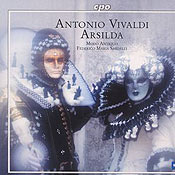
VIVALDI: Arsilda, Regina di Ponto

Antonio Vivaldi composed Arsilda, Regina di Ponto for the Venetian theater of Sant’Angelo in the fall of 1716. While Vivaldi had, by its debut, been an important member of Venetian musical culture for over a decade as a violinist and composer, he had begun composing only three years earlier. Domenico Lalli, his librettist, who settled in Venice in 1710 after fleeing his native Naples upon being charged with embezzlement, was one of the most important librettists of the first decades of the eighteenth century.

Antonio Vivaldi: Arsilda, Regina di Ponto (RV 700)
Simonetta Cavalli (Arsilda); Lucia Sciannimanico (Lisea); Elena Cecchi Fedi (Mirinda); Nicky Kennedy (Barzane); Joseph Cornwell (Tamese); Sergio foresti (Cisardo); Alessandra Rossi (Nicandro).
Modo Antiquo and the Coro da Camera Italiano, Federico Maria Sardelli (cond.)
cpo 999 740-2 [3CDs]
Antonio Vivaldi composed Arsilda, Regina di Ponto for the Venetian theater of Sant'Angelo in the fall of 1716. While Vivaldi had, by its debut, been an important member of Venetian musical culture for over a decade as a violinist and composer, he had begun composing only three years earlier. Domenico Lalli, his librettist, who settled in Venice in 1710 after fleeing his native Naples upon being charged with embezzlement, was one of the most important librettists of the first decades of the eighteenth century.

This recording features the Baroque orchestra of Modo Antiquo, an ensemble with particular expertise in the music of Vivaldi and his contemporaries. Founded in 1984 under the direction of Sardelli, the group has made several recordings with Amadeus, cpo and Tactus, including the first complete recording of Vivaldi's cantatas. They have also performed at many European early music festivals, including the Italian festival Opera Barga, for which this production of Arsilda was prepared in 2001. Sardelli is working on a critical edition of Arsilda for Istituto Antonio Vivaldi; in his authored excerpt in the liner notes, he points out his intention to implement both a musical and a musicological approach towards Vivaldi's operas. The music in this recording is based on the autograph of the work and is described as a "reconstruction of the original version" that emphasizes the first arias written rather than the composer's later changes and additions for the 1716 performances.

Arsilda is a typical early eighteenth-century plot in its use of love intrigues, mistaken identities, and musical features such as simile arias. As such, it perfectly encapsulates the contemporary Pier Jacopo Martello's tongue-in-cheek satire of opera of the day, which argued that opera, in order to be entertaining, should avoid following Aristotelian rules of drama and instead feature favored scenic conventions, such as prison and sleep scenes. Arsilda employs several such scenarios, including a hunt that takes place in a verdant forest and a dungeon scene. Moreover, its story hinges on concealed identities. Reliant on a pair of twins for its main intrigue--one male and one female--the story opens with Lisea, disguised as her brother Tamese and posing as King, and Arsilda, engaged to be married to "Tamese." We learn that Tamese has been lost at sea and is presumed dead, and in order to preserve the throne, Lisea has adopted his identity. Arsilda is puzzled and disappointed by "Tamese's" lack of interest, while Lisea/Tamese, for her part, is angry when she learns that her true fiancé, Barzane, has betrayed her and instead pursues Arsilda. The true Tamese, meanwhile, is disguised as the palace gardener, and both Arsilda and Lisea have an unexplained attraction to him.

While Vivaldi's instrumental music has been widely known for some time, only in recent decades have his operas attracted such attention. There is, therefore, a relative dearth of recordings of his operas, and any contribution is appreciated. Modo Antiquo's contibution is a quality recording, done on period instruments with highly competent singers. While at times the sound quality of the recording could be more focused, with low frequencies at times overwhelming the vocal lines and occasionally making comprehension of the text difficult, the recording overall gives wonderful insight into Vivaldi's characterizations and skill at both instrumental and vocal writing. Thanks to the efforts of Sardelli and Modo Antiquo, scholars, Vivaldi fans, and opera lovers in general now have an additional example of Vivaldi's early operatic style.

Many of the arias employ striking instrumentation to help convey the sense of the text. Fipple-flutes are used for pastoral settings, for example, while horns are used for the hunting scenes. Simile arias appear in abundance, such as Arsilda's Act 2, sc. 12 aria "Son come farfalletta" where muted violins and fast arpeggios imitate the fluttering of wings, and Mirinda's "Io son quel Gelsomino" in Act 1, Sc. 15, which imitates the blowing of wind through leafy branches with imitation between voice and strings. All of the singers on this recording convey the individual characterizations with knowledgeable awareness of performance practice and attention to phrasing, dynamics, and ornamentation. Particularly charming are the arias for Mirinda, the naïaut;ve maid, sung by Elena Cecchi Fedi who has a flexible voice perfectly suited to the virtuosic arias often given to this character. Equally pleasing is Lucia Sciannimanico as Lisea and Sergio Foresti as Cisardo.

Dr. Mary Macklem
University of Central Florida

Send to a friend

Send a link to this article to a friend with an optional message.

Friend's Email Address: (required)

Your Email Address: (required)

Message (optional):