Benjamin Britten: Folk Song Arrangements
Felicity Lott (Soprano), Philip Langridge (Tenor), Graham Johnson (Piano), Carlos Bonell (Guitar)
NAXOS 8.557220-21 [2CDs]
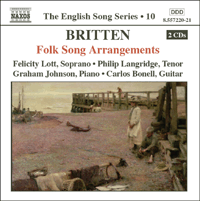
Britten's folksong arrangements, which span much of his career from 1943 to 1976, provide unique insights into the composer's oeuvre. Having been strongly encouraged by his teacher, Frank Bridge, to at all times be true to himself and to develop his own voice, one might expect Britten to eschew the folksong tradition, which had been so used (and misused?) by the generation before him. But Britten, following more in the line of Grainger than Vaughan Williams, voiced his distinctive style in these arrangements with appealing results. Sometimes making merely subtle changes and the simplest of accompaniments, Britten's arrangements display artistic grace and sensitivity that has made them some of the most beloved choices of singers and audiences alike.
Reproduced from a three-CD Collins Classics set, Naxos's newest release of Britten's collected folk songs culls out a few of the lesser known pieces in order to facilitate a two-CD format. The first disc consists of arrangements of folk songs from the British Isles: Volume 1 (published in 1943), Volume 3 (1947), and Volume 5 (1961). The second disc contains Volume 4 (Moore's Irish Melodies, published in 1960), Volume 2 (French Folksongs, 1946), and Volume 6 (English Folksongs, 1961). Peppered through both discs are pieces selected from "Tom Bowling and Other Song Arrangements," a collection of songs performed during the composers lifetime but not published until 2001. An unidentified folk song ends the second disc, which, in absence of a text, is performed with cello and piano only. This release unfortunately doesn't include Volume 7 of the folk songs, the eight-song set arranged for high voice and harp that Britten wrote near the very end of his life.
The ordering of songs generally works well, with a mix of solos for tenor and soprano accompanied by piano forming the body of both discs, followed by two duets at the end of the first disc, and mixed instrumental ensembles (tenor/guitar, tenor/cello/piano, and cello/piano) at the end of the second disc. The choice to end the collection with a wordless arrangement for cello and piano seems a curious one, since, by the end of two CDs filled with song, the absence of vocal sonorities and texts is difficult to overcome.
Naxos supports this release with a detailed CD booklet. Britten's brief biography begins the notes, and historical details of the compositions follow. Particulars of first performances and song dedications complement publication details. Biographies of the performers (with the exception of cellist, Christopher Van Kampen) confirm historical details and summarize long lists of well-earned credentials. The German translation of the notes follows, and the complete lyrics (with translations where necessary) fill the remainder of the booklet.
Among the most imaginative pieces on this release are those that begin with simple, sparse accompaniments, but that then give rise to more dissonant, distinctively Britten harmonies, enacting a subtle but telling shift from folk song to art song. Examples can be found in The trees they grow so high and The Ash Grove. Complementing these songs, are those pieces that begin with Britten in full voice, like O the sight entrancing, The Shooting of his Dear, and O can ye sew cushions?. My favorite of this type, The Brisk Young Widow, opens with a bitonal canon that makes for a fascinating comparison with the original folk song collected by Cecil Sharp.
The arrangements as a whole vividly project the diegetic worlds of the texts, with the piano at times simulating objects like spinning wheels, mill wheels and other instruments such as guitar and harp. The sounds of bells, in At the mid hour of night, enact the last line of the song by "faintly answering still the notes which once were so dear," echoing Schoenberg's "bells" in his piano pieces Op. 19, No. 6 (up a half step here). Imbued with the colors of distinctive scenes, the songs employ a variety of textures and harmonies -- from canon to solitary chords, from clusters to tender monophony -- to evoke a multiplicity of moods ranging from ridiculous (Oliver Cromwell and The Crocodile) to chilling (Quand j'étais chez mon pére and Eho! Eho!) to tenderly beautiful (Sally in our Alley and Sail on, sail on).
Philip Langridge sings the lion's share of songs (34 of the 52 including two duets with Lott). His extensive experience with Britten's music (his recordings include a Grammy award winning performance of Peter Grimes) shows in these songs. Many critics have compared Langridge's lithe tenor with that of Peter Pears, and although the voices are quite distinct (for starters, Langridge's vibrato is less heavy and his consonants dryer), moments that highlight similarities can be found in Pray Goody, The Plough Boy, and particularly Greensleeves. Langridge's crystal clear enunciation and technical facility serve him well on these discs. Intonation flags a bit in a few spots, but perhaps with expressive result, especially when donning the persona of the sailor praying for beer in The Soldier and the Sailor. His dramatic pacing and lyrical phrasing lend an intimacy to the songs that makes them all the more compelling.
Felicity Lott's soprano voice sparkles on her selections (19 of the 52). Although a bit harsh on the highest notes of O can ye sew cushions?, selections such as O Waly, Waly and The last rose of summer compensate with exquisite beauty. The rolled r's in her Scottish accent in The Bonny Earl o' Moray distinctively complement the rolled piano chords in the accompaniment, and while her diction is excellent throughout, her French vowels (Voici le Printemps, Fileuse, etc.) are especially convincing. The duets with Langridge (Soldier, won't you marry me? and The Deaf Woman's Courtship) offer good-humored closure to the first disc.
Graham Johnson's accompaniments evidence his long association with Britten and Pears. Although not quite as colorful a pianist as Britten himself, his renditions here prove articulate and not overly presumptuous. Accuracy and technical facility characterize his playing, as does sensitivity to the pacing and phrasing of both soloists. It is clear that he understands this genre inside and out. Guitarist Carlos Bonell ably accompanies Langridge in the Volume 6 songs, originally written for Pears and Julian Bream. Christopher Van Kampen, cello, rounds out the list of players, accompanying a German folk song, The Stream in the Valley (sung in English), and soloing on the final unidentified folk song.
While a certain elegant simplicity characterizes the folk song genre, Britten's creative arrangements in the hands of these expressive performers exude music that is both sophisticated and full of meaning. More than just charming, the folksongs are delightfully clever and, at times, deeply moving. Even the most casual listeners will find that these songs seduce their attentions and reward careful listening.
Shersten Johnson, Ph.D.
University of St. Thomas