Recently in Recordings
The Sixteen continues its exploration of Henry Purcell’s Welcome Songs for Charles II. As with Robert King’s pioneering Purcell series begun over thirty years ago for Hyperion, Harry Christophers is recording two Welcome Songs per disc.
In February this year, Albanian soprano Ermonela Jaho made a highly lauded debut recital at Wigmore Hall - a concert which both celebrated Opera Rara’s 50th anniversary and honoured the career of the Italian soprano Rosina Storchio (1872-1945), the star of verismo who created the title roles in Leoncavallo’s La bohème and Zazà, Mascagni’s Lodoletta and Puccini’s Madama Butterfly.
Collapsology. Or, perhaps we should use the French word ‘Collapsologie’ because this is a transdisciplinary idea pretty much advocated by a series of French theorists - and apparently, mostly French theorists. It in essence focuses on the imminent collapse of modern society and all its layers - a series of escalating crises on a global scale: environmental, economic, geopolitical, governmental; the list is extensive.
Amongst an avalanche of new Mahler recordings appearing at the moment (Das Lied von der Erde seems to be the most favoured, with three) this 1991 Mahler Second from the 2nd Kassel MahlerFest is one of the more interesting releases.
If there is one myth, it seems believed by some people today, that probably needs shattering it is that post-war recordings or performances of Wagner operas were always of exceptional quality. This 1949 Hamburg Tristan und Isolde is one of those recordings - though quite who is to blame for its many problems takes quite some unearthing.
The voices of six women composers are celebrated by baritone Jeremy Huw Williams and soprano Yunah Lee on this characteristically ambitious and valuable release by Lontano Records Ltd (Lorelt).
As Paul Spicer, conductor of the Royal Birmingham Conservatoire Chamber Choir, observes, the worship of the Blessed Virgin Mary is as ‘old as Christianity itself’, and programmes devoted to settings of texts which venerate the Virgin Mary are commonplace.
Ethel Smyth’s last large-scale work, written in 1930 by the then 72-year-old composer who was increasingly afflicted and depressed by her worsening deafness, was The Prison – a ‘symphony’ for soprano and bass-baritone soloists, chorus and orchestra.
‘Hamilton Harty is Irish to the core, but he is not a musical nationalist.’
‘After silence, that which comes closest to expressing the inexpressible is music.’ Aldous Huxley’s words have inspired VOCES8’s new disc, After Silence, a ‘double album in four chapters’ which marks the ensemble’s 15th anniversary.
A song-cycle is a narrative, a journey, not necessarily literal or linear, but one which carries performer and listener through time and across an emotional terrain. Through complement and contrast, poetry and music crystallise diverse sentiments and somehow cohere variability into an aesthetic unity.
One of the nicest things about being lucky enough to enjoy opera, music and theatre, week in week out, in London’s fringe theatres, music conservatoires, and international concert halls and opera houses, is the opportunity to encounter striking performances by young talented musicians and then watch with pleasure as they fulfil those sparks of promise.
“It’s forbidden, and where’s the art in that?”
Dublin-born John F. Larchet (1884-1967) might well be described as the father of post-Independence Irish music, given the immense influenced that he had upon Irish musical life during the first half of the 20th century - as a composer, musician, administrator and teacher.
The English Civil War is raging. The daughter of a Puritan aristocrat has fallen in love with the son of a Royalist supporter of the House of Stuart. Will love triumph over political expediency and religious dogma?
Beethoven Symphony no 9 (the Choral Symphony) in D minor, Op. 125, and the Choral Fantasy in C minor, Op. 80 with soloist Kristian Bezuidenhout, Pablo Heras-Casado conducting the Freiburger Barockorchester, new from Harmonia Mundi.
A Louise Brooks look-a-like, in bobbed black wig and floor-sweeping leather trench-coat, cheeks purple-rouged and eyes shadowed in black, Barbara Hannigan issues taut gestures which elicit fire-cracker punch from the Mahler Chamber Orchestra.
‘Signor Piatti in a fantasia on themes from Beatrice di Tenda had also his triumph. Difficulties, declared to be insuperable, were vanquished by him with consummate skill and precision. He certainly is amazing, his tone magnificent, and his style excellent. His resources appear to be inexhaustible; and altogether for variety, it is the greatest specimen of violoncello playing that has been heard in this country.’
Baritone Roderick Williams seems to have been a pretty constant ‘companion’, on my laptop screen and through my stereo speakers, during the past few ‘lock-down’ months.
Melodramas can be a difficult genre for composers. Before Richard Strauss’s Enoch Arden the concept of the melodrama was its compact size – Weber’s Wolf’s Glen scene in Der Freischütz, Georg Benda’s Ariadne auf Naxos and Medea or even Leonore’s grave scene in Beethoven’s Fidelio.
Recordings
03 Jul 2005
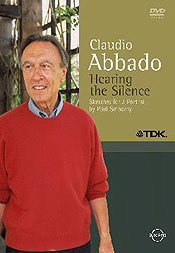
Claudio Abbado: Hearing the Silence — Sketches for a Portrait
Five minutes into this DVD there has been a lot of talk on Abbado’s aura, his aristocratic reserve and the fact that he is a private thinker. With a deep sigh I was reminded of some of those dreadful documentaries on Arte (a German-French arts channel which I have on cable) that have promising titles and then soon lose themselves in a lot of philosophical treatises without any real content. And what was almost the last image of this documentary?: “In collaboration with Arte”
Claudio Abbado: Hearing the Silence — Sketches for a Portrait
Produced and directed by Paul Smaczny
TDK Euroarts 2053278 [DVD]
Five minutes into this DVD there has been a lot of talk on Abbado's aura, his aristocratic reserve and the fact that he is a private thinker. With a deep sigh I was reminded of some of those dreadful documentaries on Arte (a German-French arts channel which I have on cable) that have promising titles and then soon lose themselves in a lot of philosophical treatises without any real content. And what was almost the last image of this documentary?: "In collaboration with Arte"
Subtitles like "hearing the silence" and "sketches" and not a portrait itself should have warned me and they keep their promises: lots and lots of vague high-minded talk with some hidden nuggets. After ten minutes into this experience we get some footage of 1968 in an interview with Marcel Prawy, the recently deceased grand old man of opera in Austria. Prawy asks some simple but really interesting questions and so we learn that Abbado as a young music student in Vienna was not allowed to attend rehearsals with the great conductors on the roster. His solution was simple: with his good bass-baritone he became a temporary member of the chorus and saw the great men in action. End of the historical footage. But an interviewer really interested in Abbado's art would have asked what he learned, if indeed he learned anything, by watching Karajan and Walter. And another inevitable question would have been: how did his own singing experiences influence his behaviour towards his singers in his many operatic performances? Nothing of this at all. The only moment we see Abbado conducting an opera is during a less typical performance of Elektra and there is no comment at all on the problems of that difficult relationship between stage and pit, of Abbado's vision on "Das Regietheater."
Of course there are a lot of interviews with some of his players and here too it is strange to note that nobody offers hard facts on Abbado's stick technique, his downbeat or other important signs of music making. We learn that everybody calls him Claudio and not maestro, that he is very democratic, charismatic, etc. but what does that tell us? Indeed, the only really interesting details are given by Abbado himself for 30 seconds and strangely enough by his friend and actor Bruno Ganz who has studied Abbado's gestures during a concert. In exchange Ganz may expand on every question of life and death, recite German poems of Hölderlin (admired by Abbado) so that the director can show some landscapes and tell us there were problems with composer Luigi Nono. What kind of problems? That's not for us to know. Ganz has almost as much to tell as Abbado himself and we should not forget that the actor is "hot" as he played (not too well in my opinion) the title role in "Der Untergang," the movie about Hitler's last days.
There is a lot of footage on Abbado's concerts and there at last we can see for ourselves how he leads with his eyes and the "pa, pa, pa" sounds he makes. But it is not clear why this or that piece is chosen. No one ever asks the conductor which kind of composers he prefers or why he conducts this and not that. It comes as a kind of surprise in this philosophical entertainment that such worldly themes as his illness — he was diagnosed with cancer 4 years ago — pop up though he now distinctly looks better than a few years ago when, with superhuman strength, he continued conducting and one feared he would not finish some concerts. We also learn that he left the Berliner Symphoniker of his own accord in 2002, though it is a lifetime post. Of course everybody deeply regrets his decision and there is no dissenting voice to tell some of the less savoury stories. The orchestra deeply loved its maestro but it loved something more: money. For one or another reason (a saturated market; Abbado's simplicity and humility compared with his predecessor's incessant marketing of himself) Abbado's records didn't sell well: often only a few thousand copies were sold worldwide. At one time, the Berliner and Abbado were even relegated to accompanying the love couple's (Alagna-Gheorgiu) Verdi duets. That didn't sit well with an orchestra that remembered too well the rich pickings on the record market during Karajan's era. The grumbling and his illness were reasons enough for Abbado to keep the honour of resigning to himself. All in all, this DVD is a missed chance.
Jan Neckers