Subscribe to
Opera Today

Receive articles and news via RSS feeds or email subscription.


twitter_logo[1].gif


9780521746472.png

Recently in Recordings

Adding Movie Magic to The Magic Flute

What better way for Masonic brothers, Wolfgang Amadeus Mozart and Emmanuel Shikaneder to disseminate Masonic virtues, than through the most popular musical entertainment of their age, a happy ending folktale that features a dragon, enchanting flutes and bells, mixed-up parentage, and a beautiful young princess in distress?

L’Incoronazione di Poppea from Virgin Classics

Since its first performance at the Teatro Santi Giovanni e Paolo during Venice’s 1643 Carnevale, Monteverdi’s L’Incoronazione di Poppea has been one of the most important milestones in the genesis of modern opera despite its 250 years of unmerited obscurity. 

Saverio Mercadante: I due Figaro

Though 2013 is the bicentennial of the births of Giuseppe Verdi and Richard Wagner, the releases of Cecilia Bartoli’s recording of Bellini’s Norma on DECCA, a new studio recording of Donizetti’s Caterina Cornaro from Opera Rara, and this première recording of Saverio Mercadante’s forgotten I due Figaro, suggest that this is the start of a summer of bel canto.

Christian Thielemann’s Der Ring des Nibelungen

Recording Richard Wagner’s Der Ring des Nibelungen is for a record label equivalent to a climber reaching the summit of Mount Everest: it is the zenith from which a label surveys its position among its rivals and appreciates an achievement that can define its reputation for a generation. 

Cecilia Bartoli as Norma

Few people who love opera in general and bel canto in particular have never heard the comment made by Lilli Lehmann, veteran of the inaugural Ring at Bayreuth in 1876, that singing all three of Wagner’s Brünnhildes—in Die Walküre, Siegfried, and Götterdämmerung, respectively, all of which she sang to great acclaim—pales in comparison with singing the title rôle in Bellini’s Norma

Ariane et Barbe-Bleue on Blu-Ray

Paul Dukas’ Ariane et Barbe-Bleue, first heard in 1907, once seemed important. Arturo Toscanini conducted the Met premiere in 1911 with Farrar and later arranged some of its music for a 1947 recording with his NBC Symphony.

Kaufmann Wagner

The economics of the recording companies dictate much that is not ideal. Wagner’s operas were not composed as they were in order to permit the extraction of bleeding chunks, even on those occasions when strophic song forms do occur.

Mahler: Symphony No. 8

Among the recent recordings of Mahler’s Eighth Symphony, Valery Gergiev’s release on the LSO Live label is an excellent addition to the discography of this work.

Songs by Zemlinsky

While not unknown, the songs of Alexander von Zemlinsky (1871-1942) deserve to be heard more frequently.

Gustav Mahler: Lieder eines fahrenden Gesellen, Rückert-Lieder, Kindertotenlieder.

Recorded on 5 and 6 May 2008 and 17 and 18 January 2009 at the Lisztzentrum (Raiding, Austria), this recent Bridge release makes available the piano-vocal versions of three song cycles by Gustav Mahler, Lieder eines fahrenden Gesellen, Rückert-Lieder, and Kindertotenlieder performed by mezzo-soprano Hermine Haselböck, accompanied by Russell Ryan.

Kathleen Ferrier: A Film by Diane Perelsztejn

Contraltos rarely achieve the acclaim and renown of sopranos. Assigned few leading roles in opera, they are condemned to playing the villain or the grandmother, or to stealing the castrati’s trousers in en travesti roles.

1612 Italian Vespers

Following their 2011 Decca recording of Striggio’s Mass in 40 Parts (1566), I Fagiolini continue their quest to unearth lost treasures of the High Renaissance and early Baroque, with this collection of world-premiere recordings, ‘reconstructions’ and ‘reconstitutions’ of music by Giovanni and Andrea Gabrieli, Monteverdi, Palestrina, and their less well-known compatriots Viadana, Barbarino and Soriano.

Eternal Echoes: Songs and Dances for the Soul

Eternal Echoes is an album of khazones [Jewish cantorial music] for cantorial soloist, solo violin and a blended instrumental ensemble comprising a small orchestra and the Klezmer Conservatory Band.

Mahler: Symphony no. 3 / Kindertotenlieder

Michael Tilson Thomas’s recording of Mahler’s Third Symphony is an outstanding contribution to the composer’s discography.

Oliver Knussen’s Symphonies from NMC

Oliver Knussen burst into British music with an unprecedented flourish. In 1967, the London Symphony Orchestra premiered Knussen’s First Symphony, with István Kertész scheduled to conduct.

Ludwig van Beethoven: Fidelio

Based on performances given in Summer 2010 at the Lucerne Festival, this recording of Beethoven’s Fidelio is an admirable recording that captures the vitality of the work as conducted by Claudio Abbado.

Stanisław Moniuszko: Flis

Stanisław Moniuszko (1819-1872) was one of the most popular composers of his day in Poland, and of the many works he wrote for the stage, two are performed from time to time, Halka (1848) and Strazny dwór [The Haunted Manor] (1865).

Stanisław Moniuszko: Pieśni Songs

The Polish alto Jadwiga Rappé is a familiar voice in various stage and concert works, and the recent release of a selection of songs by Stanisław Moniuszko (1819-1872) is an opportunity to hear her performing artsongs.

Joan Sutherland and Richard Bonynge: Serate Musicali

Originally released on multiple discs in 1981 this reissue on two CDs is a comprehensive collection of art songs by Italian and French composers from the nineteenth and early twentieth centuries.

Richard Strauss: Salome

An exciting contribution to the discography of this popular opera, the live performance of Richard Strauss’s Salome from the Festspielhaus at Baden-Baden is a compelling DVD.

OPERA TODAY ARCHIVES »

Recordings

DonGiovanni(Glyndebourne)
15 Jul 2005

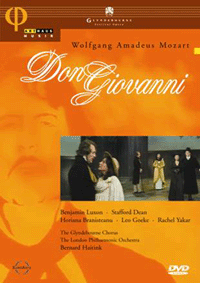
MOZART: Don Giovanni

This staging of the Mozart/da Ponte masterpiece took place in 1977, at the Glyndebourne Festival. Although the conductor is Dutch, and members of the cast come from Eastern Europe and the States, a more British performance would be hard to imagine.

Don Giovanni

Benjamin Luxon, Stafford Dean, Horiana Branisteanu, Leo Goeke, Rachel Yakar. London Philharmonic Orchestra, Glyndebourne Chorus, Bernard Haitink (cond.)

Arthaus 101 087 [DVD]


This staging of the Mozart/da Ponte masterpiece took place in 1977, at the Glyndebourne Festival. Although the conductor is Dutch, and members of the cast come from Eastern Europe and the States, a more British performance would be hard to imagine.

The sets (or set, truthfully) and costumes evoke a Mid-Victorian setting, and the title character, a role that dominates the action, is performed by Benjamin Luxon, a tall, reasonably attractive English singer. His ample locks alone would serve to inform any survivor of the "Disco era" as to the time of filming.

Some may question how an opera of seething passion and sexuality such as Don Giovanni would work when presented in the supposedly conservative, tight-lipped world of Victoria and Albert.

Surprisingly well. This Don may look and move as if he were a proper gentleman, but his actions prove otherwise, and the disparity between appearances and reality makes for a most effective contrast. Luxon may not be a great Don, but for this production, he does very well. We don't sympathize with him much, or truly comprehend the attraction that has allowed him to rack up such a list of conquests. However, we get a strong sense of da Ponte's implied social criticism, and for once we can watch the furies drag the Don down to hell with something approaching approval.

Stafford Dean's Leporello takes top honors as a total performance. A fresh, spontaneous actor, his rich baritone and comic timing enliven all his scenes. Leo Goeke cannot overcome the crippling blandness of Don Ottavio, and he is not helped by the director's insistence on long close-ups. Goeke does manage to present his two big arias with some style, if not much beauty. Of the other men, John Rawnsley's plump Masetto is right out of a British farm, and Pierre Thau has the command of the ominous low range of the Commendatore.

The females pose problems. Horiana Branisteanu, the Donna Anna, needs to warm up, and the shrillness in the first scene remains with one for a while. By the second act her voice has settled, and though by no means a sympathetic portrayal, she renders her last aria with dramatic detail.

Rachel Yakar's Elvira makes it too clear why the Don moved on, but she also suggests the neurotic need of this woman for a man who clearly is not worthy of her. Elizabeth Gale is far from the most sensual of Zerlina's, but her modest manner gives the role an interesting dimension, and mutes some of the less appealing aspects of the words to Batti, batti.

Described in the booklet as "filmed," the production seems to have been captured without an audience present — and yet, at the end, we see curtain calls, at least of the cast. Curious, as the camera captures many scenes in ways that would seem impossible during a live performance in the theater. The serenading Masetto (disguised as the Don) is viewed from the perspective of Donna Elvira on her balcony. During the second act quartet, the singers' heads are superimposed over the stage picture. Many singers also sing directly to the camera at several points.

However the production was filmed, the sound engineer decided to include one relic of live performance — a copious amount of foot stomping and other stage noise. As Haitink leads a most energetic, detailed performance of the score, the extra noise is not welcome.

And as is so typical, the subtitles offer an amusing array of misspellings and awkward syntax.

For collectors of this opera, this Glyndebourne version can be highly recommended. It could not be a first-choice for it singers, and the production probably will enchant few, but the totality of the performance is much more than the sum of its parts. And surely some of the more recently recorded Don Giovanni DVDs will look as dated as this one in over 25 years — and possibly be of less musical distinction. Overall, a fine piece of work.

Chris Mullins
Los Angeles Harbor College
Send to a friend

Send a link to this article to a friend with an optional message.

Friend's Email Address: (required)

Your Email Address: (required)

Message (optional):