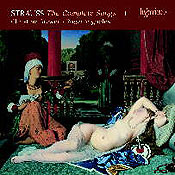
Richard Strauss: The Complete Songs Vol. 1.
Christine Brewer, soprano; Roger Vignoles, piano
Hyperion CDA 67488 [CD]
Among the best-known works of Richard Strauss is his set of Vier letzte Lieder, the so-called four "last" songs. These are just a fraction of the music he composed in this genre, with over 200 songs for voice and piano, and around fifty of them arranged with orchestral accompaniment. The prospect of a new series of complete songs is promising, and it should augment the various recorded selections of his Lieder that are currently available. As Roger Vignoles states in the notes that accompany the first volume, the Hyperion set of Strauss's Complete Songs is based on the following criteria:
In selecting the songs for this series, it has been decided to follow musical, as much as musicological, considerations. Strauss's groupings by opus number have not necessarily been adhered to, since although some sets are unified by the choice of poet, in other cases it is not always obvious that Strauss intended a particular set of songs to be performed as a group, or indeed that they were put together for any other reason than convenience of publication. Not infrequently, songs stand side by side that are quite clearly conceived for totally different voice types, while elsewhere the variation in style and content disrupts any great sense of musical cohesion. (p. 3)
These comments put forth a false apposition of musicological method against musical judgment, when such a distinction is unnecessary, especially since musicology as it is currently practiced attempts to support artistic concerns. At the same time, the decision to change the order of the Lieder also contravenes the decisions of the composer to allow various pieces to be published together, which are the result of other factors. The generalizations about the organization of Strauss's work in this genre suggest a level of disorder that does not exist for all of the Lieder. Other considerations motivate the arrangement of Hyperion's set of Strauss's Complete Songs, and they probably entail the role of the performers involved with this recording project. As the introductory note continues, the criteria are explained:
The endeavour therefore is in each case to entice the listener with the sequence of songs while playing to the strengths of the singer concerned. In the case of Christine Brewer, who opens the series, these strengths are evident and matched by the choice of repertoire, ranging chronologically from the familiar Zueignung [Op. 10, no. 1] to the rarefied (and rarely, if ever, performed) Gesänge des Orients Op. 77. These latter songs, not to mention dramatic numbers such as Ich liebe dich [Op. 37, no. 2] and In der Campagna [Op. 41, no. 2], would be well-nigh impossible without a voice of the heft and versatility of Christine Brewer, who thereby provides us with a panoramic view of the heights and depths of Strauss's song-composing style.[p. 3]
These comments point to the performance considerations as the primary criterion for the arrangement of the Complete Songs and suggest aspects of the conventional song recital as part of the motivation for the selection of Lieder found on this CD and, most likely, on the ones to follow. It is a curious that the strengths of the performers are given such prominence, but it makes sense in the context of the music, which embraces a number of ranges and voice types. The precedent for using multiple singers may be found in the set of Strauss's Orchesterlieder conducted by Friedrich Haider, which involves seven different singers to present the forty-seven Lieder with orchestral accompaniment. Even when a single performer makes the monumental effort of recording the entirety of Strauss's Lieder with piano accompaniment, as Dietrich Fischer-Dieskau did with his accompanist Gerald Moore, some pieces are inevitably stronger than others. Yet such an important project like this new set of Strauss's complete songs will ultimately be difficult to consult without more transparent organization. It would be useful to have entire sets of songs kept together, and if musical judgments warrant the use of different performers in order to play to their strengths, the option of using different singers within a set is not unreasonable and might offer a more viable solution. In dealing with such a volume of songs of Strauss's 200 Lieder, one can only hope for the best when it comes to finding individual pieces that have become detached from their original groupings and are distributed among several CDs.
As to Christine Brewer's performances in this CD, they are marked by her fine, pointed soprano sound, which is characteristically focused. The quality of "heft" as indicated in the liner notes is not the best way to describe a voice that can maintain its individuality within some of the more thickly textured accompaniments that Strauss composed. "In der Campagna" is one example of a piece that requires an effective balance between voice and piano with its highly evocative accompaniment that suggests, at times, an orchestral milieu. Yet even in the song that follows in this recording, "Frühlingsfeier" (Op. 56, no. 5), the intense accompaniment sometimes forces as talented a singer as Brewer to strain a bit in the more sustained supplications to Adonis in this piece.
At the same time, Vignoles deserves recognition for his consistently fine performances. While some of the piano parts are technically challenging, other accompaniments pose problems in achieving a balance with the voice. The accompaniment of "Die heiligen drei Könige" (Op. 56, no. 6), which follows "Frühlingsfeier," is admittedly a reduction of an orchestral accompaniment and the elements of melodrama in it requires the kind of nuance and subtlety that Vignoles offers. This interpretation of this less-played song is stricter rhythmically than the Fischer-Dieskau/Moore recording and, perhaps because of the recording techniques used by Hyperion, offers some fine shadings that hint at orchestral color. Other accompaniments are notable, like that of "Wiegenlied" (Op. 41, no. 1), which demonstrates the facility and subtlety Vignoles brings to this music.
While some of the songs in this volume may be familiar, others are less so, and one of the pleasures of this recording is the set of Gesänge des Orients (Op. 77), which collects five settings of poetry by Hans Bethge. The orientalism in this work is less prominent than the Straussian lyricism, which emerges in this work completed in 1928 after a long period when the composer did not compose Lieder. Those familiar with Mahler's music will recognize the poet, Bethge, whose German adaptations of Chinese verse were the basis for the orchestral song cycle Das Lied von der Erde. While Strauss's settings of Bethge are less monumental than Mahler's, the Gesänge des Orients is nonetheless notable for its effective settings of poetry inspired by Hafiz and others.
All in all, this recording is a laudable beginning of a new enterprise that should encompass some ten CDs when it is complete. Recorded 22-24 March 2004 in All Saints Church, East Finchley, London, the sound is quite fine, and the resulting balance between voice and piano is as strong as the partnership evident in their execution. For a detailed list of the contents of this CD, consult the Hyperion site, which should also list forthcoming releases in this promising set.
Those interested in this repertoire may want to consult the uniform set of Strauss's Lieder recorded on EMI by Dietrich Fischer-Dieskau, baritone, and Gerald Moore, piano. (EMI Classics, CDMF 63995, 6-CD set). The orchestral songs, which merit inclusion in Hyperion's series, have been released on CD as Richard Strauss: Die Orchesterlieder, which includes various singers performing with the Orchestre Philharmonique de Nice, Friedrich Haider, conductor (Nightingale, NC 000072-2, 3-CD set). A thorough discussion of Strauss's Lieder is part of Normal Del Mar's study of the composer's works (Richard Strauss, 3 vol., Cornell University Press, 1986), with the section entitled "A Lifetime of Lieder Writing" (3:246-404), which benefits from a chronological treatment of the music. In fact, a useful tool in Del Mar's study is the chronological list of songs (3:499-504), and those interested are welcome to consult the present writer's table of Strauss's Lieder (with the piano-vocal versions aligned with the orchestral ones) in The Cambridge Companion to the Lied (Cambridge: Cambridge University Press, 2004), reviewed elsewhere by Opera Today. These materials may be useful to those who wish to explore Strauss's Lieder further as they listen to this particular Hyperion recording and prepare for the release of other volumes in this set of the composer's Complete Songs.
James L. Zychowicz
Madison, Wisconsin