Recently in Recordings
The Sixteen continues its exploration of Henry Purcell’s Welcome Songs for Charles II. As with Robert King’s pioneering Purcell series begun over thirty years ago for Hyperion, Harry Christophers is recording two Welcome Songs per disc.
In February this year, Albanian soprano Ermonela Jaho made a highly lauded debut recital at Wigmore Hall - a concert which both celebrated Opera Rara’s 50th anniversary and honoured the career of the Italian soprano Rosina Storchio (1872-1945), the star of verismo who created the title roles in Leoncavallo’s La bohème and Zazà, Mascagni’s Lodoletta and Puccini’s Madama Butterfly.
Collapsology. Or, perhaps we should use the French word ‘Collapsologie’ because this is a transdisciplinary idea pretty much advocated by a series of French theorists - and apparently, mostly French theorists. It in essence focuses on the imminent collapse of modern society and all its layers - a series of escalating crises on a global scale: environmental, economic, geopolitical, governmental; the list is extensive.
Amongst an avalanche of new Mahler recordings appearing at the moment (Das Lied von der Erde seems to be the most favoured, with three) this 1991 Mahler Second from the 2nd Kassel MahlerFest is one of the more interesting releases.
If there is one myth, it seems believed by some people today, that probably needs shattering it is that post-war recordings or performances of Wagner operas were always of exceptional quality. This 1949 Hamburg Tristan und Isolde is one of those recordings - though quite who is to blame for its many problems takes quite some unearthing.
The voices of six women composers are celebrated by baritone Jeremy Huw Williams and soprano Yunah Lee on this characteristically ambitious and valuable release by Lontano Records Ltd (Lorelt).
As Paul Spicer, conductor of the Royal Birmingham Conservatoire Chamber Choir, observes, the worship of the Blessed Virgin Mary is as ‘old as Christianity itself’, and programmes devoted to settings of texts which venerate the Virgin Mary are commonplace.
Ethel Smyth’s last large-scale work, written in 1930 by the then 72-year-old composer who was increasingly afflicted and depressed by her worsening deafness, was The Prison – a ‘symphony’ for soprano and bass-baritone soloists, chorus and orchestra.
‘Hamilton Harty is Irish to the core, but he is not a musical nationalist.’
‘After silence, that which comes closest to expressing the inexpressible is music.’ Aldous Huxley’s words have inspired VOCES8’s new disc, After Silence, a ‘double album in four chapters’ which marks the ensemble’s 15th anniversary.
A song-cycle is a narrative, a journey, not necessarily literal or linear, but one which carries performer and listener through time and across an emotional terrain. Through complement and contrast, poetry and music crystallise diverse sentiments and somehow cohere variability into an aesthetic unity.
One of the nicest things about being lucky enough to enjoy opera, music and theatre, week in week out, in London’s fringe theatres, music conservatoires, and international concert halls and opera houses, is the opportunity to encounter striking performances by young talented musicians and then watch with pleasure as they fulfil those sparks of promise.
“It’s forbidden, and where’s the art in that?”
Dublin-born John F. Larchet (1884-1967) might well be described as the father of post-Independence Irish music, given the immense influenced that he had upon Irish musical life during the first half of the 20th century - as a composer, musician, administrator and teacher.
The English Civil War is raging. The daughter of a Puritan aristocrat has fallen in love with the son of a Royalist supporter of the House of Stuart. Will love triumph over political expediency and religious dogma?
Beethoven Symphony no 9 (the Choral Symphony) in D minor, Op. 125, and the Choral Fantasy in C minor, Op. 80 with soloist Kristian Bezuidenhout, Pablo Heras-Casado conducting the Freiburger Barockorchester, new from Harmonia Mundi.
A Louise Brooks look-a-like, in bobbed black wig and floor-sweeping leather trench-coat, cheeks purple-rouged and eyes shadowed in black, Barbara Hannigan issues taut gestures which elicit fire-cracker punch from the Mahler Chamber Orchestra.
‘Signor Piatti in a fantasia on themes from Beatrice di Tenda had also his triumph. Difficulties, declared to be insuperable, were vanquished by him with consummate skill and precision. He certainly is amazing, his tone magnificent, and his style excellent. His resources appear to be inexhaustible; and altogether for variety, it is the greatest specimen of violoncello playing that has been heard in this country.’
Baritone Roderick Williams seems to have been a pretty constant ‘companion’, on my laptop screen and through my stereo speakers, during the past few ‘lock-down’ months.
Melodramas can be a difficult genre for composers. Before Richard Strauss’s Enoch Arden the concept of the melodrama was its compact size – Weber’s Wolf’s Glen scene in Der Freischütz, Georg Benda’s Ariadne auf Naxos and Medea or even Leonore’s grave scene in Beethoven’s Fidelio.
Recordings
19 Sep 2005
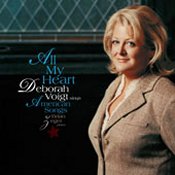
All My Heart — Deborah Voigt sings American Songs
“I send my heart up to thee, all my heart in this, my singing” Robert Browning.
The title of this CD is taken from the text of one of Amy Beach’s Three Browning Songs, which close the program. Given Deborah Voigt’s ability to sing this program with completely natural expression and crystal clear diction while maintaining a consistently high standard of vocal production and musicianship, it is easy to believe that in her singing she shares with us something of what is most dear to her own heart. Fortunately for us, in doing this she is also giving us a fine recording of American art songs, some of which will be quite familiar to many listeners, others of which will be wonderful new discoveries.
The program begins with seven songs of Charles Ives, followed by three by Leonard Bernstein. Interestingly, these very complex composers are represented by songs of innocence and nostalgia, generally easy to listen to, although not necessarily easy to perform well. “Two Little Flowers,” for instance, sets its charming little text about the composer’s young daughter and her friend to an accompaniment whose phrasing is half a beat off from that of the voice; and “The Side Show”, which opens the program, alternates triple and duple meter in imitation of a waltz tune being produced by a faulty mechanism. In these songs we can appreciate the artists’ impeccable rhythm and phrasing. “Down East” and “At the River” pass familiar tunes through the distorting power of memory, while “Berceuse” and “The Children’s Hour” share a sense of childhood viewed through adult eyes. This gentle nostalgia is set off by the liveliness of “The Circus Band”, that challenging rite of passage for any aspiring American accompanist. While Deborah Voigt sings it skillfully, pianist Brian Zeger is the real star in this song, bringing off the dense accompaniment with admirable energy and clarity. At first I was disappointed that the performers chose not to speak Ives’s written comment “hear the trombones” at the end of the bravura final interlude but, without the words to distract me, I realized just how well Zeger was in fact allowing me to hear the trombones in the bass line of Ives’s passing parade.
The short set of songs by Bernstein continues the evocation of childhood (or perhaps of second childhood, as in the playful “Piccola Serenata” written for the occasion of Karl Böhm’s eighty-fifth birthday). “Greeting,” which tells of the wonder around the birth of a new child, and “So Pretty,” which expresses a child’s bewilderment at the human cost of war, are both presented in a simple and heartfelt way. Without having to modify her large voice, Voigt is able to scale it back to sound childlike but not childish.
At the heart of the program is a fine set of art songs by the contemporary composer Ben Moore, who has composed several musical shows and cabaret pieces as well as humorous encore pieces for classical singers. While the songs earlier in the program evoked childhood, in many of Moore’s songs we see the dilemmas of people coming to terms with romantic love and the choices it invites them to make. These songs are all melodic, with interesting and singable texts, and harmonies and accompaniments that reinforce the poetry. It is fortunate that such talented artists have chosen to devote at least half of the recording to Moore’s songs, since they deserve to be heard. A particularly memorable song at first hearing is the setting of Thomas Hardy’s “The Ivy Wife,” which deflates the Victorian metaphor of the wife as clinging vine, faithful to the strong tree who is her husband. In a setting of great energy which eschews the delicacy and gentleness associated with that image, we hear a woman on a mission, telling us of how she set out to find the man whom she could cling to and eventually completely contain, and of the resultant destruction to them both.
From these most contemporary of songs, the program moves to the early twentieth century for a short but well-chosen set of songs by the often under-recognized Charles Tomlinson Griffes. The simplicity of “The Half-Ring Moon” and “Pierrot” are as well presented as the complex rhythms of “Cleopatra to the Asp” and the soaring passion of “Evening Song”, which recalls the late Romantic arias of Voigt’s debut recording. But for unabashed Romanticism, nothing on this disk can top the “Three Browning Songs” of Amy Beach, and in this case particularly it seems that the singer and songs were made for each other. The extended swelling phrases, culminating in notes held for multiple measures above the staff, the dynamic range, the skips between registers, all of these in support of the straightforward expression of emotion deeply felt and believed, cry out for the capabilities of a dramatic operatic voice like Voigt’s, and she navigates them with aplomb, as always fully and capably supported by Zeger. The order of the songs is modified slightly, placing “The Year’s at the Spring” at the end, so that the last thing we hear on the recording is the ecstatic declaration “All’s right, all’s right with the world!” Yes, indeed.
Barbara Miller