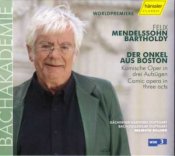
Except for the music he composed for William Shakespeare’s play A Midsummer Night’s Dream, though, Mendelssohn’s other dramatic works are relatively unknown. The catalog of his works includes seventeen works for the stage, and among them is Der Onkel aus Boston, oder Die beiden Neffen (1822-23; performed privately in1824), a comic opera in three acts to a libretto by Johann Ludwig Casper. This is the last of the young Mendelssohn’s collaborations with Casper, who contributed librettos to three other youthful works: Die Soldatenliebschaft (1820), a Singspiel in one act, and Die beiden Pädagogen (1821) and Die wandernden Komödianten (1822), another single-act work. Mendelssohn’s next work is the Die Hochzeit des Camacho, a work based on a portion of Cervantes’ Don Quixote and the only opera of Mendelssohn to receive a public performance in his lifetime.
As to Der Onkel aus Boston, Mendelssohn composed this work when he was around thirteen or fourteen years old, a time when he was experimenting with various kinds of music, including other music for the stage, like the Overture for Shakespeare’s A Midsummer Night’s Dream (1826; in 1843, he composed the other incidental music for the play). The extant criticism of Mendelssohn’s operas places Der Onkel aus Boston in the Singspiel tradition, but a closer examination of the music reveals a young composer under the influence of Mozart and Weber. In some ways, Der Onkel aus Boston is reminiscent of some of the Schubert’s wonderfully lyrical operas that have never held the stage as much as they have earned some esteem for the music they contain.
The plot for Der Onkel aus Boston involves the return of a former Hessian, Baron von Felsig, from New England to Brandenburg around 1780 to enter into the romantic and political activities of his erstwhile family. Comic situations exist when family members meet for the first time under difficult circumstances, including the wooing of Felsig’s niece. Mistaken identities and miscommunication abound sufficiently to inspire three acts of complications that require resolution in some fine ensembles. It is by no means a memorable libretto, nor is it out of the tradition of opera plots requiring the suspension of disbelief to follow the action. While the dialogue is lost for the third act, it is possible to piece together its dramatic situation, but the extant text for the first two acts points to the weakness of this work and Mendelssohn’s other operas in weak texts or, perhaps, the lack of a librettist who could work well with such a talented composer.
Mendelssohn’s search for a workable libretto spanned his career, and he rejected collaborations with some of the best-known writers of his day. Along with Eugene Scribe and J. R. Planché are individuals like Helminie von Chézy and Eduard Devrient, all names familiar to those familiar with nineteenth-century opera. The topics rejected include the usual array of historical topics, and even extend to myth. In fact, Mendelssohn started working on an opera about the Lorelei near the end of his life, and left it unfinished at his death. It is impossible to know what could have emerged from that effort, but finished scores like Der Onkel aus Boston give an idea of the kind of music Mendelssohn conceived for the works he did bring to completion.
Der Onkel aus Boston contains much music that is competently composed and pleasant to hear. The recitative and aria “O Himmel” (Act 1, no. 3) is sung well by Carsten Süß, whose fine tenor sound would lend itself to any number of roles from the period in which Mendelssohn composed this work (it is possible, for example, to imagine him as Belmonte in Mozart’s Entführung aus dem Serail). In the quartet that follows, “Nein das ist nicht auszustehn!”(Act 1, no. 4) Mendelssohn makes wonderful use of the contrapuntal possibilities for this ensemble, and the accompaniment itself is quite effective. The woodwind textures betray some stylistic choices that Mendelssohn would used in other works from this period, but the instrumental writing never outpaces the voices here or elsewhere in this work. The Finale “Laut ertönt der Jubelklang” (Act 1, no. 5) echoes some of Weber’s music from the same period and also shows the influence of Mozart in the extended instrumental interlude that divides the number. It is well-crafted scena that bears listening to hear Mendelssohn making his own ideas emerge while simultaneously bowing to operatic convention.
In the second act, the opening number, the aria with chorus “Nur stille, still, leise, leise, liebe Leute” (Act. 2, no. 6) bears an onomatopoeic resemblance to Papageno’s music in Mozart’s Zauberflöte, but the textures of divisi chorus voices, and some fine solo writing are Mendelssohn’s own. The consciousness of Die Zauberflöte explicitly in this work, since the characters of Tamino and Pamino are central to the text of the second-act quintet (Act 2, no. 9), where Mozart’s pair are points of reference of the resolution of the amorous difficulties in the present work. The quintet also embodies some of the intricate structures found in some of Mozart’s ensembles.
Likewise, the inclusion of ballet passages in the subsequent number contributes to the ardently operatic nature of this work. This tone is conveyed in Fanny’s aria “Schon naht der Abend” (Act 3, no. 11), which is sung by the soprano Kate Royal, whose seamless approach to the florid passages is laudable in its own right. As the opera draws to its conclusion, the ensemble textures intensify, with the penultimate number, the quartet “In dieser Mann voll Gnad’ und Huld” (Act 3, no 13) serving as a fine counterpart to the more choral resolution with which the work ends.
Helmut Rilling’s fine sense of style makes this recording immediately accessible, with tempos that suite the music quite well. At the same time, his deft handling of the orchestra contributes another dimension to this score. His years of experience with the Gächinger Kantorei are borne out in the choral passages, that are clearly sung, with the delicacy that this music demands. Moreover, beyond Süß and Royal, the other principals give fine performances that contribute to the overall quality of the concert that serves as the basis for the CD.
This is the premiere recording of a work that would work well in concert performances. A work like this not only demonstrates some of Mendelssohn’s promise as an aspiring opera composer, but also reflects his own stylistic development, as he moves from echoing known models to expressing his own voice stylistically. Der Onkel aus Boston truly shows a composer whose efforts in this idiom have some engaging qualities. More importantly, this well-performed recording makes available a side of Mendelssohn often neglected in the current repertoire.
James L. Zychowicz
Madison, Wisconsin