Subscribe to
Opera Today

Receive articles and news via RSS feeds or email subscription.


twitter_logo[1].gif


UCP_9780226043425.gif

Recently in Recordings

Ariane et Barbe-Bleue on Blu-Ray

Paul Dukas’ Ariane et Barbe-Bleue, first heard in 1907, once seemed important. Arturo Toscanini conducted the Met premiere in 1911 with Farrar and later arranged some of its music for a 1947 recording with his NBC Symphony.

Kaufmann Wagner

The economics of the recording companies dictate much that is not ideal. Wagner’s operas were not composed as they were in order to permit the extraction of bleeding chunks, even on those occasions when strophic song forms do occur.

Mahler: Symphony No. 8

Among the recent recordings of Mahler’s Eighth Symphony, Valery Gergiev’s release on the LSO Live label is an excellent addition to the discography of this work.

Songs by Zemlinsky

While not unknown, the songs of Alexander von Zemlinsky (1871-1942) deserve to be heard more frequently.

Gustav Mahler: Lieder eines fahrenden Gesellen, Rückert-Lieder, Kindertotenlieder.

Recorded on 5 and 6 May 2008 and 17 and 18 January 2009 at the Lisztzentrum (Raiding, Austria), this recent Bridge release makes available the piano-vocal versions of three song cycles by Gustav Mahler, Lieder eines fahrenden Gesellen, Rückert-Lieder, and Kindertotenlieder performed by mezzo-soprano Hermine Haselböck, accompanied by Russell Ryan.

Kathleen Ferrier: A Film by Diane Perelsztejn

Contraltos rarely achieve the acclaim and renown of sopranos. Assigned few leading roles in opera, they are condemned to playing the villain or the grandmother, or to stealing the castrati’s trousers in en travesti roles.

1612 Italian Vespers

Following their 2011 Decca recording of Striggio’s Mass in 40 Parts (1566), I Fagiolini continue their quest to unearth lost treasures of the High Renaissance and early Baroque, with this collection of world-premiere recordings, ‘reconstructions’ and ‘reconstitutions’ of music by Giovanni and Andrea Gabrieli, Monteverdi, Palestrina, and their less well-known compatriots Viadana, Barbarino and Soriano.

Eternal Echoes: Songs and Dances for the Soul

Eternal Echoes is an album of khazones [Jewish cantorial music] for cantorial soloist, solo violin and a blended instrumental ensemble comprising a small orchestra and the Klezmer Conservatory Band.

Mahler: Symphony no. 3 / Kindertotenlieder

Michael Tilson Thomas’s recording of Mahler’s Third Symphony is an outstanding contribution to the composer’s discography.

Oliver Knussen’s Symphonies from NMC

Oliver Knussen burst into British music with an unprecedented flourish. In 1967, the London Symphony Orchestra premiered Knussen’s First Symphony, with István Kertész scheduled to conduct.

Ludwig van Beethoven: Fidelio

Based on performances given in Summer 2010 at the Lucerne Festival, this recording of Beethoven’s Fidelio is an admirable recording that captures the vitality of the work as conducted by Claudio Abbado.

Stanisław Moniuszko: Flis

Stanisław Moniuszko (1819-1872) was one of the most popular composers of his day in Poland, and of the many works he wrote for the stage, two are performed from time to time, Halka (1848) and Strazny dwór [The Haunted Manor] (1865).

Stanisław Moniuszko: Pieśni Songs

The Polish alto Jadwiga Rappé is a familiar voice in various stage and concert works, and the recent release of a selection of songs by Stanisław Moniuszko (1819-1872) is an opportunity to hear her performing artsongs.

Joan Sutherland and Richard Bonynge: Serate Musicali

Originally released on multiple discs in 1981 this reissue on two CDs is a comprehensive collection of art songs by Italian and French composers from the nineteenth and early twentieth centuries.

Richard Strauss: Salome

An exciting contribution to the discography of this popular opera, the live performance of Richard Strauss’s Salome from the Festspielhaus at Baden-Baden is a compelling DVD.

Lulu by Gran Teatro del Liceu, Barcelona

Released in late 2011, Deutsche Grammophon’s DVD of the new staging of Berg’s Lulu at the Gran Teatro del Liceu, Barcelona is an excellent contribution to the discography of this fascinating opera.

Lulu by the Metropolitan Opera

A recent release by the Metropolitan Opera, this two-disc set makes available on DVD the famous performance of Berg’s Lulu that was broadcast on 20 December 1980 as part of the PBS series “Live from the Met.”

Elmer Gantry the Opera

The novels of Sinclair Lewis once shot across the American literary skies like comets, alarming and fascinating readers of that era, but their tails didn’t extend far behind them.

Historical Performances from Covent Garden: Barbiere, La traviata and Tosca

Once the province of only the most dedicated opera fanatics, mid-20th century recordings of privately taped live performances have become more widely available.

Lucia and the glass harmonica

Flute players in opera orchestra around the world must look forward to the frequent appearances of Donizetti’s Lucia di Lammermoor, knowing that while the stage spotlight in the mad scene will be on the soprano, the orchestral spotlight will be on their instrument.

OPERA TODAY ARCHIVES »

Recordings

MONTSALVATGE: Integral de canto
15 Sep 2005

MONTSALVATGE: Integral de canto

It is unfortunate that audiences tend to pigeonhole Xavier Montsalvatge (1912-2002) as a one-work composer. There is no doubt, however, that the popularity of his Canciones negras has overshadowed the rest of his output.

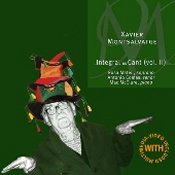
Xavier Montsalvatge: Integral de canto (vol. I) and Integral de canto (vol. II)

Marisa Martins, mezzosoprano; Mac MacClure, piano (Vol. I); Rosa Mateu, soprano; Àngels Cívit, mezzosoprano; Antonio Comas, tenor; Mac MacClure, piano (Vol. II)

Columna Música 1CM0080 [CD] (Vol. I); Columna Música 1CM0079 [CD] (Vol. II).


Aware of this situation, shortly before his death and with a light dose of acrimony, he declared in an interview:

The weight of these compositions has followed me all my life, and I have not yet solved it. I don’t want to boast, but the songs are popular from Nepal to South Africa, which has the inconvenience that they overshadow the rest of my works.

[Carlos del Amo, “Xavier Montsalvatge,” EFE News Services (December 2, 1999).]

And indeed, they do. Recorded, completely, by Victoria de los Angeles, Montserrat Caballé, Marilyn Horne, Teresa Berganza and, partially, by Bartoli and Gheorghiu, these songs are among the most popular of the twentieth-century repertoire and—given its irresistible melodic charm—a favorite encore of all singers. Needless to say, all this results in a general lack of familiarity with his other, equally appealing, compositions. The fact is that Montsalvatge’s music has been premiered by internationally renown performers such as Nicanor Zabaleta, Alicia de Larrocha, Rostropovich, Rampal, Szeryng and many others. In addition, it has also been performed at the BBC Proms and at Lincoln Center (by the New York Philharmonic). Besides Columna, several international labels, including ASV and Marco Polo, have issued many recordings entirely dedicated to his music as well. Therefore, Montsalvatge’s so-called “problem” is not that he is unknown or that his works are poorly disseminated, but rather that his music is unevenly circulated and appreciated. To be sure, these two CDs will palliate this problem.

In recent times, Columna Música, the small, independent Barcelona label, has issued an incredible amount of Spanish music, including an on-going series dedicated to the issuance of the complete works of Montsalvatge. This latest installment includes the composer’s whole production for voice and piano. Volume I includes the composer’s songs cycles Canciones para niños, Canciones negras, and Quatre rimes breus de Josep Carner. Volume II focuses on single, self-standing songs as well as opera arias arranged for voice and piano. For the first time, therefore, listeners can appreciate the full spectrum of Montsalvatge’s vocal output and not only one of its segments. The songs, as a matter of fact, cover chronologically all his career as a composer since the first song dates from 1933 and the last was written in 2001.

Montsalvatge’s musical language overtly departs from the Germanic tradition prevalent in earlier Catalan composers (Pedrell and Gerhard among others). Instead, it shows a penchant for the irony, playfulness, and popular appeal of Les Six, as well as the rhythmic experimentation and formal clarity of Stravinsky. Although his language evolved and passed through different phases (including a serialist one), he is best known for his so-called “West Indian” style (early critics called it antillanismo), which was inspired by the sounds of the Spanish Caribbean. This period includes compositions such as Tres divertimenti (1941), Cuarteto indiano (1952), and of course the popular Cinco canciones negras (1945, orchestrated in 1949). On these two CDs the antillanismo is only audible in the celebrated Canciones negras. The rest of the songs, generally speaking, use relatively simple, appealing melodic lines accompanied by astringent, modern harmonies. A predilection for the world of children is also prevalent in most of his works (as is the case in Frederic Mompou’s oeuvre, another eminent Catalan composer), but especially in his Canciones para niños (with texts by García Lorca), also included here.
Some of the performers on these CDs seem to own, in the best sense of the word, Xavier Montsalvatge’s music. American-born, Barcelona educated pianist Mac MacClure was a friend of the composer and he worked closely with him in many projects, including the recording of his complete works. His accompaniment is subtle, expressive, and clean, as well as sensitive to the singers’ quirks. Soprano Rosa Mateu was the composer’s protégé and had the privilege of premiering many of his late vocal compositions. She brings to these recordings an intimate knowledge of the music and its world, as well as her remarkable vocal qualities. Marisa Martins is one of the rising stars in Barcelona’s vocal scene. Born in Argentina and educated in Barcelona, she has already sang opera at the venerable Gran Teatre del Liceu in her adoptive city. These recordings show her great talent for the song repertoire, too, and she brings to them an exact diction and a deep understanding of the text. All things considered, one only wishes that the popularity of the greatly admired versions of Cinco canciones negras by Victoria de los Ángeles et al. do not overshadow these performances the way the compositions themselves “followed” and became a “weight” for the composer. God forbid.

Antoni Pizà, Director
Foundation for Iberian Music, CUNY Graduate Center
Send to a friend

Send a link to this article to a friend with an optional message.

Friend's Email Address: (required)

Your Email Address: (required)

Message (optional):