Subscribe to
Opera Today

Receive articles and news via RSS feeds or email subscription.


twitter_logo[1].gif


UCP_9780226043425.gif

Recently in Recordings

Kaufmann Wagner

The economics of the recording companies dictate much that is not ideal. Wagner’s operas were not composed as they were in order to permit the extraction of bleeding chunks, even on those occasions when strophic song forms do occur.

Mahler: Symphony No. 8

Among the recent recordings of Mahler’s Eighth Symphony, Valery Gergiev’s release on the LSO Live label is an excellent addition to the discography of this work.

Songs by Zemlinsky

While not unknown, the songs of Alexander von Zemlinsky (1871-1942) deserve to be heard more frequently.

Gustav Mahler: Lieder eines fahrenden Gesellen, Rückert-Lieder, Kindertotenlieder.

Recorded on 5 and 6 May 2008 and 17 and 18 January 2009 at the Lisztzentrum (Raiding, Austria), this recent Bridge release makes available the piano-vocal versions of three song cycles by Gustav Mahler, Lieder eines fahrenden Gesellen, Rückert-Lieder, and Kindertotenlieder performed by mezzo-soprano Hermine Haselböck, accompanied by Russell Ryan.

Kathleen Ferrier: A Film by Diane Perelsztejn

Contraltos rarely achieve the acclaim and renown of sopranos. Assigned few leading roles in opera, they are condemned to playing the villain or the grandmother, or to stealing the castrati’s trousers in en travesti roles.

1612 Italian Vespers

Following their 2011 Decca recording of Striggio’s Mass in 40 Parts (1566), I Fagiolini continue their quest to unearth lost treasures of the High Renaissance and early Baroque, with this collection of world-premiere recordings, ‘reconstructions’ and ‘reconstitutions’ of music by Giovanni and Andrea Gabrieli, Monteverdi, Palestrina, and their less well-known compatriots Viadana, Barbarino and Soriano.

Eternal Echoes: Songs and Dances for the Soul

Eternal Echoes is an album of khazones [Jewish cantorial music] for cantorial soloist, solo violin and a blended instrumental ensemble comprising a small orchestra and the Klezmer Conservatory Band.

Mahler: Symphony no. 3 / Kindertotenlieder

Michael Tilson Thomas’s recording of Mahler’s Third Symphony is an outstanding contribution to the composer’s discography.

Oliver Knussen’s Symphonies from NMC

Oliver Knussen burst into British music with an unprecedented flourish. In 1967, the London Symphony Orchestra premiered Knussen’s First Symphony, with István Kertész scheduled to conduct.

Ludwig van Beethoven: Fidelio

Based on performances given in Summer 2010 at the Lucerne Festival, this recording of Beethoven’s Fidelio is an admirable recording that captures the vitality of the work as conducted by Claudio Abbado.

Stanisław Moniuszko: Flis

Stanisław Moniuszko (1819-1872) was one of the most popular composers of his day in Poland, and of the many works he wrote for the stage, two are performed from time to time, Halka (1848) and Strazny dwór [The Haunted Manor] (1865).

Stanisław Moniuszko: Pieśni Songs

The Polish alto Jadwiga Rappé is a familiar voice in various stage and concert works, and the recent release of a selection of songs by Stanisław Moniuszko (1819-1872) is an opportunity to hear her performing artsongs.

Joan Sutherland and Richard Bonynge: Serate Musicali

Originally released on multiple discs in 1981 this reissue on two CDs is a comprehensive collection of art songs by Italian and French composers from the nineteenth and early twentieth centuries.

Richard Strauss: Salome

An exciting contribution to the discography of this popular opera, the live performance of Richard Strauss’s Salome from the Festspielhaus at Baden-Baden is a compelling DVD.

Lulu by Gran Teatro del Liceu, Barcelona

Released in late 2011, Deutsche Grammophon’s DVD of the new staging of Berg’s Lulu at the Gran Teatro del Liceu, Barcelona is an excellent contribution to the discography of this fascinating opera.

Lulu by the Metropolitan Opera

A recent release by the Metropolitan Opera, this two-disc set makes available on DVD the famous performance of Berg’s Lulu that was broadcast on 20 December 1980 as part of the PBS series “Live from the Met.”

Elmer Gantry the Opera

The novels of Sinclair Lewis once shot across the American literary skies like comets, alarming and fascinating readers of that era, but their tails didn’t extend far behind them.

Historical Performances from Covent Garden: Barbiere, La traviata and Tosca

Once the province of only the most dedicated opera fanatics, mid-20th century recordings of privately taped live performances have become more widely available.

Lucia and the glass harmonica

Flute players in opera orchestra around the world must look forward to the frequent appearances of Donizetti’s Lucia di Lammermoor, knowing that while the stage spotlight in the mad scene will be on the soprano, the orchestral spotlight will be on their instrument.

Levine conducts at the Metropolitan Opera: 1978 to 2006

Since his debut at the Metropolitan Opera in 1971, conductor James Levine has come to represent the house’s commitment to artistic excellence — reliable, professional, and immaculately presented.

OPERA TODAY ARCHIVES »

Recordings

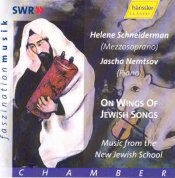
On Wings of Jewish Songs — Music from the New Jewish School
26 Sep 2005

On Wings of Jewish Songs — Music from the New Jewish School

Yiddish is a language based on medieval German that developed separately from modern German. It spread throughout Eastern Europe, where it acquired words from Hebrew, as well as Russian, Polish, and other Slavic languages.

On Wings of Jewish Songs — Music from the New Jewish School

Hänssler Classic 093041000 [CD]


Beginning in the late nineteenth century, serious writers such as Sholem Aleichem, Chaim Nachman Bialik, and Mendele Moicher Sforim produced poetry, stories, and novels in Yiddish that captured the imagination of Jews worldwide. At the same time, Jews became conscious of a repertoire of songs and melodies--old ones passed down from earlier generations and new ones that sprang up--in Yiddish, as well as sacred music in Hebrew. Collections of such music were published, beginning in the early twentieth century and continuing till today.

What is called the “New Jewish School of Music” has its roots in these secular and sacred songs, which from the early twentieth century were also used by “serious” or “classical” composers. For this recording, the artists have chosen 36 items that date primarily from the first half of the twentieth century, some for solo piano, most for voice and piano.

The singer featured on this CD is the American-born and -educated mezzo-soprano Helene Schneidermann, who has been with the Stuttgart State Opera for more than twenty years. She has performed dozens of roles in opera houses in the United States, Europe, and Israel, including Carmen, Orlofsy in Fledermaus, Maddalena in Rigoletto, and Rosina in The Barber of Seville. Her rich mezzo voice is excellent for the more serious works on the recording, but Schneidermann also gives a spirited and light-hearted rendering when it is called for. One of the latter, “Ich bin a bal-agole” (I am a coachman), was written by Solomon Rosowsky (1878-1962). Son of the cantor and composer Baruch Leib Rosowsky, Solomon was a composer, musicologist, collector and editor of Jewish music, music critic, teacher, and author of The Cantillation of the Bible: The Five Books of Moses.

Interspersed between the songs are four sets of works for solo piano by Alexander Krejn, his “Jewish Dances,” op. 50, performed by Jascha Nemtsov. Born and educated in Russia, Nemtsov graduated with distinction from the Leningrad Conservatory in 1986, and six years later moved to Stuttgart, Germany, where he still lives. His sensitive playing of the solo works and the relatively simple accompaniments suits the music very well.

Like Rosovsky, Krejn (1883-1951) was born into a musical family. His father was a klezmer musician who played violin at Jewish weddings, and his six brothers all became musicians. Kreijn achieved his greatet success as a composer for the Yiddish theater in Russia during the 1920s. The Opus 50 dances are drawn from some of his theater works. After Jewish music was banned in the Soviet Union, Kreijn wrote works unrelated to his career up till then.

The best-known of the composers on this CD is Lazare Saminsky, who is represented by four works at the beginning and three at the end of the recording. Saminsky, who grew up in Russia and emigrated to New York when he was nearly 40, became music director for Temple Emanuel, which has been called the “Vatican” of the Reform Jewish movement. If anyone can be called the Grand Old Man of New Jewish Music, it is Saminsky (whose dates, 1882-1959, are erroneously given as 1959-1982!).

The first work on the recording is “Shir Hashirim,” Saminsky’s setting of the first few sentences of the Song of Songs in Hebrew. It is appropriately prayer-like, featuring simple harmonies played mostly in chords in the piano. It sticks close to the tonic, like Torah chanting, and features flourishes at ends of some of the sentences. The Hebrew pronunciation (as well as the transliteration in the booklet) are inconsistent and, in some places, simply wrong. Nevertheless, starting off the recital with a prayerful Bible passage sets a good tone for what is to come.

Of the other composers represented on this CD, the best known is Joseph Achron (1886-1943), whose “Po En-Harod” (Here is En-Harod) in Hebrew is a tribute to a kibbutz in Israel.

Michael Ochs
Send to a friend

Send a link to this article to a friend with an optional message.

Friend's Email Address: (required)

Your Email Address: (required)

Message (optional):