Recently in Recordings
The Sixteen continues its exploration of Henry Purcell’s Welcome Songs for Charles II. As with Robert King’s pioneering Purcell series begun over thirty years ago for Hyperion, Harry Christophers is recording two Welcome Songs per disc.
In February this year, Albanian soprano Ermonela Jaho made a highly lauded debut recital at Wigmore Hall - a concert which both celebrated Opera Rara’s 50th anniversary and honoured the career of the Italian soprano Rosina Storchio (1872-1945), the star of verismo who created the title roles in Leoncavallo’s La bohème and Zazà, Mascagni’s Lodoletta and Puccini’s Madama Butterfly.
Collapsology. Or, perhaps we should use the French word ‘Collapsologie’ because this is a transdisciplinary idea pretty much advocated by a series of French theorists - and apparently, mostly French theorists. It in essence focuses on the imminent collapse of modern society and all its layers - a series of escalating crises on a global scale: environmental, economic, geopolitical, governmental; the list is extensive.
Amongst an avalanche of new Mahler recordings appearing at the moment (Das Lied von der Erde seems to be the most favoured, with three) this 1991 Mahler Second from the 2nd Kassel MahlerFest is one of the more interesting releases.
If there is one myth, it seems believed by some people today, that probably needs shattering it is that post-war recordings or performances of Wagner operas were always of exceptional quality. This 1949 Hamburg Tristan und Isolde is one of those recordings - though quite who is to blame for its many problems takes quite some unearthing.
The voices of six women composers are celebrated by baritone Jeremy Huw Williams and soprano Yunah Lee on this characteristically ambitious and valuable release by Lontano Records Ltd (Lorelt).
As Paul Spicer, conductor of the Royal Birmingham Conservatoire Chamber Choir, observes, the worship of the Blessed Virgin Mary is as ‘old as Christianity itself’, and programmes devoted to settings of texts which venerate the Virgin Mary are commonplace.
Ethel Smyth’s last large-scale work, written in 1930 by the then 72-year-old composer who was increasingly afflicted and depressed by her worsening deafness, was The Prison – a ‘symphony’ for soprano and bass-baritone soloists, chorus and orchestra.
‘Hamilton Harty is Irish to the core, but he is not a musical nationalist.’
‘After silence, that which comes closest to expressing the inexpressible is music.’ Aldous Huxley’s words have inspired VOCES8’s new disc, After Silence, a ‘double album in four chapters’ which marks the ensemble’s 15th anniversary.
A song-cycle is a narrative, a journey, not necessarily literal or linear, but one which carries performer and listener through time and across an emotional terrain. Through complement and contrast, poetry and music crystallise diverse sentiments and somehow cohere variability into an aesthetic unity.
One of the nicest things about being lucky enough to enjoy opera, music and theatre, week in week out, in London’s fringe theatres, music conservatoires, and international concert halls and opera houses, is the opportunity to encounter striking performances by young talented musicians and then watch with pleasure as they fulfil those sparks of promise.
“It’s forbidden, and where’s the art in that?”
Dublin-born John F. Larchet (1884-1967) might well be described as the father of post-Independence Irish music, given the immense influenced that he had upon Irish musical life during the first half of the 20th century - as a composer, musician, administrator and teacher.
The English Civil War is raging. The daughter of a Puritan aristocrat has fallen in love with the son of a Royalist supporter of the House of Stuart. Will love triumph over political expediency and religious dogma?
Beethoven Symphony no 9 (the Choral Symphony) in D minor, Op. 125, and the Choral Fantasy in C minor, Op. 80 with soloist Kristian Bezuidenhout, Pablo Heras-Casado conducting the Freiburger Barockorchester, new from Harmonia Mundi.
A Louise Brooks look-a-like, in bobbed black wig and floor-sweeping leather trench-coat, cheeks purple-rouged and eyes shadowed in black, Barbara Hannigan issues taut gestures which elicit fire-cracker punch from the Mahler Chamber Orchestra.
‘Signor Piatti in a fantasia on themes from Beatrice di Tenda had also his triumph. Difficulties, declared to be insuperable, were vanquished by him with consummate skill and precision. He certainly is amazing, his tone magnificent, and his style excellent. His resources appear to be inexhaustible; and altogether for variety, it is the greatest specimen of violoncello playing that has been heard in this country.’
Baritone Roderick Williams seems to have been a pretty constant ‘companion’, on my laptop screen and through my stereo speakers, during the past few ‘lock-down’ months.
Melodramas can be a difficult genre for composers. Before Richard Strauss’s Enoch Arden the concept of the melodrama was its compact size – Weber’s Wolf’s Glen scene in Der Freischütz, Georg Benda’s Ariadne auf Naxos and Medea or even Leonore’s grave scene in Beethoven’s Fidelio.
Recordings
03 Oct 2005
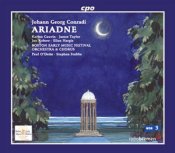
CONRADI: Die schöne und getreue Ariadne
Since its inception in 1980, the biennial Boston Early Music Festival has grown to international stature of the first rank, and while its programming is diverse in scale and repertory, its focus in recent years has been on full-scale productions of baroque opera, including Monteverdi’s L’Orfeo, Rossi’s Orfeo, Cavalli’s Ercole Amante, Lully’s Thésée, and this past summer, Mattheson’s Boris Goudenouw.
Amply underscoring the internationalism of the Festival, the opera for 2003, Johann Georg Conradi’s Ariadne, was later recorded in Bremen in a collaboration between BEMF, Westdeutscher Rundfunk Köln, and Radio Bremen.
Conradi’s Ariadne (1691) is the earliest surviving opera from the Theater am Gänsemarkt in Hamburg, and its own diversity of national influences suggests a symbolic precursor of the modern collaborative sponsorship. George Buelow brought the score of Ariadne to light in the 1970s, and describes it as a “highly expressive and cosmopolitan mixture of Venetian, German, and French styles.” The Lullian echoes here are easily heard in the overture, the dance movements, and the divertissements—Act I concludes, for instance, with a scene for dancing and singing scissors grinders; Act III concludes with a lengthy Passacaille for Venus, the Graces, Bacchus, and a Satyr; both scenes recall the entertainments of tragedies en musique. (The dancing scissors grinders, as Terpsichorean tradesmen, seem “cousins,” as well, to the dancing tailors of Lully’s Le Bourgeois Gentilhomme.) The Lullian influence derives in part from Conradi’s time as Kapellmeister at Ansbach in the 1680’s, where French opera was frequently performed and the orchestra included Johann Fischer, Lully’s one-time copyist.
Italian accents are clear in the airs and recitatives, but also in the comic character of Pamphilius, sung with imaginative flair here by Jan Kobow. Pamphilius has a philosophizing bent and a capacity for deflating the elevated feelings of his “betters” that one recognizes immediately in Monteverdi’s Iro from Il Ritorno Ulisse or later in Handel’s Elviro from Serse.
Conradi’s Ariadne, though a long work at around three hours, gives the impression of being fast-paced, with its many arias moving ahead without tarrying in lengthy development. And Christian Heinrich Postel’s libretto places the story of Ariadne in a rich weave of characters and circumstance that also helps propel things forward with interest. In the end, Ariadne’s emotionally textured third-act lament underscores that it is indeed her story that is the central one, but the love of her sister Phaedra for Theseus, the shame of their mother Pasiphæ in having conceived the monstrous Minotaur, and the love of Evanthes (Bacchus) for Ariadne are all compelling story-lines in their own right, and are given due attention in the opera. Through the modern prominence of works like Monteverdi’s “Lamento d’Arianna” we have come to see Arianna as something of a poster girl for abandonment. Significantly, in Conradi’s opera, the abandonment is given appropriate weight in Ariadne’s moving lament, but she in turn rather quickly abandons her lamentative state to unite happily with Bacchus. In the end, if she is to be a poster girl, it is in the cause of love’s ultimate fulfillment.
The performance is an unflaggingly gratifying one, sung by a uniformly accomplished cast. And significantly, the singers, though cohesive in ensemble, maintain an interesting interplay of vocal individuality that itself underscores the number of story-lines in the libretto. For example, Karina Gauvin brings to her Ariadne a vibrant sound and rhetorical flair, but also, especially in Act II’s “Ihr Augen die der Himmel zieret,” a strikingly flexible lightness. Barbara Borden’s lithe tone, contoured phrasing, and impressive articulation on rapid passage work are much to be savored in her Phaedra. And Ellen Hargis’ Pasiphæ gives wonderful evidence of both the elegance and power of her singing and the rare beauty of her finely controlled sound. The individuality of voice brings the richness of character to the fore, and it is one of the most gratifying aspects of this sterling performance. Surely the BEMF Ariadne is one that no one will want to abandon.
Steven Plank
Oberlin College